
source : the age
In his nearly 30 years of finding footy talent, David Walls has sat down to talk with thousands of young people who dream of becoming professional footballers. He’s watched them play from the sidelines at games and on countless hours of video; reviewed their psychological tests and physical tests; analysed their statistics; met with their coaches, employers, schoolteachers; and spent time in their orbit on training camps – to work out who they are, and who they could become.
But the picture is never complete until he visits them at their family home. “You can’t bullshit in front of Mum or Dad,” says Walls, once a fresh-faced rookie himself, now head of player personnel at Fremantle footy club. “Even siblings will start to say, ‘That’s not true’,” Walls tells us. “Dads, generally, are trying to sell them as footballers and mums just want to make sure they’re good people.”
Australian rules football has a rich history of freakishly talented players (Buddy Franklin, Nick Daicos, Erin Phillips) and legendary coaches (Leigh Matthews, the late Ron Barassi and Walls’s own father, Robert). Less lauded but no less critical to success are the recruiters and list managers. They determine who is in and out of a club, how to mix new blood – a handful of teen draft picks each year – with existing teams, a painstaking task that culminates in the nerve-wracking annual draft in November (for the men) and December (for the women).
Theirs is not a glamorous job. At games, you’ll spot them in puffer jackets, perched on camping chairs with binoculars, pen and notebook. Other times, they’ll be hunkered down scrutinising footage, crunching player data. Many fans like to think they could do a better job. “I think every sports fan in Australia is picking their footy team or cricket team,” veteran AFL talent expert Kevin Sheehan tells us. “It’s a tough business, the business of drafting, and it’s make or break for the careers of not just the boys [and girls] but the scouts who are looking at them.”
More than 624,000 children and adults play football in Australia. Whittling down the best young players takes years, money and skill. The stakes are high: the best players, like artists, can create something out of nothing while players with poor character or decision-making can drag down a whole team for years.
So how do the clubs in the national league (18 men’s, 18 women’s) find the next generation of elite players? What sets a future professional apart from a skillful amateur? And how can young people maximise their chances of playing at the ’G one day?
What’s it like being a potential draft pick?
At 205 centimetres, Harry Van Hattum stands out in a crowd. The year 12 student is confident, warm and mature. He also has a massive running leap, 103 centimetres into the air, just a touch higher than West Coast icon Nic Naitanui’s 102 centimetres jump as a junior. High-flying ruckmen are back in vogue after the AFL changed the rules this year to stop other players wrestling them away from the centre bounce, although Van Hattum wants it known ruckmen are about more than their aerial manoeuvres: “It doesn’t matter your size when you’re using it [the ball] well … I pride myself on having elite skills,” he told ESPN in August. In short, the 18-year-old has the makings of a very modern ruckman and, consequently, he’s a top prospect in November’s draft.
‘I was definitely pretty nervous the first time I had a meeting with someone from a club, so I was trying to be super-professional and really well-behaved. But you have just got to be yourself …’Harry Van Hattum
Yet it was only last year that Van Hattum put aside his other sporting pursuit, basketball – which he played at state level in under 12s and 14s – to focus on footy, and recruiters became part of his life. “It was around then I started talking to recruiters a fair bit and getting calls from them and organising home visits and stuff like that over that summer,” he tells us.
On a trip to New Zealand with the AFL national academy squad, made up of 50 of Australia’s most talented draft contenders, his every interaction was noted by recruiters, on the field and off. “You sit down with them and have lunch, dinner and different meetings with them on different days,” Van Hattum says, “so you get a really good sense of what their point of view is and what they are looking for from that. I was definitely pretty nervous the first time I had a meeting with someone from a club, so I was trying to be super-professional and really well-behaved. But you have just got to be yourself, don’t lie, don’t make anything up – because obviously they will find out.”
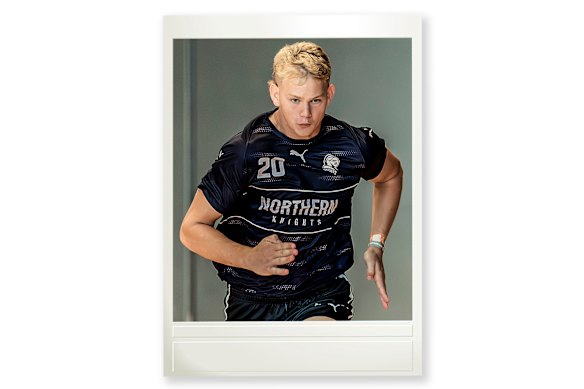
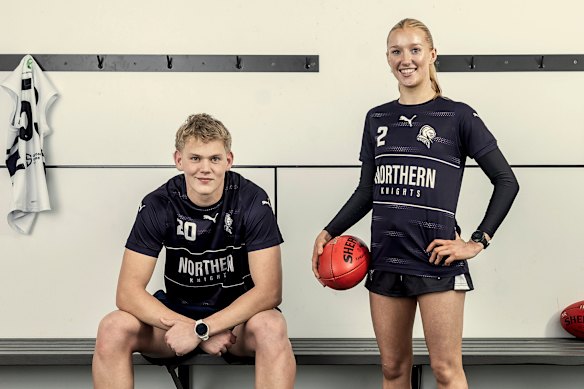
Van Hattum has signed up with a manager, a crucial step in a junior’s progress to the AFL, and has, meanwhile, been playing footy for a dizzying array of sides: Ivanhoe Grammar, his school in Melbourne’s east; Vic Metro in the AFL national championships; the AFL academy; and the Northern Knights in the AFL Talent League, Victoria’s top under-18 competition, from which most draft picks are drawn. (Gifted players also come from state leagues, or the northern academies run by Sydney, Greater Western Sydney, Brisbane and the Gold Coast, or from next-generation academies run by all clubs for Indigenous and multicultural youth.) Van Hattum considered an invitation to play for Richmond’s VFL team, too, but enough was enough. “It’s pretty busy,” he says.
Through it all, he is trying to live a normal life: studying, playing golf, hanging out with schoolmates and getting on the tools to help his dad, Rod, build a granny flat in the backyard of his family’s Kangaroo Ground property. He admits he sometimes feels like a lab rat. “It always lingers in the back of my head that there is an expectation about me and I have to perform well, but I just try to block it out of my mind and try to play to my best level and don’t think about the expectation on me every time.”
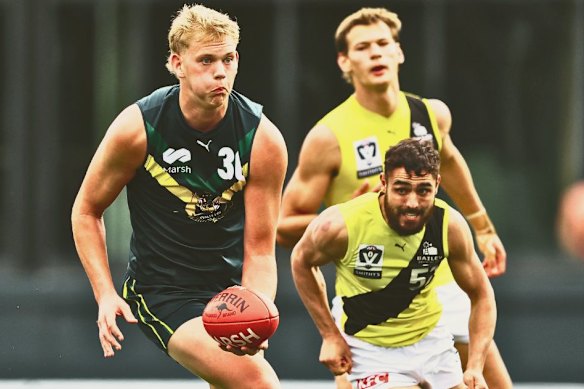
Just days after the AFL grand final, Van Hattum and other promising teenage footballers (a total of 102 men and 89 women) will attend an event called a draft combine, either in Melbourne, Adelaide and Perth, where they will talk with clubs and compete in various trials (think sprints, agility tests, vertical jumps from a standing start).
Among attendees will be year 12 student Maddy Meagher, who plays on the wing for the Northern Knights in the Talent League, the top under-18 competition in Victoria. “I base a lot of my game just off my speed,” the 18-year-old tells us. With a background in athletics, Meagher has climbed the footy ranks since she started about six years ago, this year juggling study with two three-hour training sessions a week for the Knights, games on the weekend and private coaching to “focus on the nitty-gritty”.
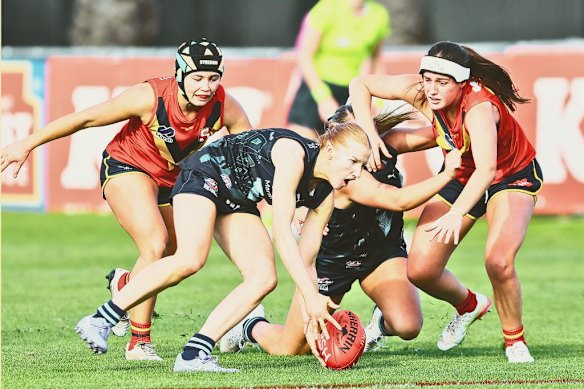
Her hard work has paid off: Meagher has signed with a player agent, toured St Kilda’s facilities and met with several clubs. “Collingwood’s was just online, and Carlton’s was going to their club, and Essendon, they came to training to have a 30-minute conversation with me and a couple of other girls,” she explains, “and I’ve got Freo coming to my house.”
She is ready to take the plunge and relocate if she’s drafted interstate. “I understand it would be extremely scary,” she says, “but the support that you get given is huge and, on top of the salary that you get given as an AFLW rookie, you also get extra money if you go interstate, to pay for your rent.” Clubs sometimes house newbies with a host family, another player, or a coach for a short while. Draft picks will be paid a minimum of $125,000 in 2027 in the men’s game; women will be on a base salary of $72,363.
Recruiters watch players for up to three years before making a move, which they can’t do until the player is 18 by December 31 of their draft year, under both leagues’ rules. Even then, being picked can be down to timing and luck. “Often,” says player agent Alec Morgan, who represents both the men’s and women’s league players, “recruiters will have a whiteboard and they’ll have a whole list of names at the start of the year on that, and then as the year goes, they cross names off and they add names on. So you could be the third-best key-position defender on everyone’s list, but if the other two ahead of you don’t get taken right until the end, you might keep coming second or third. So it’s not necessarily a knock on you, the footballer.”
What are recruiters looking for?
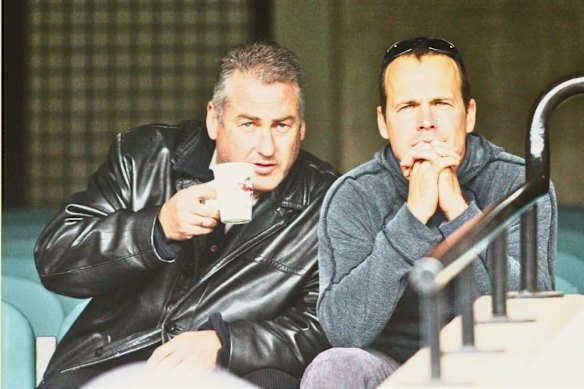
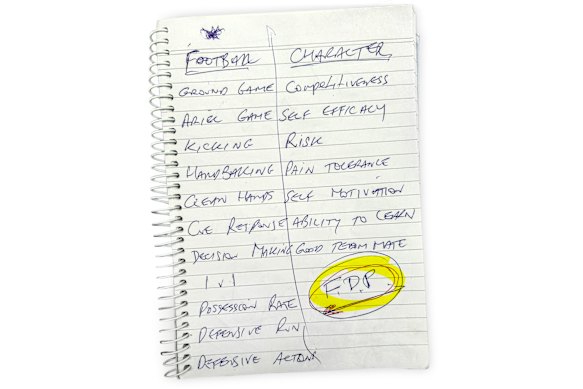
Scott Clayton has built playing lists for Brisbane, the Bulldogs, Gold Coast, West Coast and North Melbourne. “You’ve got to have talent,” he says. “Without that, we can’t help you.” Clayton, who these days is a future talent consultant, shows us a piece of paper on which he’s jotted the qualities he wants in a draft pick.
On the left is FOOTBALL: clean hands to control that odd-shaped ball without fumbling, aerial game (marking), ground game (running) and cue response, which, says Clayton, means, “You react in instinct and action in super-quick time [to] what is actually happening. Perhaps at times it is predicting the future and making a decision on what action you must actually take.”
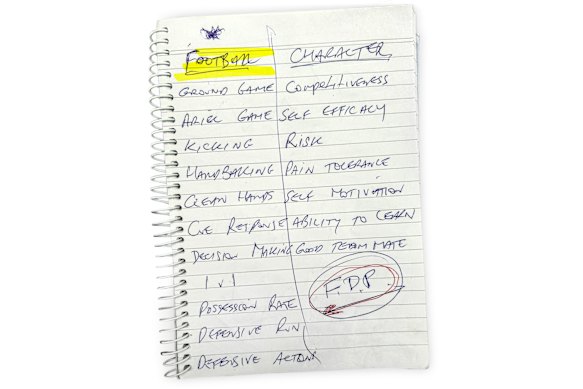
Very few players possess all of these attributes at a high level – now-retired Adelaide Crows champion Erin Phillips, a former basketballer, came pretty close – but you are better off with a laser kick or elite-standard speed than being average at everything. “If you watch where even AFL and AFLW was five or six years ago to now, the game is so much quicker,” says Alec Morgan. Walls agrees: “The distance they’re covering at high speed is just getting bigger and better.” Seven-time best and fairest, Richmond’s Monique Conti, is known for her explosive speed; Joel Wilkinson, who played briefly for Gold Coast then moved to the US National Football League, still holds the 20-metre sprint record (2.75 seconds) at a draft combine in 2010.
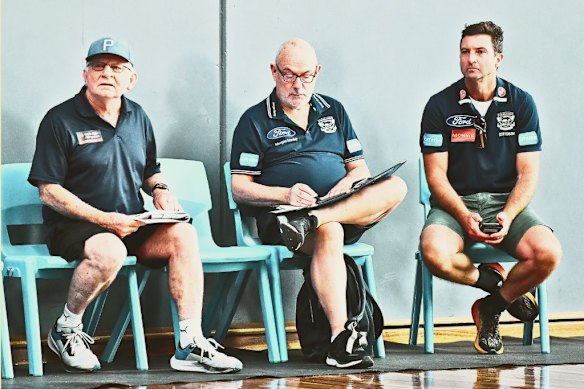
As well as athletic flair, recruiters have to predict whether players’ bodies will cope. “We get our medical department involved heavily because players change so much physically,” says Walls. “Sometimes they can’t handle the training loads and their bodies break down and they get injured a lot.” Geelong premiership coach Mark Thompson used to have a theory that if a player was injured often in junior football, they would continue that pattern in the adult game. But with advances in medical science and more nuanced approaches to training, that theory is less fiercely held.
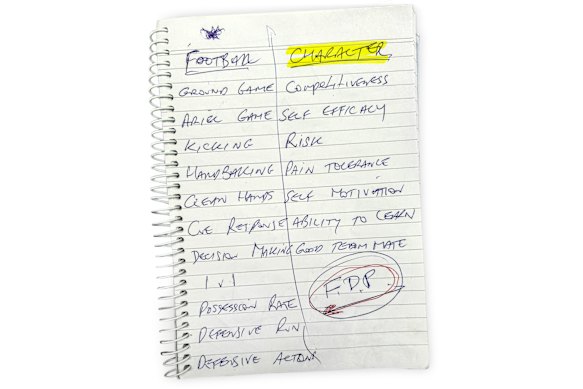
On the right side of Clayton’s ledger is CHARACTER. For many recruiters, it’s what sets apart the most desirable players from those who are merely technically very good. But what aspects of character, in particular, are they looking for?
‘I think the biggest thing that we find with clubs is competitiveness, that’s what they love.’Alec Morgan
Top of Clayton’s list is “competitiveness”, and he’s not the only one. “I think the biggest thing that we find with clubs is competitiveness, that’s what they love,” says agent Alec Morgan. “One of the things recruiters really look out for is, do you compete? And if you’re a competitive person on the ground, you’re going to be doing all the little things off the field to make sure you’re as good as you can be.” David Walls wants players who go all out: “You know that they’re going to give the same amount of effort, it doesn’t matter what game it is, it doesn’t matter if they start slowly and things aren’t going their way, or if the team’s getting belted.”
Next on Clayton’s list is something less obvious: self-efficacy, a term that describes possessing a belief in your ability to achieve an outcome. In footy, Clayton asks, “Do they go in knowing that they’re going to affect the outcome? Because in a competitive sport, that’s what you need: you need instinctive people who just want it, want to affect the outcome, and they’re bold.”
Take Joel Selwood, now retired but who still holds the league record for games as captain. A troublesome knee deterred some clubs (although not Geelong) from drafting him in 2006, but he devised his own leg-strengthening exercises — “the Joel Selwood program,” he’s joked — which he followed religiously for 16 years, barely missing a game. “Pick a player who you’d have in your side,” said Blues coach Mick Malthouse in 2014, after Selwood had kicked the winning goal against his team. “I’d pick Selwood every day of the week.”
Research backs up the importance of self-efficacy and its related traits in everyday life, too. The Dunedin Study, from New Zealand’s University of Otago, has followed the health and fortunes of 1000 boys and girls since 1972 and found that their capacity for self-control – self-discipline and perseverance – was the single biggest predictor of their success, more than IQ or class. “We also found that children whose self-control increased with age tended to have better adult outcomes than initially predicted, showing that self-control can change and with desirable results,” wrote research leader Terrie Moffitt in 2011.
‘We had a kid who went to the snow … but he wouldn’t ski because he was worried about getting injured. He just trained all day … You go, OK, this kid’s really, really serious.’David Walls
Similarly, self-motivation appears on Clayton’s list, too, a close cousin of that propulsive inner desire we call “drive”. “The players that are really driven to be the best they can be are usually the players that succeed,” says Katrina Gill, AFLW general manager at Melbourne Football Club. “You obviously need a level of talent, but talent combined with the work ethic tends to be the winning formula.”
That applies off the field, too. Fremantle’s Walls will sometimes quiz aspirants about what they do in their spare time. “We had a kid who went to the snow [with his family], went to Canada,” he recalls, “but he wouldn’t ski because he was worried about getting injured. He just trained all day, he worked out where the gyms are, where he could find an oval, where he could get a treadmill. We’re looking for things like that – where they’re giving you examples of they’re getting up early, they’re doing extra work, they’re doing recovery, they’re doing gym. You go, OK, this kid’s really, really serious.”
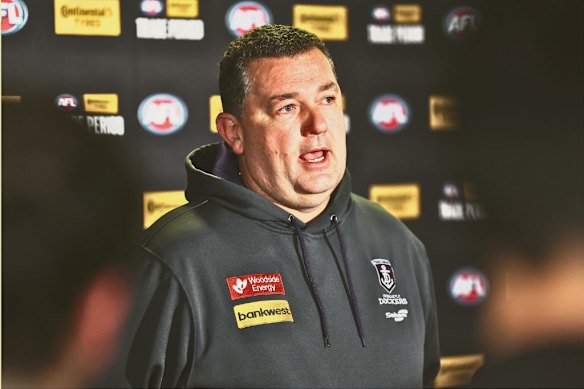
A term not on Clayton’s list but that is often heard in Aussie rules circles is “footy IQ”: the ability to read, indeed predict, the play in all its fast-moving complexities, to understand the game and tactics at a deep level, to make smart decisions in a split second. If footy IQ is tricky to pin down, Walls knows it when he sees it: he drafted Murphy Reid in 2024 after 11 clubs overlooked the youngster. Reid, 20, is regarded as one of the most astute draft selections in recent history, having won the Rising Star award in his first season, and been named All-Australian in his second. Says Walls: “Footy IQ is … really, really big. Murphy Reid, for us, is one that stands out with how smart he is and how much composure [he has] and how calm he is.”
Can they back themselves to take highly consequential, calculated risks without over-thinking and second-guessing?
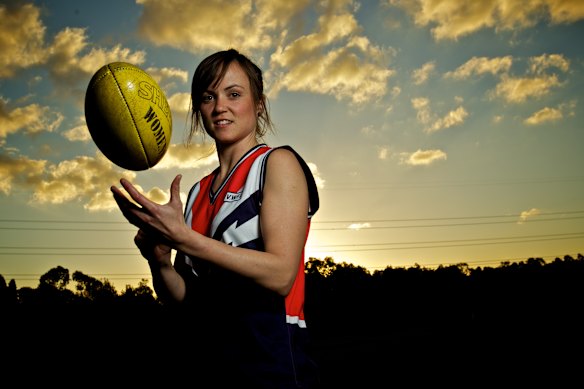
Also known for footy nous is Daisy Pearce, who balanced delivering babies (she was a midwife) with playing for the Demons in the early days of the AFLW. After having twins of her own, Pearce led Melbourne to a premiership, and now coaches the West Coast Eagles women’s team. Pearce’s footy IQ was “nothing that I’d seen before,” said football trailblazer Debbie Lee as Pearce was inducted into the Australian Football Hall of Fame. “She was a player who had so much time, she created so much space for herself, her skills were silky.”
Why is “risk” on Clayton’s list? On a footy field, big risk-takers will be prepared to take the kick that, as Clayton says, “changes the course of events”, in front of 100,000 people and millions watching on television – even if a mistake might make them look foolish. He tests a rookie’s risk appetite with a line of questioning that he adapts to them. If they surf, he asks how big a swell they are prepared to paddle out in. If they play golf, he asks which club they would use to attack a par four. Can they back themselves to take highly consequential, calculated risks without over-thinking and second-guessing?
‘Are they supportive? Are they encouraging? And it goes the other way too, where you see people speak poorly to teammates and don’t treat them well, and play in a selfish manner.’David Walls
If many of these qualities suggest ruggedly individual star power, how players relate to others – being a “good teammate”, as Clayton puts it – is a must. Gill agrees: “You want good people who are going to come in and have a positive impact on your program and be a good teammate as well.” Walls loves going out to huddles and listening to the way players talk to each other. “Are they supportive? Are they encouraging? And it goes the other way too, where you see people speak poorly to teammates and don’t treat them well, and play in a selfish manner.”
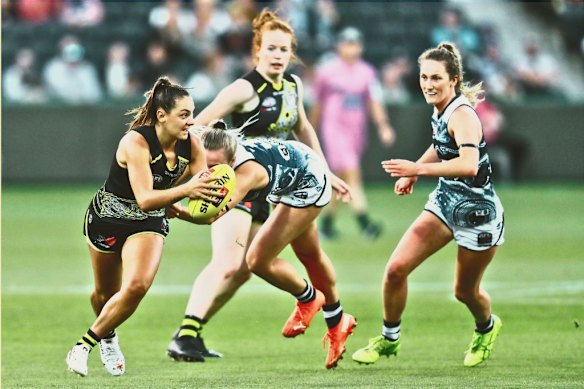
Similarly, “ability to learn”, or coachability, is another prerequisite: recruiters will observe how a player reacts to instructions, including their body language. Off the field, they’ll check school reports and find out how the kid is with their classmates. Players do need to be able to follow rules. Their ability to do the right thing goes into the recruitment mix, as does whether the club culture and the coach are good matches for them. If the standards in the club, upheld by coaches and senior players, are positive then players, regardless of their proclivities, will generally fall into line. The best coaches can mould all types into elite players while creating an environment where positive decisions are made on and off the field, more often than not.
‘… their coachability, their resilience, their grit, their fire in the belly, their self-confidence, and those things that are a bit more intangible, such as their … fear factor.’Elissa Morley
For kids with dreams of excelling in other sports, take note of these insights from Elissa Morley, who is performance pathways manager at the Australian Institute of Sport, which assesses more than 2900 athletes across 46 sports, each with their own “what-it-takes-to-win profile”. After a battery of physical tests, athletes are invited to trial with a sport to see if they have the right “psychological and behavioural factors”. “So, their coachability, their resilience, their grit, their fire in the belly, their self-confidence, and those things that are a bit more intangible, such as their feel for the water or their fear factor.” She adds there are some characteristics all athletes need, no matter the sport: resilience, persistence, self-belief, self-regulation and being proactive about solving problems.
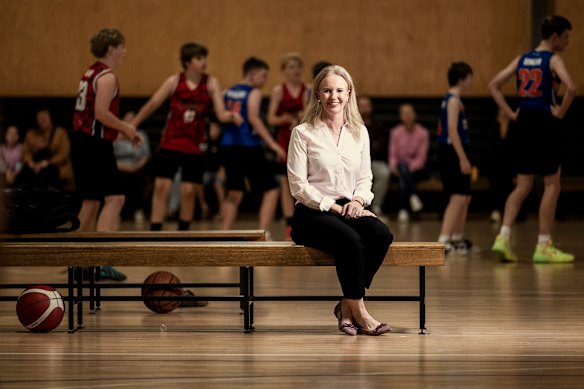
It’s an impressive alchemical mix that makes up a player’s F.D.P., or future development potential. Kevin Sheehan says the sport gets drafting “right” about 80 per cent of the time. “You will make errors when you’re trying to assess talent very early. But even the NFL makes mistakes, and their entry age is post-college, 21 or 22,” he says of the US football league.
‘I’m always, would you want to work with this guy for the rest of your career, for the next 10 years?’David Walls
The Demons’ Katrina Gill says recruiting still requires a touch of instinct. “You’re crystal-balling, to an extent.” Fremantle’s David Walls agrees, and says it makes him “sick to his stomach” when his team recruits the wrong player. “We’ve done it before, where they’re hard work and there’s issues off the field and they cause problems,” he tells us. “I’m always, would you want to work with this guy for the rest of your career, for the next 10 years? Because we’re dropping them off with these players, and is he going to make the most of the opportunity? And is he going to be a great teammate for the players that are already there?”
What’s survivability? And how can parents help?
Being a young footy star can be tough. Living the dream will include strangers critiquing them and their team, yelling over the fence at games, writing negative comments online, and placing bets (literally) on their performance. So there’s another factor that plays into how a player is chosen: their survivability. “It’s a pretty full-on environment that you’re going into if you’re drafted at 18 and you’re straight out of school,” says Walls. “Are they going to be able to come in and work and be resilient and deal with setbacks? And if they’re playing reserves and developing for two years, are they going to be able to grind for that amount of time?”
One recruiter from a non-Victorian club tells us survivability includes coping with travel: basic self-management, being organised, being able to manage emotions. The Dockers take notice of what sort of company a prospect is over dinner – after all, they’ll have to spend a lot of time away with teammates. Says Alec Morgan: “Sometimes you can get a vibe from players that they’re really big homebodies and the club, if they’re going to bring them interstate, they’re going to have to have a lot of support.” The Brisbane Lions changed their selection process and welfare support program after five young players requested trades back to their home states at the end of 2013. Now, all northern states ensure “resilience” is weighted heavily in assessing players.

Some factors are beyond a player’s control. In a group from the same school-year level, for instance, those born in the first six months of the year tend to have had a head start on their development, are likely to have more confidence and so be elevated – a much-noted pattern that applies in other areas of education, too.
Also known to help carve a contenders’ path to selection is attending a school with a high-performing footy program, which often offer scholarships to gifted players, too. Twenty-two per cent of last year’s draft attended an Associated Public School in Victoria, such as Geelong Grammar or Scotch College, says Luke Soulos, chief executive of APS Sport. In Melbourne, particularly, school footy is “big”, says Scott Clayton, with some clashes attracting several thousand fans. The AFLW isn’t yet dominated by APS schools, says Soulos. “We’re at, I would say, the embryonic stages in regards to girls’ football. We do get one to three players drafted in a given year.”
Some youngsters might also hail from a family of sportspeople, which can confer genetic advantages and/or the chance to model their parents’ athletic drive; or their father might have played footy, in which case they can be admitted under the AFL’s father-son or father-daughter rules. (Close to 100 players arrived at AFL clubs as father-son picks from 1998 through to 2025; over the short history of the women’s league, at least 13 players joined under the father-daughter rule, including sisters Abbie and Sophie McKay, who followed their father Andrew to Carlton.)
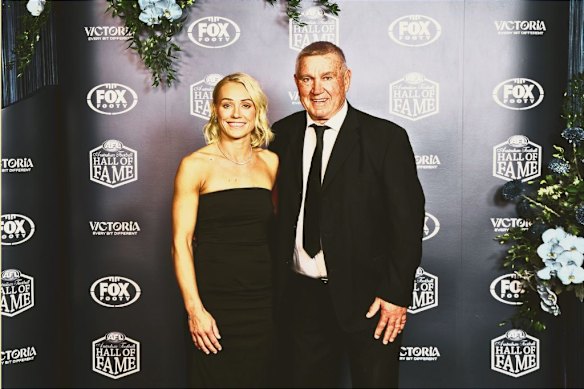
“Dad taught me the game, Mum took me to all my games,” the Crows’ Erin Phillips said when she was inducted into the Australian Football Hall of Fame in 2025. Phillips’ dad Greg played for Collingwood and Port Adelaide, and she was a “cross-coder”, playing footy until age 13, when pathways for girls ended, then switching to pro basketball before going back to footy for the women’s league’s first season, in her early 30s. “Having experienced being in an elite environment since I was 16 years old, I feel like I have a good grasp of what makes really successful teams.”
The Darcy family has produced three generations of footballers: the late David Darcy played 133 games, his son Luke notched up 226, and his grandsons Sam and Will are both Bulldogs. Luke, now a podcaster, has warned that hyper-competitive parents are destroying their children’s love of team sport. “They [teens] actually don’t care that much at 14 about winning or losing, but they get in the car and what happens is Mum or Dad say, ‘Why didn’t you play harder?’” he said. “You’re not their coach, you probably weren’t good enough to do it, so why are you trying to overlay your world on to your kids? If they’re there, and with their mates, end of story.”
‘They’re not going to draft someone who isn’t committed and who isn’t going to do their part.’Maddy Meagher
The APS’s Soulos offers this: “The better parents are the ones that stand to the side and don’t interfere and don’t get involved, other than maybe a quiet word in the car of how well they played, or [saying], ‘It was exciting to watch you play’.” Katrina Gill concurs. “Ultimately, it’s going to be the athlete that drives their own career and determines how far they go.”
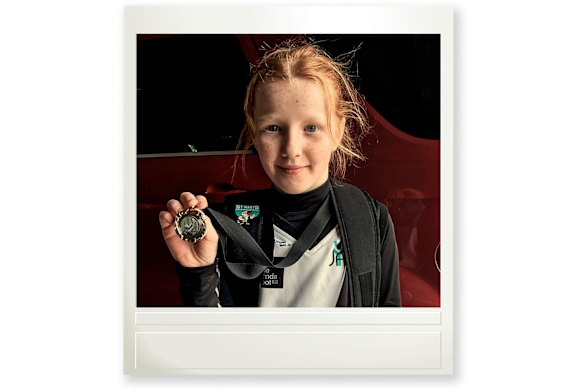
Maddy Meagher’s dad Steven, who originally coached his daughter, says he has been lucky to “watch her play a sport that many girls before her simply didn’t have the opportunity to play”. “She had a dream of playing AFLW, and once we knew how much she wanted it, our role became more about giving her opportunities to develop and see how far she could go,” he tells us. “She could potentially end up anywhere in the country, or she might not get drafted at all. Whatever happens, it certainly won’t be because she didn’t put the effort in.”
Meanwhile, Meagher and Van Hattum are chasing their dreams with level heads. “They’re not going to draft someone who isn’t committed and who isn’t going to do their part,” Meagher says. After school, she plans to combine football with a TAFE course in myotherapy (a form of physical treatment) then do university studies in it or physiotherapy. Amidst the whirlwind, Van Hattum often reminds himself why he is doing what he is doing: “Keep it enjoyable, because you have to love footy to be there [on draft night]. It’s a big commitment at this age.” His agent Max Hayes says Van Hattum is locking in on what is important now the business end of the year has arrived, and it’s not all football. “He’s hitting the books hard right now,” Hayes said.
Get fascinating insights and explanations on the world’s most perplexing topics. Sign up for our weekly Explainer newsletter.