Source : the age
Half a dozen journalists are sitting around a table, heads bent, their thumbs buried in plasticine. We are getting an express class from Will Harding, a model-maker at Aardman, in making the head of Shaun the Sheep in the old-school way; I’m determined to master the ridges in his woolly topknot.
If someone had told me this is what a bunch of adults would be doing on a set visit for Aardman’s latest stop-motion feature – Shaun the Sheep: The Beast of Mossy Bottom – I would probably have said something bitter about being treated like an Insta-idiot influencer. At least, I might have said that if it had been anywhere but Aardman, where fun – and plasticine – is taken entirely seriously. This is, in fact, the most fun you will ever have visiting a film studio, but it’s also an exercise in dexterity and concentration. Everyone wants to get it right.
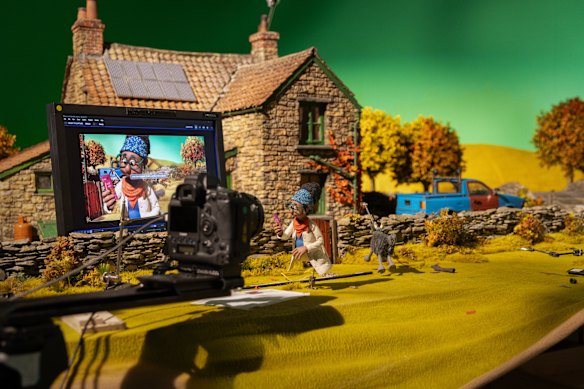
Getting very, very small things right is what Aardman is all about. Stop-motion is an almost inconceivably exacting way to make a film, with hand-made models moved by tiny increments on beautifully crafted table-top sets by animators. The numbers are formidable. There are 1289 shots in the film; an animator will complete 2.5 shots a week – or, put another way, two seconds a day. At its peak, this production has 47 units working at the same time: a crew on site of around 170 people.
Directors Matthew Walker and Steve Cox started thinking about this film when they were making the sixth season of Shaun the Sheep for television, which launched early in 2020. Their original idea was a Valentine’s Day special, which gradually evolved into a comedy horror.
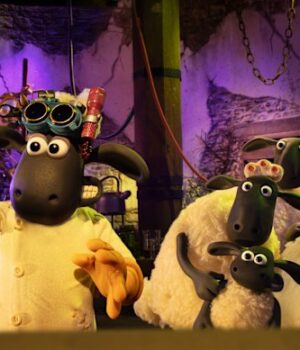
As always, Shaun is the source of all mischief. Just wanting to help, he turns to weird science to try to boost the farm’s Halloween pumpkin crop and the farmer’s romantic prospects, cooking up potions in his makeshift laboratory like an ovine nutty professor. His solutions, however, only create more problems – not least the unhappiness of the flock, as they see their leader becoming increasingly obsessed with his test tubes.
An irony, no, to make a stop-motion film about obsession? Walker and Cox nod agreeably. “We understand Shaun’s problem,” says Walker.
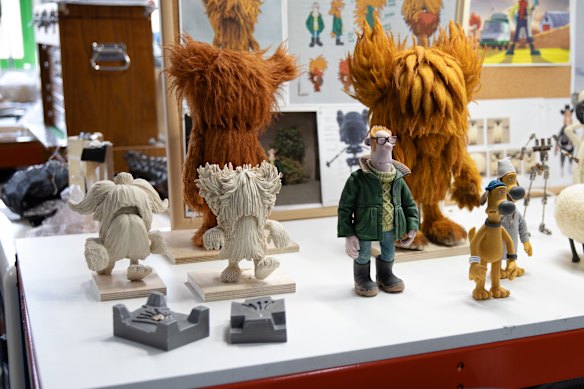
Theirs is a lovely obsession, though. I have been lucky enough to visit Aardman several times; there is always the same benign buzz of people working hard to a whimsical common purpose. Our first stop is the puppet-making department, where designer Kate Anderson plunges us into her world of steel armatures, clay mixes, silicone mouldings and the problems associated with animating a furry beast.
“I don’t know if you’ve seen the film Fantastic Mr. Fox,” she says. Wes Anderson’s 2009 adaptation of Roald Dahl’s story was also stop-motion animation; obviously, it was full of fur. “They made a feature of the fact that every time you touch the fur or the air conditioning blows it, it ‘boils’, we call it. We found that our directors and animators really don’t like that. So we had to find a way to make the fur look nice, but not twitch too much.”
The Beast isn’t really scary – Shaun’s core audience is between five and eight years old, too little for scares – but it is supposed to be scruffy. “That meant we could put in a treatment that made the fur fairly rigid. But then there are lots of parts that are animatable.”
The fringe is wired; the ears rotate. “And then the fur on the body and arms is a bit flatter so they can grab it.”
The design of a new character is the work of years, although it has been speeded up by collaboration with a CGI artist who can try out different looks on screen. “I’m pleased with how successful it is,” she says. “There’s some shots that I just really want to give the Beast a hug. He just looks so sorry for himself.”
As a Halloween story, The Beast of Mossy Bottom is literally much darker than the original 2015 Shaun the Sheep film or its 2019 follow-up, Farmageddon. Director of photography Charles Copping says how enjoyable it has been to cast scenes in dim autumnal light or create Shaun’s laboratory, with luminous purple goo bubbling in a hand-blown miniature glass beaker, lit by UV lamps.
And although the mood is ’80s Ghostbusters rather than Friday the 13th, there are visual references – a version of Nosferatu’s shadow walking downstairs, for example – to provide any film-buff parents with an entertaining game of Spotto.
“I’ve been on Shaun since the start,” Copping says. “But here it’s more exciting; we’re pushing the colours, pushing the contrasts, and we’ve made it more dynamic. We’ve leaned into it being richer; there’s a Gothic feel. It’s been a joy to do.”
But then, it always is: clay animation, he says, feels honest. “Everything is in front of the camera and feels tangible.”
Effects are often created with stuff everyone has in their kitchen drawers. One character’s hair is modelled on a saucepan scourer, fetched from the Aardman canteen by an inspired puppet-maker. The sea is created with cardboard tubes with scrunched foil over them, lit to look like ripples. “Foil, cling film – we’d be lost without them. Also, KY jelly.”
Given that none of the characters speak – even the farmer merely burbles – the story has to be told through facial expressions. This is complicated by the fact the sheep faces are made of hard resin; only their eyes and the odd mouths that protrude from the sides of their heads are malleable.
“All they really have are that mouth shape and their eyelids,” says Jay Grace, the chief animator. “So you can do a little bit to angle the eyelids to create a worried or an angry expression, but there are limitations to how far you can push that.”
They also have motion, of course. Aardman’s key collective talent is an expressive physical comedy that hearkens back to Buster Keaton. Everyone unhesitatingly refers to the animators as actors, even though what they are actually doing is moulding mouths into new expressions with their thumbs and inching the characters through each scene. These are performances filtered, you might say, through puppets.
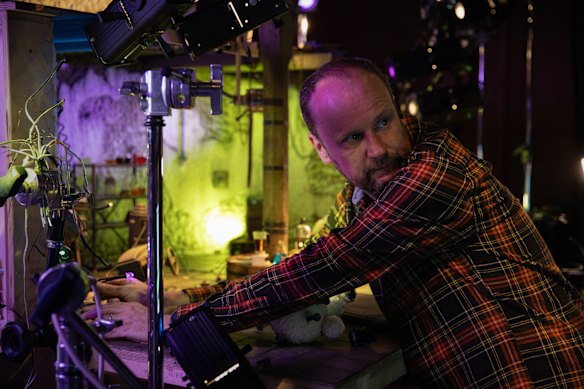
“We do think of our animators as actors,” says Grace. “We often film them acting out scenes, and they then use that information, that they have recorded themselves, to put into the characters. If there’s a moment in the film that’s a sad moment, the animator has to embody that sadness and get the emotion into the film.”
Sometimes a movement – an expression of joy or a bouncing gait – can be clearly identified with the person who animated it. “Just because they’re thinking, ‘This is the way a person walks.’ It’s their own acting going into it. It’s fascinating, really.”
Given this, a good part of Grace’s job is making sure the characters stay consistent across all the scenes being created by different animators. Where they are hand-moulding, their models have to match exactly. Occasionally, something jars.
“It can be very, very subtle things to the general audience,” he says. “They may not notice, but you can see that, say, the eyelid shape is not quite right. This nice curved shape is very Shaun, whereas this one” – he points to a reject – “is just too straight and a little bit too thick on one side. As a viewer, you wouldn’t necessarily notice what the specifics were, but you might be able to pick out that it doesn’t quite look like Shaun.”
There are short-cuts. For characters with visible mouths – most of the humans and Bitzer the dog – there are as many as 20 interchangeable mouthpieces covering basic expressions. These are squeezed into place on a resin face and can then be moulded as required. Back in the ’70s when Aardman was founded, everything would be moulded on set, but that is even more time-consuming.
“My personal preference is doing character shots where you’ve got a full clay face and you’re really pushing it around and making that piece of clay live,” says Grace. “To me, that’s what I love about stop-motion.”
As I push and pull at bits of black and white plasticine, which are turning disappointingly grey around the edges, I can imagine that. I also have to face the fact that, like most people, I’m not very good at it. I’d love to work in this house of fun but, clearly, you need to be a little bit obsessed.
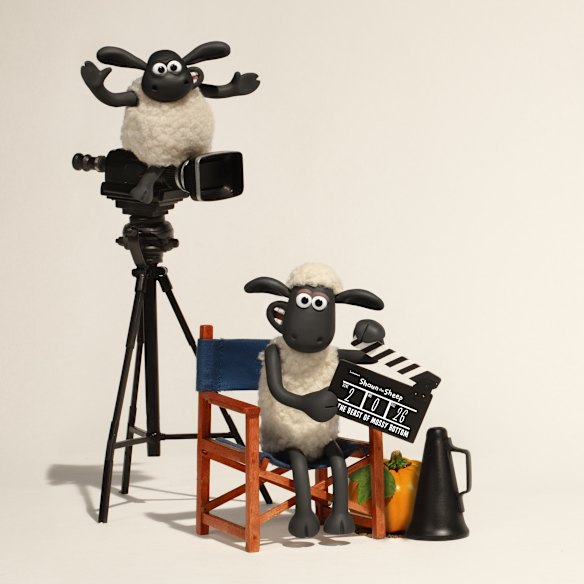
Shaun the Sheep: The Beast of Mossy Bottom is released in cinemas on September 24.