

Source : the age
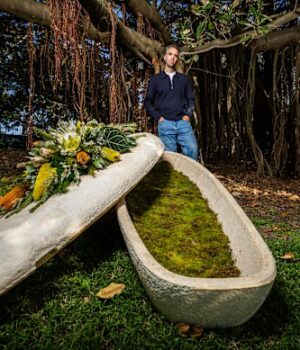
About 200,000 funerals take place in Australia every year, but a service in the Blue Mountains on Friday marked a first for the country – the woman farewelled was in a coffin grown from mushrooms.
Carolyn, a woman in her 70s whose family requested her surname be withheld, was buried at Springwood Cemetery after a service in Faulconbridge.
“It feels very true to who she was that even after her death, she can still do something for others while giving something back to nature,” said her husband Donald.
The technology created in the Netherlands involves mixing hemp fibres from the agricultural waste stream with mycelium, the hidden, root-like structure of a mushroom colony. The material is arranged around a mould and kept in the best growing conditions in a climate-controlled room.
“The organism grows in seven days into the shape of that mould, which is of course the shape of the coffin, and that’s how we grow mushroom coffins,” said Bob Hendrikx, founder and chief executive of Loop Biotech.
“We are trying to create a cocoon that’s actually biodegradable. In ideal conditions, in 45 days it will be one with the soil, and instead of polluting the earth, it is enriching the soil.”
The mushroom coffins are part of a growing trend. Asha Dooley, managing director of Grace Funerals and national president of Funerals Australia, said client families had become much more interested in environmental sustainability over her 15 years in the industry, and especially in the past four or five years.
“It’s coming up more and more,” Dooley said. “Having proper sustainable options like the coffins … is probably the thing that people see the most as opposed to solar panels on the roof [of the funeral home].”
Dooley, who directed Carolyn’s funeral, said the mushroom coffins were beautiful and soft to touch in person. “Almost the way I describe it is kind of like a marshmallow, but I don’t know that that does it justice. It looks beautiful, and it feels wonderful, and it’s incredibly environmentally sustainable.”
Other environmental innovations include human composting, which turns human remains into soil. This masthead has reported on a push to legalise it in NSW, which would make it the first state in Australia to permit the alternative to cremation or burial.
Cremations outnumber burials in Australia by seven to three, mainly because it is much more cost-effective, especially in big cities such as Sydney and Melbourne where land is valuable. Yet cremation emits about 160 kilograms of carbon dioxide into the atmosphere – or less if an electric hybrid cremator is used.
Traditional coffins use materials that could have been put to other uses – such as wooden furniture – but will instead degenerate and may pollute the soil. Dooley noted that the mushroom coffins could be used for either cremation or burial.
Hendrikx, 32, started the project as a university project when he tried to see what could be made from mushrooms and hit on the idea of trying to create a more environmentally sustainable coffin. He has spent the past five years developing the technology and starting a business.
He fielded inquiries from Australia right from the beginning, and after navigating Australia’s famously strict biosecurity laws, has now signed Arrow Bronze as a distributor for the Loop Living Cocoon used by Carolyn and other products grown from mushrooms, such as urns.
The products are currently grown in the Netherlands and exported to Australia by container ship. Hendrikx said he bought carbon offsets for the transport emissions, and planned to establish a growing facility in Australia as the market grew.
Get to the heart of what’s happening with climate change and the environment. Sign up for our fortnightly Environment newsletter.
 Caitlin Fitzsimmons is the environment and climate reporter for The Sydney Morning Herald. She was previously the social affairs reporter and the Money editor.Connect via email.

