

Source : THE AGE NEWS
If you’re younger than 55, gold has been largely irrelevant to the global financial system in your lifetime. For decades, it was regarded as little more than a pet rock. That is now changing.
Gold has always been important for jewellery and for some industrial purposes. But, after the US abandoned the gold standard in 1971 and instead attached the value of the US currency to nothing more concrete than the “full faith and credit” of the US government, gold has been more novelty than necessity.
Gold fetishists, nostalgists, libertarians and perma-pessimists invested in the metal. Its status as a “barbarous relic” of ancient times, as John Maynard Keynes dubbed it, has always given it a fringe fascination.
But global central banks and authorities, which were the biggest gold owners for a century, gradually sold the bulk of their holdings over the course of 40 years.
Gold fell from grace – hard. The share of gold in worldwide official reserves fell from an average of 50 per cent in the 1970s to about 10 per cent early this century.
Australia’s Reserve Bank was part of the trend. It sold two-thirds of its gold in 1997 and has held its remaining 80 tonnes or so since. Australia’s natural endowment of unmined gold is the world’s biggest, according to the US Geological Survey.
Gold’s price languished. It lost its vaunted status as a protection against inflation. For example, if you’d bought a troy ounce in mid-1980 and sold 20 years later, your investment would have halved in value. Even after adjusting for inflation.
Gold was also supposed to be a hedge against financial crises. But crises came and went and gold didn’t do much at all. Worse, gold produces no interest nor dividend income.
It was, in short, a dud investment so long as the mighty US dollar and US Treasury bonds held fast as the reliable ballast for the world system.
But gold’s long lassitude is over. Each time the US has demonstrated systemic risk, gold has benefited. A slow gold revival began with the global financial crisis in 2008-09 and quickened with COVID.
The truly galvanising event proved to be Russia’s grab for Ukraine in 2022. It wasn’t the Russian attack in itself but the Western response.
When the US, UK, EU and Japan punished Moscow by freezing $US330 billion worth of Russian financial assets in the global system, many countries saw it as a weaponisation of the dollar-based system. They feared for the future of their own holdings.
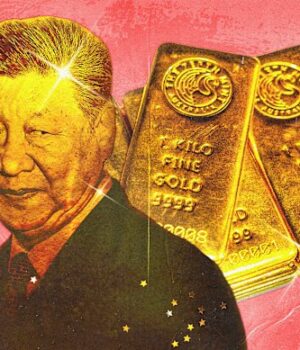
Their response? Led by China, many central banks fled US dollar assets, chiefly Treasury bonds, and embraced gold instead.
But if China and others are escaping from the risk of Western impoundment of their dollars by buying gold, couldn’t the West simply freeze China’s gold holding in some future crisis?
No. While most Western countries, including Australia, hold most of their official bullion reserves in immense underground vaults in London or New York where they can be traded readily, China hoards it’s at home. So does Russia.
By early this year, central banks globally had cut the share of US dollars in their reserves from 60 per cent to 40 per cent. They’ve stockpiled gold correspondingly. The barbaric relic is in vogue for an increasingly barbaric world. Gold’s share of official reserves worldwide has tripled from 10 per cent to 30 per cent.
The People’s Bank of China has bought gold for a record unbroken streak of 21 consecutive months, adding a net 20 tonnes in July alone, its biggest monthly gain in three years.
Perhaps surprisingly, there’s been only a marginal global shift into China’s yuan, but that’s because Beijing doesn’t allow full convertibility of its current account. As long as it insists on capital controls, China will not replace the US as the reserve currency. That default displacement of the dollar is occurring through gold instead.
It’s accelerating. Combined central bank buying of gold has totalled 1000 tonnes a year over the past four years, double the average of the previous decade.
Deutsche Bank calls this “the return of history”, with geopolitics, not economics, forcing the tectonic realignment. The final indignity to the US-made global system is the great vandal Donald Trump. The European Central Bank reported in June that the value of gold held by the world’s central banks had overtaken that of their holdings of US Treasury bonds.
On the day Trump was inaugurated for his second term, gold was trading at about $US2700 an ounce. Today it’s about $US4400. This sharp increase of about 60 per cent is a good approximation for the comprehensive Trump risk premium to global stability – political, economic, trade and financial.
Trump has delivered political instability by undermining the US alliance system. He’s inflicted economic instability by incompetently attacking Iran, sending a shockwave of inflation around the globe, and trade instability through his tariff roulette.
And the prospect of financial instability is now haunting the bond markets as Trump’s Treasury secretary, Scott Bessent, tries to hold bond interest rates down through artifice rather than cutting an enormous federal deficit of 6 per cent of US GDP.
All this uncertainty is helpful to Australia in a narrow sense. It’s doubled the value of Australia’s annual gold exports over two years to about $70 billion. That makes gold the country’s second most valuable export after iron ore. But the forces that made gold more expensive have made Australia more vulnerable.
The gold price may be an index of Trump-inspired instability but even more unambiguous is the way that central banks of US allied nations are removing their bullion reserves from Trump’s grasp.
Countries that have held their national gold reserves in New York since World War II are physically relocating their gold. Last week the Netherlands central bank was the latest, moving 78 tonnes of gold from Manhattan to London. It cited “increasing geopolitical unrest”, which is diplomatese for Trump. The French removed gold reserves from the US this year and the Germans did the same in 2016.
In the meantime, a big global seller of gold is Russia. In the first seven months of this year, Moscow shipped almost 100 tonnes of gold worth about $US13 billion to Hong Kong. The gold is subject to Western sanctions; Chinese buyers don’t care. Russia, by tripling its sales from a year earlier, is financing Putin’s war on Ukraine.
So as Trump damages global trust in the US, he inadvertently pumps up the price of gold, helping Putin continue his aggression. Meanwhile, China builds the reserves it needs to insulate itself from future US pressure.
Peter Hartcher is political and international editor. His political column appears on Saturdays.
Get a weekly wrap of views that will challenge, champion and inform your own. Sign up for our Opinion newsletter.
 Peter Hartcher is political editor and international editor of The Sydney Morning Herald and The Age.Connect via email.

