

Source : Perth Now news
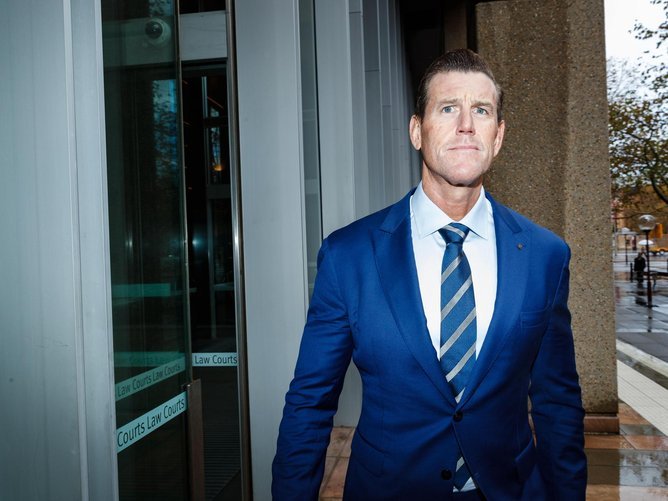
More than 500 people’s identities have been kept secret in fresh evidence filed against Ben Roberts-Smith, with the former Red Cross recipient’s legal team fighting to find out which pseudonyms relate to current soldiers, a court has been told.
The country’s most decorated former soldier was charged with five counts of war crime murder following his arrest by the Australian Federal Police in April this year.
It’s alleged the former SAS soldier took part in the killings of five unarmed men while he was deployed in Afghanistan between 2009 and 2012.
He has yet to enter pleas to any of the charges.
The commonwealth Director of Public Prosecutions on Monday filed 4000 documents of non-sensitive evidence on Mr Roberts-Smith’s legal team that includes hundreds of witness statements, a court has been told.
Part of the newly filed evidence includes pseudonyms on the identities of 574 people, which brings the total tally of identities kept secret to more than 700.
Mr Roberts-Smith’s lawyer, Karen Espiner, is now pushing to find out which of the hundreds of protected identities relates to current soldiers so she can properly understand what is in the documents, arguing that non-sensitive information has no basis for a pseudonym.
“Every time those persons are referred to, their names are redacted,” Ms Espiner said.
While she said she understood that prosecutors had taken a “cautious approach”, Ms Espiner asked that they notify her of names that relate to sensitive information regarding current Australian Defence Force soldiers.
“I understand that that process is likely to take some time and the sooner it starts, the better,” she said.
The prosecution in turn asked for more time to resolve the issue with Mr Roberts-Smith’s legal team directly. a request granted by Judge Susan Horan.
Prosecutors were also granted more time to file the charge certification, and an update on the service of the remaining evidence will be given on October 13.
Mr Roberts-Smith will remain on bail.
The additional pseudonyms come after a staggering 206 court orders were made under the National Security Information Act last week that will ensure that highly sensitive information will be handled securely during Mr Roberts-Smith’s proceedings.
The move will protect Mr Roberts-Smith’s right to a fair trial and the proper administration of justice, Judge Horan told the Downing Centre Local Court last week.
Among the orders are a series of protections for people posted to the Special Operations Command of the ADF, with members to be referred to by pseudonyms in open court to protect their identities, according to court documents seen by NewsWire.
The court has also been given powers to allow members to give evidence by an audio link or behind a screen, have a private entry and exit to the courtroom and building, or have the court closed for their evidence where necessary, the documents state.

Mr Roberts-Smith has long maintained his innocence in relation to the allegations, which were the subject of his unsuccessful Federal Court defamation suit against Nine Newspapers.
He has consistently denied any wrongdoing and Federal Court findings against him were made to the civil standard of the balance of probabilities, which is below the criminal standard of beyond a reasonable doubt.
The first two charges relate to the alleged killing of two men at a compound known as Whiskey 108 at Kakarak on April 12, 2009.
Mr Roberts-Smith is alleged to have ordered another officer to kill one man and to have shot another man, who had a prosthetic leg, in the head.
He is also alleged to have taken part in the murder of Afghan shepherd Ali Jan in Darwan in September 2012 when he allegedly kicked the handcuffed man off a cliff before ordering a junior member of his patrol to shoot him.
The final two charges relate to the alleged killing of two “persons under control” at Syahchow in October 2012 when Mr Roberts-Smith allegedly ordered another soldier to execute one of the prisoners.
He is also alleged to have jointly murdered the other “person under control” before placing “throwdowns” – pieces of military paraphernalia that give the appearance of a lawful combat killing – on the bodies.


