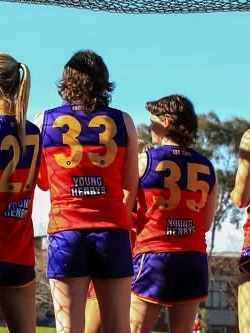
Source : ABC NEWS
Multiple Victorian Amateur Football Association (VAFA) clubs have expressed disappointment with how women’s competitions are being handled this season, as players across the league say the women’s competition is being treated as secondary.
The VAFA is the state’s largest amateur Australian Rules football league with about 300 teams and 12,000 participants.
Last week, Fitzroy Football Club and St Mary’s Salesian released public statements expressing disappointment over two separate incidents that affected their finals campaigns.
Fitzroy celebrated its final home-and-away season win, believing the victory put it into the top four and its first finals series of the premier women’s division.
However, the league had declared an earlier season game between two other clubs, St Kevin’s and Kew, “abandoned” due to an ineligible player, and recalculated the match ratio for the teams, putting Fitzroy outside the four.
The club said it was “bitterly disappointed” not just with how the league managed the competition, but with its communication with clubs.
“To say we are frustrated with the decision is an understatement,” Fitzroy said in its statement.
“We’re incredibly proud of their season and all they have achieved. The same cannot be said for the VAFA’s handling of this matter, and it goes to a concern that this premier women’s competition is not being as well run as it should be.
“The fact the top tier of the VAFA has only nine teams creates a situation such as this to occur. As one of the top levels of women’s football in Australia, it beggars belief that an odd number of teams are in the division. Would this happen in the men’s premier competition?”
Loading Instagram content
Fitzroy president David Leydon said the club took great pride in playing in the premier women’s division, “a very prestigious competition” that has taken them a long time to get into.
He said making finals was a big moment for the club
“And to have that ripped away from us courtesy of an arrangement that we were unaware of until after our last game, I was heartbroken,” Leydon said.
He said the abandoned game should have been communicated to all other clubs in the competition.
Earlier in division two, St Mary’s Salesian won an important preliminary final but were later disqualified after a player was ruled ineligible for finals.
The St Mary’s player had only played two home-and-away games instead of the required three, following a rule change that year.
VAFA changed the requirement to three games at the start of the season and updated its website. But St Mary’s claim PlayHQ, the platform the VAFA runs every fixture, team list and season through, still stated the old eligibility requirement for division two women’s finals as two in-season games, upon which the club relied.
St Mary’s said it would never have selected an ineligible player in a final had they known.
Loading Instagram content
The player missed most of the season due to maternity leave.
The club says it was not notified of the rule change, and that the men’s eligibility rule was updated on PlayHQ this year, but the women’s was not.
VAFA’s response
VAFA strongly refuted any “any gender bias” in applying the competition rules.
It said the club statements, and subsequent social media comments on the posts, brought the integrity of the competition into question and framed the issues as being gender-based.
“Whilst we understand the emotions that such commentary provokes, the inaccuracy of these club statements is misleading and being considered by the board for potential breaches of the VAFA’s policies,” the VAFA told the ABC.
It said the ineligible St Kevin’s player was never a matter that would affect Fitzroy’s ladder position or qualification for finals, so Fitzroy was not involved in the initial enquiries into the game result.
VAFA CEO Jason Reddick said he was in touch with Fitzroy on the Sunday of round 18, the final home-and-away round, both over the phone and in writing.
Fitzroy asked for an investigation into the matter on the Monday. The VAFA looked into it and released its findings on the Friday, the day before the finals series commenced.
In response to Fitzroy asking if something similar would happen in the men’s, the league said it was not a fair question.
“This is not a gender-based issue,” it said.
“The matter is about the VAFA Rules pertaining to the playing of an ineligible player. We have the example of stripping reigning Premiers Uni Blues of all their points and fining them $22k for playing ineligible players in their Premier Men’s team in 2022, so there is clearly no gender bias when it comes to applying the Rules of the VAFA competition.”
Regarding St Mary’s statement, the league said member clubs presented and voted on any rule changes each year, so all clubs knew the finals eligibility rules at the start of the season.
It also said it sent out a reminder ahead of the finals through its portal to all clubs.
‘Just looks like flat-out discriminatory’
Multiple women’s players across various VAFA clubs, who wished to remain anonymous due to fear of repercussions from the league, said they were not aware of the finals eligibility rule changes this year.
One player from a premier women’s side said the women’s competitions were treated “1,000 per cent” like an afterthought, particularly in fixturing, scheduling and grounds.
She gave the examples of the women’s division one, two and three having their grand finals at 9:40am, 9:20am and 9:20am respectively last weekend, which she said was “just awful”.
The men’s competitions received their fixtures months in advance, whereas the women received theirs just weeks before their season starts, she said.
“I think if it was like at least some of the men’s teams got s*** locations and times, it would be slightly more understandable, because I know that obviously the council plays a big part in that [and)]in getting access to grounds at certain times. But it just looks like flat-out discriminatory,” she said.
She said the issues around player eligibility also came down to broad structural issues within women’s football, where clubs were often low on volunteers and didn’t receive “a whole lot of help or guidance from VAFA about how to deal with situations”.

Fitzroy says it is frustrated with the league. (Supplied: Fitzroy Football Club)
“That’s another issue with, and this is not VAFA’s fault, but by default, women have less community support and less money, less financial support, which means that the burden often feels heavier on women’s teams to make sure that they’re on top of all of this admin,” she said.
“It’s normally someone random who has no idea how football works, who’s doing the team management stuff, which is checking who the players are and if they’ve got their correct numbers and all of that admin that goes towards eligibility and selection and reporting and all of the flow and stuff.
“So I do think that there’s also a bit of like a burden on VAFA also to make more of an active effort to communicate changes, knowing that like this is all volunteer-run clubs.”
Earlier this year, the ABC reported that VAFA women’s players found issues with inequitable resourcing and fixturing by the league.
‘Very under-resourced’
A source who has worked in senior administrative roles across different VAFA clubs, and who wished to remain anonymous for fear of repercussions at their club, said there were many issues with how the women’s competitions were run.
“Firstly … it’s tough for them. I think they’re very under-resourced,” they said.
“They’re essentially set up as a men’s competition traditionally and historically, and they’ve added women, you know, 10 years ago. And so that’s always going to come with a need for serious transition and a need for serious recalibration.”
Fitzroy says the club was heartbroken to learn it didn’t qualify for the finals. (Supplied: Fitzroy Football Club)
They said there wasn’t a clear strategy for the women’s competition, pointed to “anomalies” across the competition, highlighted “fixture mistakes”, and said, “we’re having administrators at the VAFA giving wrong information to clubs”.
“So that’s just a reflection of, well, they’re not resourcing it enough, and they’re not actually prioritising women’s footy in their strategic goals and operations, and it’s reflected in the under-resourcing, which means you have these mistakes,” they said.
Leydon said after Fitzroy released its public statement, the support was overwhelming, including from other clubs in the league.
“Hopefully it turns into something positive, and we can try and fix the way the women’s program is conducted and get everyone to take it a lot more seriously,” he said.