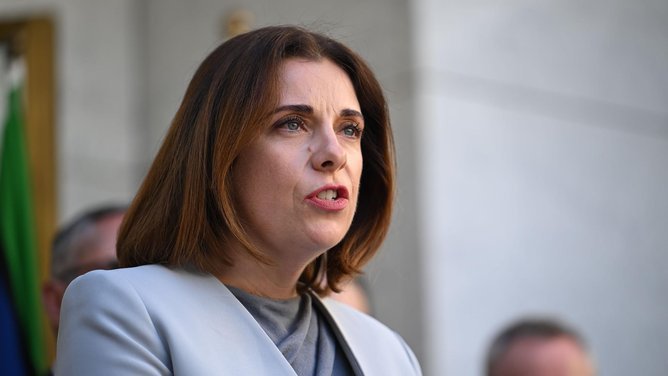
Source : Perth Now news
Deciding what “seriously harmful” material is under newly pitched internet safety laws could fall to parliament and not a government minister, Communications Minister Anika Wells has said,n a bid to placate the Coalition’s censorship concerns.
The proposed digital duty of care threatens hefty fines for tech giants that fail to keep Australians safe online, putting the onus on companies to root out illegal and harmful content, such as child pornography and material that encourages eating disorders.
But Angus Taylor this week declared draft legislation “unacceptable in its current form” because it gave “a blank cheque for political censorship” to Ms Wells – a claim she dismissed on Sunday, insisting there were “a number of limits” on ministerial power.
“Firstly, I must consult with the eSafety commissioner,” she told the ABC.
“Secondly, when I make the rule, any member or senator can move a disallowance motion in the House or the Senate.
“I have 15 days to convince that member or senator, and if I don’t, it goes to a vote on the floor and majority wins.”
She said she would “love to hear” any alternatives from the Coalition but that she had not “had so much as a phone call from the shadow communications minister on the exposure draft”.
“I didn’t receive a letter iterating their concerns, seeking a meeting to talk about what would be the differences required for them to support the bill,” Ms Well said.
“Instead, they convened a special party room meeting to reject an exposure draft, and then they convened a press conference to make sure you all knew about it.
“It’s an extraordinary series of decisions – they are playing Yahtzee with kettlebells on this.”

She called on them to “reconsider” because “we really do want this to be supported by all parliamentarians”, saying that she was “prepared to work with the Coalition on the wording to make that work”.
That included giving up ministerial power to classify online harms.
“This is about giving you choice back over your (social media) feed,” Ms Wells said.
“This is about trying to get rid of the illegal content that is being beamed into your eyeballs against your will.
“And this is about keeping children more safe online than they have been, as we get more and more evidence around the psychosocial harms that they are experiencing – like AI chatbots telling girls how to subsist on only 600 calories a day, like grooming occurring on Roblox, a gaming platform that many, many Australian children use.”
Under the draft legislation, providers must conduct regular risk assessments and mitigate platform design features with negative behavioural impacts, such as doom scrolling and algorithms – the systems that decide what users see online.
On social media, algorithms have been found to push emotionally or politically charged content to people to keep them scrolling longer, which radicalisation experts warn is driving extreme views.