

Source : THE AGE NEWS
Self-driving cars have successfully developed to a point where a major insurer believes they reduce the risk of collision enough to warrant offering some owners using the technology cheaper insurance premiums.
Most Australians may not realise they’re already sharing the road with self-driving cars or have full confidence in their safety, but on Monday Zurich Insurance said it will offer discounted premiums to drivers who insure a Tesla that uses Full Self-Driving (FSD) Supervised mode.
The Tesla drivers will be deemed less risky policyholders after early-stage data reviewed by Zurich’s underwriters showed there was lower accident frequency for drivers using the futuristic technology. The underwriters formed the view that the automated trips using FSD were safer than human-driven journeys.
FSD mode – which requires a human’s constant supervision to legally operate – became available for owners of certain newer Model 3 and Y Teslas in Australia about 12 months ago, allowing those who pay a $149 per month fee to let their vehicles drive them around.
The technology relies on eight cameras fixed on the car that provides a 360-degree view, which feeds information into a neural network navigation software that processes more than one million pixels of visual data every millisecond to determine how to steer, accelerate, brake and change lanes to navigate to a user’s pre-entered destination. If no destination has been set, the car continues driving straight ahead, while sticking to its lane.
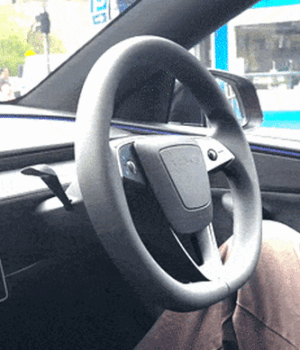
Drivers using FSD must be paying attention to the road, with an internal camera monitoring their retinas to ensure they are not distracted and are ready to intervene and take over control should the car make an error.
If the car detects that the supervising driver’s eyes are distracted or their hands are holding anything and not otherwise ready to grab the wheel at any moment, a warning will be issued. The car will automatically pull over and deactivate the self-driving option for the rest of a trip if a supervising driver is repeatedly caught failing to pay attention or have their hands free.
By requiring supervision to operate, Tesla’s FSD is classified as a Level 2 Advanced Driver Assistance System under Australia’s road rules, with the human behind the wheel considered legally in control of the vehicle. Supervising drivers can intervene to re-take control at any time, whether by choice to redirect or pull over, or if prompted due to issues with the car’s sensors.
Data from Tesla shows Australians have now self-driven more than 132 million kilometres, suggesting a sharp uptake since its launch, but still a fraction of the 264 billion kilometres driven by all vehicles in 2025.
The launch of the technology has triggered a flood of social-media videos and perplexed reactions from other road users and pedestrians when seeing Teslas move without their drivers touching the steering wheel.
While safety data suggests accidents are less frequent when the feature is in use, the kinks in the technology are still being ironed out.
In the months after it launched in Australia, roundabouts, as well as Melbourne’s unique hook turns, appeared to be among the features of local roads that the US-based electric-vehicle giant had not yet mastered.
During a test drive conducted by this masthead this week, FSD’s handling of roundabouts was smooth, with the car swiftly slowing to respond to hazards and pedestrians during a drive across Sydney.
However, the car’s navigation system became confused at times, including when driving through recently updated lane changes off Sydney’s Harbour Bridge. At one point, it attempted to exit using a bus-only lane, and another time it did not recognise a school zone 40 km/h speed limit.
The inclusion of FSD as a risk rating factor is a first in Australia. Zurich believes it is just the second globally to take the step. Zurich would not specify the exact discount would be in price terms for FSD users.
The offer of cheaper insurance comes at a time of surging costs for motorists, with premiums jumping by about 50 per cent between 2019 and 2025.
“As vehicle technology and driver behaviour continues to evolve at an extraordinary pace, it is critical that we continue to innovate alongside this change”, said Alex Morgan, Zurich’s head of general insurance.
“Humans make mistakes. They get tired. They can be distracted. It’s not that the machine is perfect, but it does appear to be true that on average, across the population and over time, it makes fewer of the mistakes that humans do,” Morgan said.
“It should be noted that self-driving technology helps to solve a lot of problems associated with driver error. It does not, however, do much to solve the problem of a tree branch falling on your roof in a storm, a shopping trolley being pushed into your passenger door, hail smashing your windscreen, or your vehicle being stolen,” he said.
Thom Drew, Tesla’s Australia director, said the company was pleased to see insurers beginning to recognise the safety benefits of automated driving. “FSD [Supervised] is making driving significantly safer, and it’s encouraging to see … this [insurance] benefit and reflecting the reduced risk for Tesla owners.”
 Elias Visontay is a National Consumer Affairs Reporter at The Sydney Morning Herald and The Age.Connect via email.

