Source : the age
The small bear bell tied to my backpack jingles as my eight-year-old son and I walk hand in hand through a bamboo grove up the slope to the site where Tsumago Castle once stood. Suddenly, Oliver stops and bends down to pick up a pine cone he spots in the leaf litter before we continue the climb.
At the summit, we settle onto a crumbling wooden bench, the morning sun warming our backs as we gaze across layers of mountains unfurling into the distance. We wonder aloud what it might have been like to be among the 300 soldiers who defended the now-demolished castle against an army of 7000 in the 1500s.
We had learned about the battle in an impromptu history lesson that morning after coming across the Nagiso Town Museum in Tsumago – a cluster of three buildings that includes a historical museum housed in a former honjin, or high-class inn. Built during the Edo period, honjin were official rest houses for the powerful feudal lords who governed much of Japan between the 15th and 19th centuries and travelled along trails such as the one between Tokyo and Kyoto that we are tracing. Known as the Nakasendo Way, meaning “central mountain road”, the path was also used by samurai, merchants and even princesses bound to arranged marriages as it was considered safer than the coastal route.
Before becoming a mum, hiking holidays were among my favourite ways to travel and, like a growing number of Australians, I was drawn to the idea of doing one in Japan. But can you tackle a hiking trip with a child in tow? That’s what I set out to discover. I opted for a self-guided tour with World Expeditions, which meant we could move at our own pace, with our bags transported ahead to our accommodation each day. And, if things became too much, we could skip sections and hop on a bus.
Our journey begins in the town of Magome, where we wander past a rustic water wheel and up a cobblestone path between rows of restored timber machiya (townhouses). With our bellies rumbling after a shinkansen and bus ride from Tokyo, we stop at a restaurant we happen upon for lunch. “Taste this, Mummy – but don’t have too much,” Oliver says, cheekily pouring the ingredients of an unlabelled shaker into my hand. He giggles as the heat of chilli catches on my tongue.
Sated by a bowl of thick udon noodles, we set off on our way. Its early spring, and snow still clings to the surrounding peaks while plum blossoms are beginning to bloom. We are partway up the first hill when Oliver declares he is exhausted, and I start to wonder if I’ve been overly ambitious.
But while my thighs burn, he is soon skipping up the stone steps, butterflies flitting around him. “Mummy, look how pretty these flowers are,” he exclaims, and part of me wishes he could stay this small and innocent forever. “This is actually really good; I like it a lot,” he adds, and my anxiety begins to ease.
Then we come across the first bear warning sign. It had been one of my few hesitations about embarking on a self-guided tour, though my research suggested sightings were rare and that bells along the trail offered a reassuring – and fun – precaution. Noticing Oliver’s concern, I tell him that we are meant to make lots of noise. “Like this?” he asks, before letting out a high-pitched squeal.
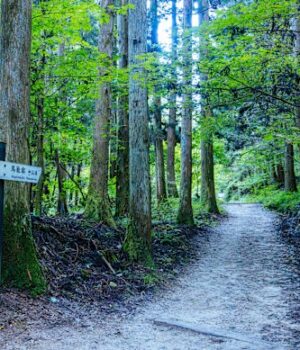
As we meander across wooden bridges and through a forest beside a rocky stream, I use the trail signage showing the remaining distance as an opportunity to teach Oliver about the metric system. I also introduce him to the Japanese concept of ikigai – the idea of having a reason for being, something that gives life meaning and makes you want to get up in the morning.
Around halfway along the eight-kilometre track between Magome and Tsumago, we come to a traditional teahouse with low timber beams, antique farming tools hanging on the walls and an irori sunken charcoal hearth with a pot suspended above it. As I pour tea from a large urn, a volunteer offers Oliver a handful of fruit-flavoured lollies.
Sugar proves a reliable motivator. Our tour pack includes a voucher for a menu item at another teahouse in Tsumago, which I’d read is known for shaved ice. My notes warn that last orders are at 4pm, so we hurry and arrive just in time – only to learn that shaved ice is out of season. Fortunately, an American expat at the next table translates for us, and we instead receive a sweet chestnut treat, formed into a neat ball from a smooth paste.
When we arrive at the family-run bed and breakfast where we are spending the night and are shown to our room, we find only a small table with two cushions on a large bamboo mat. “Where are the beds?” Oliver asks, perplexed. Our host, who speaks limited English, points to a page in the guest book explaining that futons will be laid out while we are having dinner.
We dress in kimono before heading downstairs to the dining room for a bento-style feast served in small, lacquered trays, featuring pickles, grilled fish and tempura vegetables. Much to my horror, Oliver pops an edamame bean and sends it flying across the room. He bravely tries sweetened locusts, declaring that they taste like honey.
The next day’s journey is as delightful at the first, though in a different way. We stop to admire koi ponds, pointing out our favourite fish, before exploring the town of Kiso-Fukushima. After stumbling upon a footbath in a riverside park where artists are painting watercolours of a bridge, we stop to take off our shoes and roll up our pants, soothing our tired feet in the water. We are soon joined by a local man who explains their importance. “Second heart,” he says, tapping the back of his calves, before introducing Oliver to the pleasures of the nearby reflexology path.
Dinner that night is a multi-course extravaganza, including miso soup and river trout, the ryokan’s signature dish. Oliver passes on the steamed congee eel but eagerly tucks into the grilled beef cooked on a hot plate at the table. I am quietly thankful to be there in spring, as it allows me to try the cherry blossom liqueur, which is simply divine.
As we are reunited with our luggage at the train station on our final day, the affable woman from the baggage delivery company hands Oliver a leather bookmark – a small gesture that feels like a nice way to end our journey.
But I must admit that while it has been a special experience, it isn’t all smooth sailing. Oliver protests whenever we take detours to see attractions along the way. There are tears when he accidentally breaks the bear bell we had purchased in a souvenir shop that he had been planning to take in for show-and-tell at school. And when I worry I’ve taken a wrong turn and we might miss the shave ice stop, he declares it the worst day of his life. But you don’t embark on family adventures like this without expecting moments like these. You just have to be mentally prepared and hope that, in the end, it will all be worth it. And it was.
THE DETAILS
TOUR
World Expeditions’ three-day Nakasendo Way Self-Guided Walk runs from May to November from $2390 per person, twin share. Longer options are also available. See worldexpeditions.com
FLY
Jetstar, Qantas and Japan Airlines are among the carriers that fly to Tokyo. From there, it’s around a three-hour shinkansen ride to Nakatsugawa via Nagoya, then a 25-minute bus ride to Magome.
The writer travelled as a guest of World Expeditions.