
SOURCE :- SIASAT NEWS
Hyderabad: In what seems to be a glaring Artificial Intelligence (AI) error, the Instagram handle of the Salar Jung Museum (SJM) here posted a photo of the erstwhile Hyderabad state under the Nizams with a wrong border. Two images were posted by the SJM’s handle, one of which also had an incorrect picture of Mir Osman Ali Khan, the last Nizam of Hyderabad (1911-48), during whose time the annexation of Hyderabad had taken place.
The post on Instagram focussed more on Sardar Vallabhai Patel, who was the Union Home Minister of India after independence in 1947. It was under him that the Indian government sent the Army to annexe the erstwhile Hyderabad state after negotiations with Osman Ali Khan broke down due to various reasons, including political violence. Called Operation Polo and Police Action in local parlance, the annexation is a also a painful memory for thousands of Muslim families that faced communal violence in the erstwhile state.
What the Salar Jung Museum map got wrong
In both of the images, the map of the Hyderabad state (1724-1948) is not only different but highly inaccurate. While the borders of the princely state had changed a lot (mainly shrunk) during the reign of seven Nizams of Hyderabad, both of the maps were entirely off and seemed like it was done on AI.

According to a source, it was posted on the social media handle of the Salar Jung Museum based on what had come from the top, meaning the Union Ministry of Culture. The issue was highlighted on X by journalist Serish Nanisetti. The photos have since been taken down.
Background of Operation Polo and the Hyderabad state
Run by its last Nizam, the Hyderabad state was the largest one in India. It ran over 82,698 square miles, which included all of Telangana, five districts of Maharashtra and three of Karnataka. It had a population of about 1.6 crore, of which 85% were Hindus and a little over 10% were Muslims (about 43 percent of people lived in the Telangana region).
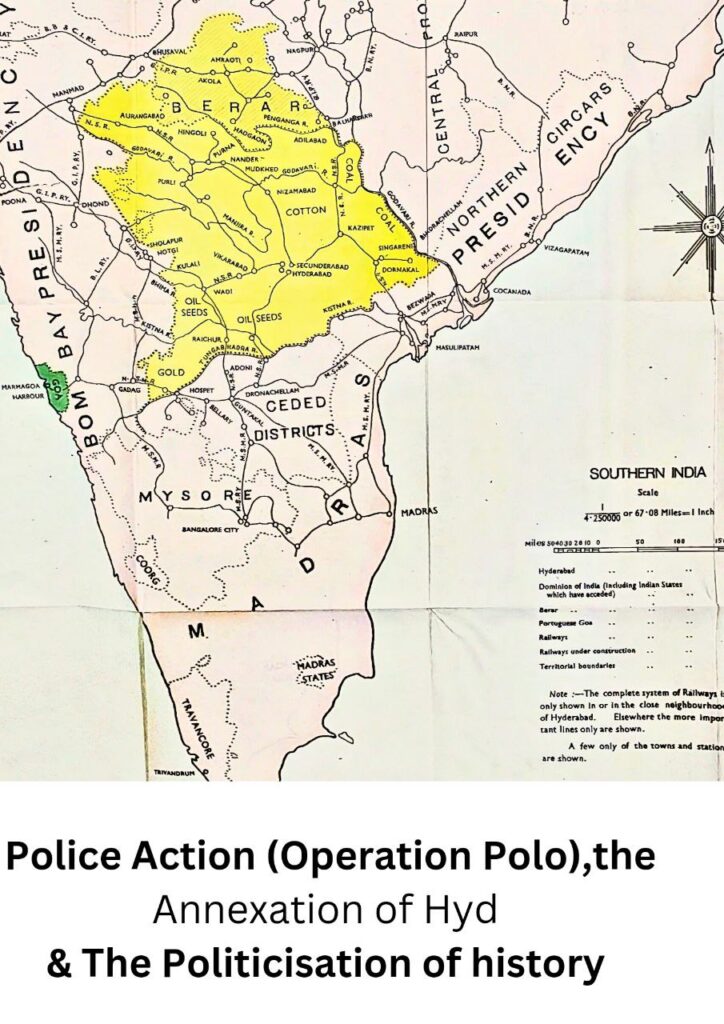
After months of deliberations and talks with Mir Osman Ali Khan failed, the Indian government finally decided to send its army to annexe (or merge, as some call it) the erstwhile princely state of Hyderabad to India with force. Operation Polo formally began on on September 13, 1948 and concluded in about five days on September 17. The Indian union had begun stationing troops well in advance anticipating a fight.

Operation Polo was led by India’s Maj. Gen. JN Chaudhuri. Called Police Action in local parlance, it has left deep scars on the psyche of Muslims even decades later, as thousands had lost their lives in the aftermath. Moreover, another major reason for sending in the army was the Communist Party of India (CPI)-led Telangana Armed Struggle (1946-51).
It was essentially a peasant uprising against feudal Jagdirdars (landlords) in the Hyderabad state. It had begun much earlier in 1946. Wary of a communist takeover, the Indian government also wanted to crush the communist movement, which continued till 1951. The CPI called it off on October 21, 1951 and joined the Indian democratic system.
Final days in Hyderabad before Operation Polo
One of the reasons that many believe that set forth Operation Polo was the suspicion that the Nizam was directly or indirectly helping the Razakars. However, this blame perhaps can be put on Laiq Ali, who was more or less doing that. These developments convinced the Indian government that the Nizam was either in league with Qasim Qazvi or was powerless before them.
It was a matter of time before Operation Polo would commence. A militia, and a very legitimate concern that communists would take over the state (they had control of the rural areas) gripped the Indian government. In the aftermath of Operation Polo, Lt. Col. J. N. Chaudhuri, who led Operation Polo, took over as military governor for 18 months of Hyderabad, after which a provincial government under M. K. Vellodi existed till the first general elections. It may be noted that the last Nizam was made the Rajpramukh in 1950, while Razvi had been arrested and sent to jail for nearly a decade, after which he was allowed to leave for Pakistan.
The Sunderlal committee report formed in the aftermath of Operation Polo states that 26,000 to 40,000 Muslims were killed in communal violence, mainly in the districts of Maharashtra and Karnataka. As far as casualties are concerned with regard to armies of both sides, the Indian Army lost 42 soldiers, while 97 were wounded and 24 missing. For the Hyderabad state army, 490 were killed and 122 were wounded.
SOURCE : SIASAT