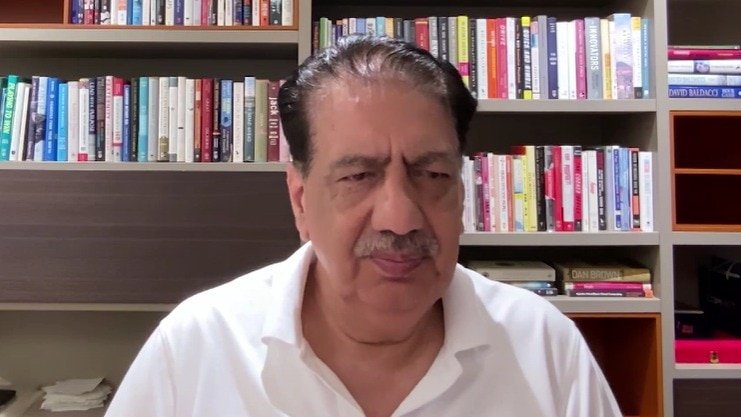
Source : INDIA TODAY NEWS
Is the fear that artificial intelligence could become an existential threat to humanity by the end of the decade being overstated?
Former HCL Technologies CEO Vineet Nair believes the growing alarm around AI needs to be viewed with greater scepticism. While acknowledging the technology’s enormous potential, Nair said the claims surrounding AI are running far ahead of its actual delivery and commercial use.
advertisement
Nair compared the current AI narrative to the familiar “sher aya, sher aya” story, in which repeated warnings about a lion eventually lose their impact.
“Although I am a great fan of AI, it is running way ahead of its delivery. So the hype cycle is going up,” Nair said in an exclusive interview with India Today TV.
He said the narrative around AI had progressively shifted from claims that it would become more intelligent than humans and take away jobs to warnings that it could eventually kill humans.
“Don’t buy into the argument of either AI is going to lead the humans or AI is going to kill the humans,” Nair said.
The interview came amid a controversy that erupted after researcher Jacob Coxon resigned from Anthropic and said in an interview with Fox News last week that countries and AI companies should work together before AI technology gets out of hand.
“This is possibly the most dangerous technology that humanity has ever created,” Coxon said.
His concerns were echoed by Anthropic CEO Dario Amodei, who, in his latest blog post, spoke about the need to slow down the development of frontier AI and make it safer.
He also questioned the incentives behind increasingly ambitious claims about AI, particularly as companies seek massive valuations.
“A lot of these companies want to get listed at a trillion dollar valuation and my question is where is the use case,” he said.
WHERE IS AI’S BIG COMMERCIAL USE CASE, ASKS NAIR
Nair argued that AI has yet to produce a revenue-generating application comparable with the major commercial breakthroughs that followed the internet.
“When internet came in, it took seven years for Amazon, Facebook and Google to come in, and those were mega use cases which transformed the use of technology into revenue-bearing activity. Where is that revenue-bearing activity which AI is driven?” he said.
He said AI would eventually transform industries, education and other sectors, but argued that its commercial impact has not yet reached that stage.
“After electricity, there was a use case. After internet, there was a use case. So it will come, but it is not coming right now. It is not coming tomorrow,” Nair said.
At the same time, he said businesses should not dismiss AI. Instead, companies should identify specific applications where the technology can transform their operations.
“Corporates should look at business cases, not using, but look at business cases of using the technology to transform their business,” he said.
AI COULD STILL DISRUPT BUSINESSES: NAIR
Nair said the next wave of AI innovation could significantly disrupt existing business models by delivering capabilities at a fraction of their current cost.
He said emerging technologies could solve 70-80 per cent of certain problems at one-tenth the cost and much faster, potentially creating major disruption across markets.
Nair also cautioned against accepting claims about AI without examining why they are being made.
“We don’t have to be the snake dancing to the tune. We have to use our own rationale and say, why are they saying it? What is their incentive in saying it?” he said.
‘SAFETY OVERSIGHT, BUT NOT EXCESSIVE REGULATION’
While Nair backed safety oversight for advanced AI systems, he cautioned against excessive regulation.
He said technologies capable of having a major impact on humanity should be supervised, but regulation should not become so heavy that it stifles innovation.
The debate over AI’s potential risks is already being taken seriously within the industry. Anthropic, for instance, has argued that a slowdown or temporary pause in frontier AI development could be beneficial if it gives safety research and societal safeguards time to catch up, while warning that an uncoordinated slowdown could allow less cautious actors to gain an advantage.
Nair’s argument, however, is that the public debate should not swing from uncritical enthusiasm to equally uncritical fear. For him, the more immediate question is simpler: what can AI actually deliver, and where are the transformative business cases?
– Ends
SOURCE :- TIMES OF INDIA