

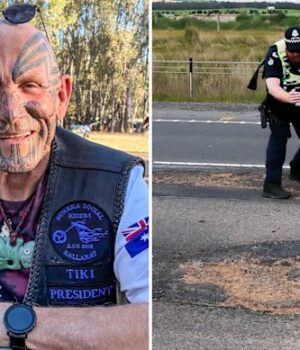
source : the age
Last Wednesday, the Victorian Auditor-General’s Office released its report into the condition of this state’s roads. Its findings were damning. Almost half of state roads were in poor or very poor condition in 2024. This was a rise from 39 per cent in 2021. Most were in regional Victoria, and bore most of the state’s traffic and freight vehicles. Worryingly, a third had only five years of usefulness before they crumbled so badly they could not be driven on safely without limits on speed and loads; another 10 per cent had between five and 15 years left.
On Sunday, motorcyclist Peter Mason, 71, known as “Tiki”, was riding on the Western Highway near Trawalla. His bike hit a pothole, causing him to lose control. He fell over the handlebars and died. Close friend Barrie Trubie remembered “Tiki” as someone “giving to anyone who needed it”. His death makes tragically real the nexus between words and actions. For potholes and Victorians, it is now not an exaggeration to say, it is a matter of life and death.
The auditor-general’s report found that in Pyrenees Shire, where the crash occurred, a third of the highway was in very poor condition in 2024; just over 10 per cent was in very good condition. Elsewhere, two-thirds of roads in the Loddon Mallee region were poor or very poor and Hume and the Grampians both hovered around the 50 per cent mark. The data shows that the Western Highway was second only to the Princes Freeway when it came to pothole reports, but that road authorities were better at plugging them quickly compared with some other roads in the state.
The report found that for the year from January 2025, the gap doubled between road defects and road repairs. “Renewal spending is not keeping pace with deterioration, and defects are appearing faster than they are repaired,” it said.
In an editorial published the week before the report was released, we applauded moves by the Labor government and the opposition to tackle the problem, notwithstanding how a looming election, and voter sentiment, can concentrate the minds of politicians. Labor has pledged an extra $352 million on top of a committed $1 billion in the May budget to repair 500,000 potholes; the Coalition vowed $5 billion over four years to repair 1 million. Premier Ben Carroll also announced a pilot program to use minimum security inmates to undertake basic roadside maintenance to free up professional road crews to repair potholes.
These financial commitments, however, fall well below the $3 billion a year the Department of Transport and Planning in its 2026-27 business case estimates is needed just to maintain road-pavement conditions at their present level. The auditor-general’s report noted “while resurfacing and rehabilitation aim to restore or improve condition and extend the road’s useful life, major patching is a shorter-term solution intended to slow further deterioration. It is generally reactive.”
Carroll said on Tuesday that the government accepted “responsibility for making sure our roads are safe”. He was roads minister from 2020 to 2022 – a point he made clear at a news conference on Tuesday by saying that now he wasn’t. He was premier. He was unable to say how many potholes had been fixed since he announced the extra funding to fix them.
Victorian Farmers Federation president Ryan Milgate recently said regional roads were “the worst they have ever been. Many are literally falling apart and some are straight-up death traps.”
On Monday, motorbike riders assembled outside state parliament to both mourn the death of “Tiki” and to call on the government to fix the roads, now, to a level where driving on them isn’t putting one’s life in one’s hands. Motorcyclist Paul Povh told a news conference he had warned lawmakers that a death was imminent. It shouldn’t need to be said, but we say it. The priority of government is the safety and wellbeing of the people for whom it governs.
According to a spokesman for Roads Minister Paul Hamer, road crews had travelled to the site of “Tiki’s” death to patch the potholes. For family, friends and communities, however, a life lost leaves a hole that can never be patched.
Get a weekly wrap of views that will challenge, champion and inform your own. Sign up for our Opinion newsletter.
 The Age’s View – Since The Age was first published in 1854, the editorial team has believed it important to express a considered view on the issues of the day for readers, always putting the public interest first.

