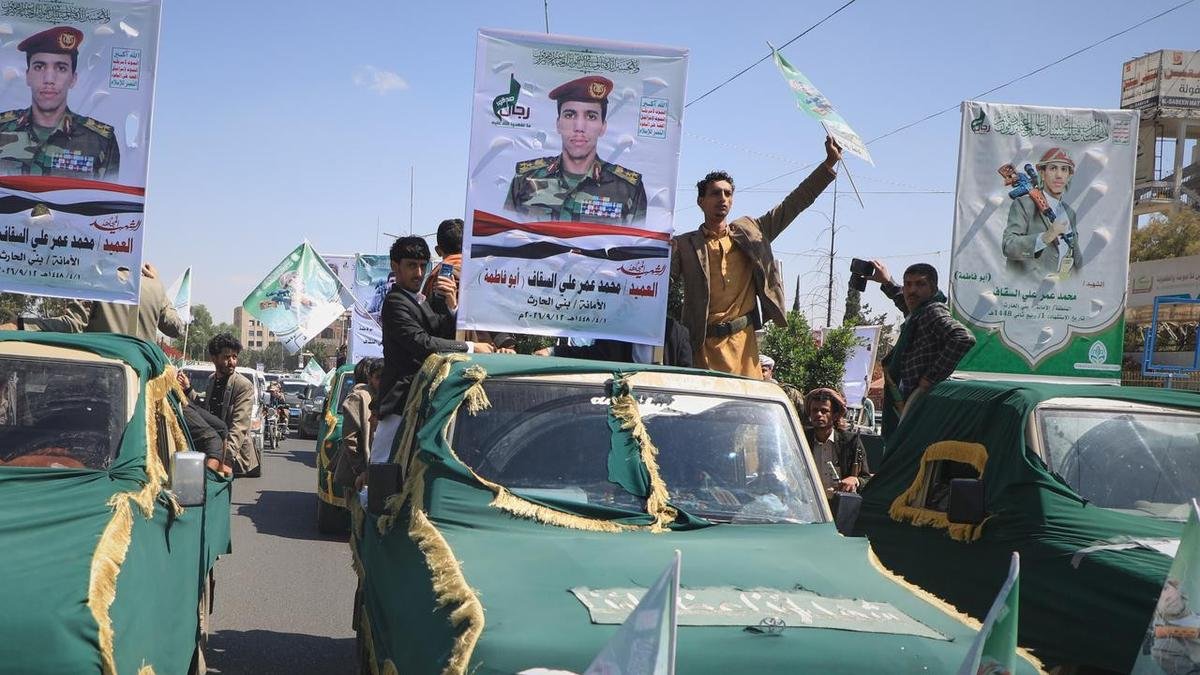
Source : Perth Now news
Saudi warplanes have pounded Yemen, the Houthis say, as the Iran-backed fighters solidify their gains after a lightning advance that has extended Tehran’s reach in the Middle East war and further disrupted global oil supplies.
In a sign of the worsening conflict in a new theatre, the United States tightened its travel warning for Saudi Arabia, banning government employees from travelling within 30km of the Yemen border.
The Houthis, who since last week have swept through Yemeni towns along the Red Sea coast and seized islands in the Bab el-Mandeb strait at its mouth, on Wednesday released battlefield video overnight of fighters seizing armoured vehicles from Saudi-backed forces.
Warplanes flew overhead and huge explosions billowed into the sky from desert dunes.
Houthi military spokesman Yahya Saree said the Houthis had shot down a Saudi F-15 fighter jet.
No immediate evidence was presented and Saudi officials did not immediately respond to emails seeking comment.
Saree said the Saudis had carried out as many as 450 air strikes on Yemen this week.
Officials in the Saudi-backed government that controls southern Yemen have acknowledged that their forces and those of Saudi Arabia were conducting air strikes on Houthi positions, though Riyadh itself has not confirmed them.
The Houthis have fired repeatedly into Saudi Arabia in the past week causing alarms over cities in the south and west.
An attack blamed on Iran-aligned fighters in Iraq last week also knocked out Saudi Arabia’s East-West Pipeline, the main route used to divert exports away from the blockaded Strait of Hormuz.
Riyadh said its air defences had shot down a Houthi drone south of Mecca on Tuesday before it entered prohibited airspace over Islam’s holiest city, an attack it said crossed a “red line” of threatening shrines sacred to all Muslims.
Houthi spokesman Saree denied the group had targeted Mecca, and said the Saudi reports were a set-up for propaganda purposes.
The extension of the war into Yemen threatens to worsen the global energy supply shortage caused by the six-month-old US-Israeli war on Iran, which has disrupted shipping through the Strait of Hormuz.
The price of Brent crude hovered about $US108 a barrel on Wednesday, close to its highest level since May.
Traders say a prolonged closure of Saudi Arabia’s East-West Pipeline could cut off as much as four per cent of global oil supply.
Saudi Arabia has not said when operations might resume, but US Energy Secretary Chris Wright told CNBC on Tuesday that crude oil should be flowing through the pipeline within days.
Saudi Arabia has led a coalition battling the Houthis since 2015.
The conflict had largely quietened under a ceasefire in recent years, but reignited when the Houthis declared a naval blockade against Saudi Arabia in July and fired at southern areas in the kingdom.
Violence has intensified sharply this month when the militant group pushed back forces aligned with the Saudi-backed internationally recognised Yemeni government.
Saudi Arabia’s Crown Prince Mohammed bin Salman phoned US President Donald Trump last week seeking military support, which so far has been limited to intelligence aid.
The United States bombed the Houthis for two months in 2025, but halted that campaign after reaching what President Donald Trump described as a ceasefire with the group.
Trump now faces a dilemma of whether to stand by and risk the Houthi advance worsening the global energy crisis, or provide more direct military support to the Saudis and risk extending the costly US intervention to another theatre.