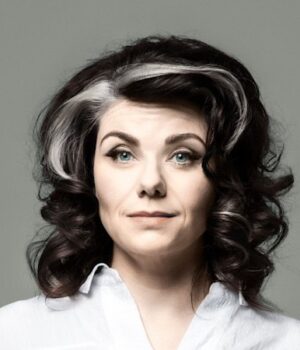
Source : the age
For nearly 35 years, hundreds of thousands of readers around the world have turned to Caitlin Moran – for laughter, and her signature wily perceptiveness about how to cope with life’s toughest parts. Provocative (just enough) and penetrating, her nine books talk to how we live now and, often, how we may be able to live better. How to Be a Woman was a bestseller, How to Build a Girl was made into a movie, and What About Men surprised everyone.
One of eight children, Moran grew up in poverty in a down-at-heel English town and, at 15, needing to help support her siblings and wanting to fulfil a promise to her brothers and sisters that she’d buy them bunk beds to get them off sleeping on the floor, she pitched a piece to The Times in London to earn the money. They bit. She has a column at the storied paper to this day.
Moran grew up resilient, creative, realistic. She had long been “appreciative of anything and everything that scores above not actively shit on the Pantone moods chart”, as she puts it in her new book, How to Be Hopeful. She was not easily knocked over.
But then came 2019.
“Around that time, I went completely crackers,” Moran tells Samantha Selinger-Morris in The Morning Edition podcast.
Her family became wary of her. “They [thought] Mummy was having a nervous breakdown.”
“It feels like it’s an overwhelm constantly. The phone in your pocket, the TV. It’s a 24/7 news cycle, and sprinkled on top of that, you’ve got someone like Donald Trump being the most powerful man in the world, just suddenly saying things like, ‘I’m going to buy Greenland’. Like, the human mind finds it very hard to cope with this kind of situation.”
In her new book, Moran documents what happened after she discovered that the dream Welsh cottage she had planned to escape to, as a solution to her despair, was a decrepit money pit that her husband and two twenty-something daughters were so dead-set against that “this was literally going to break up the family”. And how she learnt to adopt a new way of experiencing the humdrum efforts of living, to rediscover that life “really is a quietly loving thing”.
Click the player above to listen to the full episode, or read on for an edited extract of the conversation.
Samantha Selinger-Morris: Your book begins in 2019. Because you are feeling, it has to be said, despair. You write that you’re crying three to four times a day, and you say ‘I think a lot about purpose as I get older, sadness and despair. A sudden flatness is always near’. What was happening? Like how bad was this?
Caitlin Moran: Well, I mean that’s a combination of hormones being a bitch and the world, right? I mean that. That was the beginning of the menopause. I didn’t know it was the menopause at the time … but the other half of it was the world. It’s a particularly chaotic time. It’s a particularly anxious time. Diagnoses of anxiety are rising not only in young people but in children…
[And] I thought I had reached a new point of sanity because I was like, ‘OK, civilisation is doomed. I’m going to accept all this information I’m being given 24/7. I am going to retreat to the mountains of Wales. I’m going to get a self-sufficient farm. I’m going to have my own water source. I’m going to grow my own vegetables. I’ll have my own iron forge, so I can make my own rakes in case they run out in the apocalypse, and I’m going to sit this one out’. And I was just following the money because that’s what all the billionaire tech bros have done. They’ve all got apocalypse bunkers in Hawaii and New Zealand, and they clearly know something we don’t know. So I was just like, follow the money. But then I very rapidly found out why it is only millionaire tech bros that have apocalypse bunkers, because it’s incredibly expensive. I could not afford to run away.
That was when I realised that I had to go on a quest, which is always an annoying thing to realise as you approach 50. I was going to have to go on a quest, and the quest was to stay in my normal life in civilisation as part of humanity and find a way to feel hopeful about the world again.
And you make an interesting point in your book, which is maybe the shortcomings of gratitude and even keeping a gratitude journal, which I think a lot of us see those in self-help books. We get a bit angry. We want to maybe punch a wall, but you’re coming to our rescue here because you actually talk about how you’ve been an optimist your entire life. You said ‘I love being grateful’. I love this. You said that you’ve always been, quote, ‘appreciative of anything and everything that scores above not actively shit on the Pantone moods chart’. Love that. So why was that not enough? Tell us. I guess it has its limitations because clearly that did not keep you from nearly going off the deep end in 2019.
Yeah, because … if the underlying tone, which it does seem to be, is the world is terrible, how do we save the world? And then the realisation is you can’t. No one can save the world. That’s too big an ask. No one can save the world. But what can you actually do?
You’ve got to do grateful. That’s what makes you feel better at the end of the day. So, simply things like donating blood. It still blows my mind that more people don’t do it because it’s seen as like an altruistic thing. You’ve got to go and have some blood taken. First of all, you get quite high when someone’s taking a pint of blood out your body. Like you are pleasingly woozy. Like you’re kind of one-and-a-half pints drunk.
But secondly, as you watch that bag of blood being taken away on a trolley, you know the next person who sees that is someone who is probably dying. Like you have sent this, you’ve sent love, you have sent love and compassion for the world to someone you don’t know. It’s like a letter that you’ve sent out into the world, and someone having the worst day of their life, your bag of blood is going to come into that room and change everything for them.