Source : the age
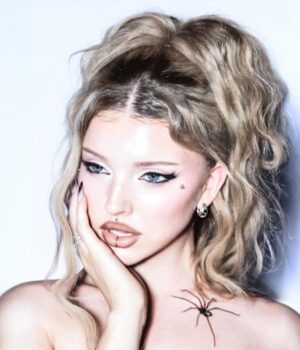
If R&B has been perennially overlooked in Australia, Larissa Lambert has been its best-kept secret. The 30-year-old has a voice so warm and vibrant it could melt your butter, fry your pancakes, boil your coffee – the full breakfast. It’s the kind of thing a religious person might call “a gift from God”. When did she know she had it?
“This is so cliche but, honestly, I knew since I could f—ing talk,” Lambert says with all the bluntness that’s made her a social media favourite. “I have memories of my family and people at school sitting around me being like, ‘do it again!’, and I’d sing a line and they’d be like, ‘whoa!’ So I knew, like, ‘I’m good at this’. There was no doubt about it. I had no plan B. I was like, ‘I’m gonna be a singer’.”
More than a decade into her career, with viral successes and plaudits from superstars like SZA and Justin Bieber to her name, she’s finally releasing her long-awaited debut album, Yearning. Filled with her effortless vocals, production flourishes that flitter between Y2K nostalgia and club trends, and writing that coolly probes her desires and insecurities, the album is a cohesive triumph. It begs the question: why did it take so long?
“I just never felt like I was ready,” says Lambert. “I was always like, ‘people are expecting so much from me’, so it needed to feel authentic. It needed to be me.”
Wearing black leather pants, her pierced septum gleaming, Lambert looks every bit the star as we speak in a room the size of a confessional in Virgin Music’s offices in inner-Sydney’s Chippendale. We’re barely 10 minutes into the interview when she begins to outline the harrowing challenges that, at least partly, skewered the timeline to her debut.
Three years ago, Lambert suffered psychosis following withdrawals from an addiction to prescription Valium. “My brain basically just went f—ing haywire. It took me a whole year to get back to normal,” she says. “During a psychosis, your whole world is flipped. I just felt hopeless. It’s f—ing scary.
“It’s like a panic attack on steroids. Everyone’s different with how they experience psychosis; some people can be aware they’re in it and some people can completely black out. I understood what was going on but you’re in an intense state of paranoia, you have intrusive thoughts, your moods are up and down. Writing was the only thing that was keeping me sane.”
She’d been through drug psychosis before, years prior when she was 22. “That was from an edible, actually, because even marijuana is a big trigger for psychosis. If your family has a history of mental health issues you should never touch it,” she says.
She’s more protective of herself now. “No substances, I’m 100 per cent sober,” she says. “I used to have a very addictive personality and I couldn’t say no, couldn’t turn down the party phase. Growing up, it was always like that.
“The music industry, artists, creatives – we’re so addicted to escapism, especially if you come from not the best upbringing. You tend to emotionally regulate through substances. In my case, that’s what it was. I never knew how to deal with my emotions, so I would smoke to get out of them or take some sleepers to mellow out.
“It’s so toxic, man, and it catches up to you. It caught up to me. So I’m 100 per cent sober, straighty-180 now. Maybe a little sip of wine here and there, but otherwise … I can’t, it’s not worth it.”
Lambert had been working at a pizza shop in her home town, Rio Bravo in Ballarat – “incredible pizza, one of my favourite jobs I ever had” – when she scored her first break. At 16, a scout from The X Factor, then airing on the Seven Network, phoned, inviting her to an artist development camp after seeing videos she’d posted on Facebook of herself singing on her bedroom floor. “I thought it was a scam,” Lambert recalls. “He was like, ‘we’ve got this camp, it’s $500’. I was like, you’re f—ing joking.”
After verifying the call was legit, she used funds she’d been saving to buy a laptop to accept the offer. Her boss at the pizza shop paid for her flights to Sydney. “He was a blessing,” says Lambert. At the camp, she was successfully recruited into the girl group Paris Inc.
“It was fun. It felt like training,” Lambert recalls of her time on The X Factor. “I needed it for my confidence. I used to be really, like, inwards. Being in the girl group helped me come out of my shell.”
In 2019, after Paris Inc split, Lambert received interest from the States; a girl who was working with R&B star Jeremih – famed for his DJ Mustard-produced smash Don’t Tell ’Em, still a barbershop staple – found her on Instagram and pitched her to the singer. “He took me under his wing,” says Lambert. “He mentored me about how the States works, the culture, the people, certain flows and how to add more pockets to my songs. I’m so grateful for him. He wanted to sign me at the time but I ended up turning it down because I wanted to stay independent.”
Even now, Lambert remains an independent artist. She must’ve had major labels chasing her for ages? “Oh yeah, I’ve had an offer from pretty much every single label, but it’s always just been a standard label deal,” she says.
What does that mean? “It means they’ll give you a label deal out of the 1980s where there’s nothing – literally, less than minus – in your favour,” she says, laughing. Her current arrangement with Virgin Music is a distribution deal, where she owns her masters and licenses them to the label for a set period.
“Virgin were the only label that respected me, understood the vision and listened,” Lambert explains. “With a lot of the major labels, you’re just another TikTok viral sensation they’re gonna sign, and if you pop off, you pop off. I feel like labels have lost the art of developing an artist.”
When labels approached her in the past, being a young artist, how did she know the deals weren’t in her best interests? “My intuition, I guess. It just never felt right.”
She pauses and recalibrates. “Actually, you know what it was? It’s because I went viral before I ever signed anything, so I started seeing my cheques!” she says with a laugh. “And knowing that a label would take 80 per cent of my earnings just to say they have me but not do anything for me? I was like, that is stupid, you’re not taking my money!”
Back in 2021, a cover she sang of SWV’s Weak went “stupid viral” on TikTok. “Someone from the Philippines, and Indonesia as well, they started a dance trend to it. All these different trends took off. It was like a tree branch. It just kept going.”
Lambert once said the viral cover made her “a lot of money”, enough to keep her career going. How so? “Well, I dropped the full cover on Spotify and then, you know, you make money from the master percentage. But then all the publishing obviously goes to SWV. So they made a good chunk off me, too!”
She’d lucked into the exact kind of virality record labels employ entire departments to manufacture. “Yeah, and you can’t,” says Lambert. “You can definitely make a song viral if you put millions of dollars into it but is it gonna stick, though? Authentic viral is so special but no one knows the f—ing recipe. If I did, I’d go viral every time.”
The experience gave her a unique insight into industry machinations, which was significant when record labels came calling. “They literally take 80 per cent of your earnings – it’s crazy! Like, how are you supposed to live? Off a tiny advance that’s supposed to last you three years? It doesn’t make sense. In my opinion, if you’re an artist and you sign to a label, you shouldn’t be working a nine-to-five. You should be able to put all your time and focus on your music and have an advance that will last you,” she says.
“But, like, it’s a risk on both sides because labels are also risking a lot of money on certain artists, so I get it. But that’s why I chose to stay independent with a distro deal, and I vouch for that for any up-and-coming artists as well. It’s good because it forces you to learn every angle, so you’re never getting taken advantage of.”
On social media, Lambert’s gift has earned praise from SZA, Bieber and Ty Dolla $ign, a case of game recognising game. Do such co-signs translate into anything tangible? “Like, does it bring people to me?” Lambert asks. “Oh, of course. Especially when they’ve shared my stuff, they put on so many new listeners. But just having the recognition from them is crazy. The fact that my idols are seeing me and appreciating me? It’s a huge pat on the back to let me know I’m doing something right.”
It makes it even more intriguing that she didn’t release her debut album sooner. Any other young artist would’ve been convinced to capitalise on the moment while there’s heat.
“I know, I look back and I wonder if I could have, but I don’t think it would have worked,” says Lambert. The key to unlocking her album, she says, was linking up with executive producer Khaled Rohaim. Rohaim – a Grammy-nominated Sydney producer who has worked with stars including Rihanna, Doja Cat and The Kid Laroi – had long had Lambert in his sights.
“He was trying to get me to leave the girl group when I was 17 and I was like, ‘who is this guy?’,” Lambert says, laughing. “I had no idea what he’d done but he actually has some of the most insane credits. Eventually I ended up doing a session with him three years ago, and we’ve been inseparable ever since.”
The album’s emotional through line lies in its title. “Yearning” is a term that has had a cultural blow-up this year, a buzzword that’s defined a generation’s pushback against the casual nonchalance of online dating. It’s also long been the central emotion in R&B, from Jodeci’s Feenin’ to Kehlani’s Folded.
“It’s about letting go of ego, bringing back authenticity and longing and openness,” says Lambert of her album’s message. “We’re in such a culture of being independent and being within yourself, and it’s toxic because we’re not meant to be like that. It makes people go insane and get depressed.”
She sees the album as an antidote to an era of dark, brooding R&B. “I feel like R&B went through a period where ‘dark love’ was trending, and I just kind of miss the cringe love song.”
Lambert has said Yearning “was created during a period of genuine clarity and inner alignment”. She’s reached a point in her life where she’s at peace and ready to tell stories she wasn’t comfortable with before.
“I was always worried about, oh, what if I tell people I’ve gone through psychosis and they’re like, ‘oh, little druggy!’ I think that’s why it’s taken me so long to have my debut album,” says Lambert.
“I just got so in my head. I started making songs for other people rather than the reason why I started making music in the first place, which was artistry and expression. But you’ve just got to get to a place of not giving a f—, and that’s when it all flows out.”
Larissa Lambert’s debut album Yearning is out now.