source : the age
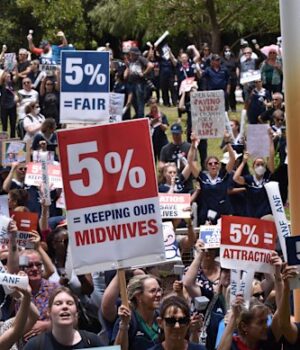
WA’s peak nursing union has warned of impending strike action after the organisation was told that nurse and midwife-to-patient ratios, due to be implemented by the state government this month, have been postponed.
The proposed rollout of the third phase of ratios was scheduled to be in place by September 21, but Australian Nursing and Midwifery Federation WA state secretary Romina Raschilla said members had recently been told the implementation had been rescheduled.
“Last Thursday we had a meeting with the chief nurse midwifery officer, and she advised us that the nurse midwife patient ratios that were due to be implemented on the 21st of September have been halted,” she said.
“This was going to affect over 90 wards in the metropolitan public hospitals, and it’ll affect a lot of nurses and midwives, and also a lot of patients.
“Our members are really angry. They want to strike right now, but there is a process that needs to take place.”
The third phase of the rollout was set to address particular wards, including geriatrics, some pediatrics, neonatal and other specialties, following the completed first two phases.
Raschilla said ratios assist with the care that is delivered to the most vulnerable people in the community.
“When that doesn’t occur, then the nurses and midwives have got more patients than they should have, and it is very difficult to provide that excellent care that each nurse and midwife wants to provide to their patient,” she said.
“If we decide to strike or rally, we will ensure that it is done in accordance with the Industrial Relations Act, and we will also ensure that our patients do not suffer because nurses and midwives do not want a negative impact on their patients.
“However, if this is the only way that the government will pay attention, respect, and not disregard nurses and midwives. We will do whatever we need to do.”
If industrial action goes ahead, it will be the first time WA nursing staff have committed to a work stoppage since thousands of members went on strike across WA in November 2022, with those at metropolitan hospitals gathering at Parliament House before marching to the health minister’s office at nearby Dumas House.
WA Health Minister Meredith Hammat said the government has been delivering landmark nurse and midwife-to-patient ratios and will continue to do so.
“I met with the Australian Nursing and Midwifery Federation this week and had a productive discussion about the next phase of the nurse and midwife-to-patient ratio rollout,” she said.
“The next phase will further expand the program to include Peel Health Campus, Murray District Hospital, Bentley Hospital, Kalamunda Hospital and Cockburn Health, and remaining metropolitan speciality medical and surgical wards, rehabilitation wards and emergency departments.”
Hammat said the wards represent some of the most complex clinical environments within the hospital system, requiring careful planning.
“This is a long-term, system-wide reform and it is important we take the necessary steps to get it right, for patients and for the health workforce,” she said.
“Patient safety will always be the highest priority in any decision relating to the rollout of ratios.
“It is also important that the needs of the health workforce are at the forefront of decision making, and our nurses and midwives can continue to provide safe care to the community of Western Australia.”
Raschilla said union members have little confidence in the government, and it is diminishing at a rapid rate, which is going to affect the healthcare provided for patients.
“We feel that we have been, as nurses and midwives, disrespected and disregarded, and we have not been given priority with the nurse and midwife patient ratios that should have been rolled out,” she said.
The proposed strike action comes as the WA Police Union launches a new campaign calling for public holiday penalty rates for officers ahead of the King’s Birthday public holiday on Monday.
WAPU spokeswoman Simone Taplin said police officers should not be treated differently when they are required to work on public holidays.
“Police officers don’t get to choose whether the community needs them on a public holiday. They turn up, put on the uniform and do the job,” she said.
“For many families, a public holiday means time together, a day trip on our roads, a family lunch or simply a day to switch off.
“For our members, it can mean another shift, another road trauma, another day away from their families and another public holiday spent keeping the community safe.
“And for doing that, they receive no additional public holiday penalty rate. That’s not the recognition our members deserve.”