Source : the age
The younger generation doesn’t want our stuff. Sorry, correction. Upon our demise, the children are happy to accept the house, the clapped-out car and the bank account (should there be anything in it) – they are less keen on the furniture, the crockery and the table linen. This is according to a recent report which, while British, rings uncomfortably true.
An auctioneer is quoted in the report: “A lot of the things baby boomers collected and treasured aren’t really worth a huge amount at the moment, and [they are] flooding the market at the same time.”
Jocasta and I are hardly “collectors”. We don’t have a lazy Jackson Pollock in the second bedroom. Jocasta lacks a Louis Vuitton handbag lurking in her top drawer. But surely our stuff is worth something?
The bookshelf we inherited from Jocasta’s father is beautiful, all dark wood and skilful inlays. As is the silver bowl we picked up two decades ago on a holiday in Mexico – probably fake silver, but it looks lovely, sitting there atop Max’s bookshelf. Plus, there are our dining table and chairs, built from Sydney blue gum by some bloke in Kempsey, the timbers so big you risk a hernia whenever you offer someone a seat.
Where will these things go when we die? According to the report: to the tip, to charity or sold off cheap. Younger people don’t like old stuff. They like new things, usually with a Swedish name from IKEA. The old stuff is too big and too dark for the smaller spaces they are now required to occupy. They need a sofa called a Spjütlägä, a chair called a Färklängër, and a table made entirely of lingonberries.
Perhaps, also, this generation has less interest in the past. I cheer on this idea, then remember my own lack of interest in my mother’s treasures. After her death, it fell to me to empty her home. The stuff was well-made, but not my taste. A sideboard of dark carved wood, topped with white marble. A grandfather clock, ticking away. A giant oil painting, featuring an outback scene of cattle and ringers.
Younger people don’t like old stuff. They like new things, usually with a Swedish name from IKEA.
I discovered that she’d taken out hefty insurance, as if every item was destined for the Louvre. Well, maybe not the Louvre. But the grandfather clock was, according to her, worth tens of thousands, as was the collection of British model cars collected by her husband. (Not my father. My English teacher. Long story.)
As it turned out, the most useful things proved to be her rusty old fridge and her dented washing machine. I dispatched them to my oldest son, then setting up a household in Victoria’s Wimmera. He wringed another 10 years out of them. The rest of the stuff was sold at auction, for amounts that would have reduced my mother to tears. The couch: $100. The treasured painting: not much more. And $300 for the fancy sideboard with the white marble top.
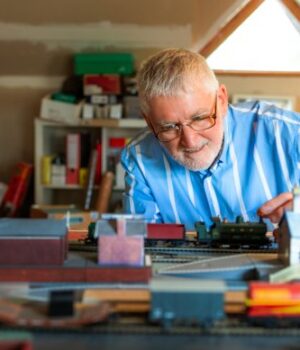
Even worse, from my mother’s point of view, was the complete lack of interest in the British toy car collection – insured, as I remember it, for $10,000. In the absence of an offer, I became the owner. They are now in my home. Being destroyed by my grandchildren. Please yell if you are interested in a 1960s Matchbox car with two missing wheels.
Will this be the fate of my own stuff? I’ve hatched a plan to create a list of all the important items in the house. I’ll take a photo of each item, explain its significance, and then send the file to my offspring.
Item: An abnormally large wax penis, which we’ve kept for over 45-years. It was a prop for the Joe Orton play What the Butler Saw, an amateur production of which was produced by Jocasta at the Australian National University. I walked past the theatre one day, popped my head in the door and offered to paint her sets. (Not a euphemism.) Anyway, that’s how the parents of these two children met, and so, when they throw the wax penis on the tip, as they inevitably will, at least they’ll know why we kept it.
Item: My dad’s Free French Medal. My father had some imperfections, but he was a gregarious and creative man. As a British Navy guy, he worked with the Free French, helped run a Navy newspaper in the Pacific, then visited Hiroshima just months after the bomb. Just because his ungrateful son wrote a misery memoir about his parents’ faults, doesn’t mean his achievements should be forgotten.
Item: A watercolour of a Papua New Guinean woman, drawn by a friend of my father’s, probably in the early 1950s. It has a wooden frame, and the mount – the area between the frame and the image – consists of reeds, beautifully woven. Here’s the thing: the reeds were woven by her, the woman in the picture. The wooden frame was made from the timbers of a WWII warship sunk in Port Moresby Harbour. My father told me these things, and I’ve told my sons, but it was a long time ago. I’m sure they won’t remember.
We all need to make a list. I’ve started mine. If you are of my vintage, maybe you should start yours.