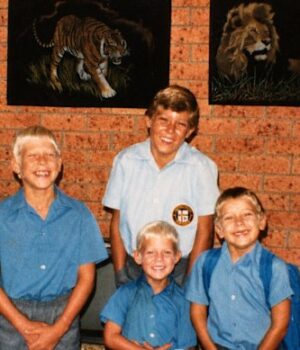
source : the age
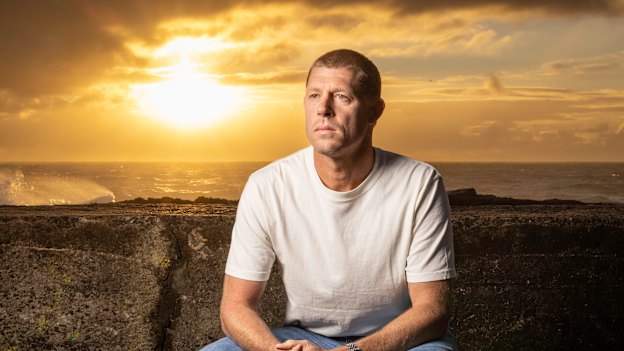
You really couldn’t script a more perfect moment for meeting Mick Fanning. A blazing sun rises from the watery horizon to the east, throwing golden light onto sandy Coolangatta, while a breezy, briny combo of spray and spit kicks up off the Pacific Ocean sky and into our eyes. A strange hippie woman is dancing and bellowing and smacking clap sticks together on the beach – she’s a regular here, apparently – while fishermen cast for bream off the big black basalt rocks on the headland. Oh, and there’s an old dude nearby smoking a very fat spliff.
This place – Snapper Rocks, at the quiet southern edge of the Gold Coast – is already putting on a show for us when a brush turkey struts through a clearing, an eagle arcs on the wind, and a rainbow – no, wait, a pair of rainbows? – beams down on Rainbow Bay (seriously), where fearless, frothing grommets carve lacerating turns into the famous point break.
Fanning, meanwhile, stands barefoot in jeans and T-shirt, blond stubble over anvil jaw – a study in coiled power – posing for a picture. And that’s when it happens – the ludicrous exclamation mark on this preposterously pretty scene. As his blue steel eyes lock in on the lens for the money shot, an enormous humpback whale breaches – right behind him – before smashing back down into the blue and sending a surge of foam skyward.
Fanning, now 45 and with smile lines betraying his years, offers a knowing yet grateful grin. “We’re so lucky. People travel all the way around the world for this,” he says. “But to me, it’s the place where I grew up, the place where I learnt my skills. It’s home. It’s a place to reconnect with Mother Nature, but also with yourself. A place where you just switch off.”
If anyone has earned the right to just switch off, it’s Michael Eugene Fanning. Don’t know his life story? Allow me to share the cinematic crib notes.
Once a bleach-blond quicksilver teenage surfer, he becomes a three-time world champion (in 2007, 2009 and 2013). Then in 2015, he punches a great white shark off the coast of South Africa. As you do. He becomes a meme – “Unless someone defeats ISIS with a boomerang,” went one tweet, “then Mick Fanning definitely wins Australian of the Year, right?” – but he also experiences recurring night terrors and triggering moments in the water.
Far more pivotal to his life story, however, is his family, much of which is taken cruelly from him. Fanning once had three big brothers – Sean, Peter and Ed – but all died early, after (respectively) a car accident, a heart condition and a badly infected wound. His dad, John, sipped his last Guinness earlier this year before slipping away, too. His sister Rachel lives overseas, but his doting mum, Liz, lives just down the road (thankfully).
Fanning’s been married and divorced – now remarried with two kids – and I’m wondering what an average day looks like after he cooks brekkie for the family, kisses wife Bree at the door, does the school run for son Xander, 6, and daughter Lyla, 2, then later ferries them between soccer practice and dance lessons. What does his middle-aged dream life look like?
“Being a fat old retired surfer!” says Fanning, laughing. “I guess I just want to show my kids the world that I had – seeing all the beautiful places, the beautiful cultures – and exposing them to how incredible life is.” But he also wants them to understand the importance of the values that helped him survive and thrive through tragedy and triumph. Namely kindness, and resilience. And heart. “You never want to be scared to take that unknown step,” he says. “You’ve only got one shot at life – you might as well give it all you’ve got.”
Everything starts with Sean. Ask anyone. Three years older, Sean was his closest brother both in age and temperament – his best mate and biggest supporter, too. “Don’t get a big head,” he used to tell little Mick. “Otherwise, I’ll come and bash it in.”
Liz points to a photo of them on the wall of her ocean-view apartment, arm-in-arm as kids, and then to framed images of her eldest sons, too. When Ed, 48, died in 2024, having cut himself on coral in Madagascar (then failing to recover from the infected wound), she remembers how Mick offered up a vulnerable and plaintive question: “Mum, is this going to happen to me? Am I not going to be here, too?” When Pete, 43, died in his sleep from a heart condition in 2015, she adds, Mick was again tender and beautiful – “Mum, let me make you a cup of coffee” – but he was also bereft.
Sean’s death was different. That particular grief was an ocean. Vast. Powerful. Bottomless.
Mick had grown up as the youngest sibling, the protected one – an affectionate, happy, athletic boy – and maybe even a bit of a sook. “He probably slept with me until he was 12 years old,” Liz says. “He just wanted to be with me.” Sean was his boyish ballast and source of confidence. “They were like two little peas in a pod. Very close, always,” she murmurs. “When Sean passed away, Mick spent one week in his room. He wouldn’t come out, he was so grief-stricken. Because they were always going to do it all together.”
Fanning opens up about Sean to Good Weekend on the lookout atop Kirra Hill, which looms over the town, but before he can dive into the memory, he sketches out their shared world below. There’s Point Danger to the east, and there – “See it?” – the apartment block with the blue roof where they grew up. He traces a line down the beach to where every Australian surf season began with what’s now called the Gold Coast Pro. “If you looked out on a competition day, that was just thousands of people lined up and celebrating. It was nuts,” he says, wistfully. “Then everyone would spill into the surf club and get raging drunk.”
Next comes Greenmount, Coolangatta, and down the cliff from where we’re standing, Kirra – “arguably in the top five waves in the world when it’s on” – then Bilinga, Currumbin, Burleigh, Nobbys, Broadbeach and finally, to the far north-west, “Gotham City”, meaning Surfers Paradise. And the biography behind the geography?
“Oh mate,” he says, shaking his head, “there’s a lot of ghosts in this town. Too many.”
Fanning gestures to the main street of Cooly: stay on this side of the road and you were safe, but cross after dark and things’d get gnarly. “Dingo” lived that way, he points, across the road from the old Pizza Hut, and “Parko” a few blocks away. And that road running perpendicular to the beach, one block inland? That’s where Sean died at 20, when Fanning was just 17. Later he points out the median strip where the car hit a tree, but right now, his eyes turn forward to a little memorial up here on the hill. Sean’s ashes are buried here, next to a stone surfboard and a native frangipani, flowering with little clusters of white and yellow petals.
“When it first happened, I would run up here every morning in the dark and water the trees,” Fanning says. “This has all changed, though.”
This was the place where “the Cooly kids” would party. If anyone in the crew won an event they’d put on a keg for the others, and the whole town would converge. In Fanning’s new memoir, he describes a New Year’s Eve up here only a year after Sean passed – passing a bottle of Bundy while watching the reflection of the fireworks on the seaboard. It’s well after sunset on the last night of the millennium, he writes, and it feels like we’re on the brink of something momentous.
When you meet him in person, a thing that stands out about Mick Fanning is just how little he stands out. Maybe it’s the black hoodie or the way he’s hiding under the bill of a green corduroy cap. He almost makes his five foot 10 (178 centimetres), 75-kilogram stature look like a conscious decision – an understated touch designed to disarm.
The frame fits the personality, too. He’s quieter and more gentle than you might expect. When summoning his old black mutt, Harper, he makes kissing sounds in the air, and she comes waddling to his side before drifting into sighing slumber at his feet. Good girl.
We sit at a cafe watching golden-haired grannies buzz up and down the footpath on electric gophers, and barefoot boys with soaked rashies amble past on the way to the board store. Fanning was once one of them, though perhaps not so carefree.
“Mick was just turbo-thrust into adulthood with the passing of Sean. That changed the dynamic of his existence,” says Ronnie Blakey, his manager, who was writing for Tracks magazine when Fanning came up. “He went from being a kid who was living his best life to someone who was suddenly burdened by this incredible grief.”
But it also grew inside him curiosity and empathy. He was the good listener on tour – the wise kid who found solace in the surf. “There’s a saying: ‘Only a surfer knows the feeling,’” says his longtime coach, Phil McNamara. “You have to understand the therapeutic nature of being in the ocean, often on your own, and the feeling you get when you’re struggling, just from making it to the end of the wave.”
He didn’t have long to dwell. Fanning joined the tour at 18 and found himself carrying boards down cobbled streets in Portugal, drinking caipirinhas in Ipanema and flipping out over the boardwalk freak show in Venice Beach, California. He started winning, too.
“It’s the best shit ever. Your heroes are ringing you up to go have a beer, and no one’s telling you you can’t,” he says. “It’s like going on school camp with no teachers. There were no rules.”
He did well to resist the worst of it, largely with help from McNamara, who preached a new type of professionalism by breaking the sport down into its quantifiable components. Focusing on wave selection and error elimination, McNamara kept tabs on the number of forehands and backhands he was surfing, and they would go hunting those conditions to equalise his practice count – basically hunting reps. Many were leery of the calculated approach – almost suspicious that trying too hard would ruin the instinctive magic of the act.
“Read that as this: there was an underlying drug culture and social malaise in surfing and Coolangatta that Mick and I were desperate to avoid,” says McNamara, who was often openly abused by other surfers on the beach for being a kind of sober “sellout”, as if he was spoiling the sport itself. “I wasn’t in that lifestyle – I didn’t drink – so I was a good foil for him, standing in as the bad cop: ‘The coach says I can’t go out tonight.’ ”
Fanning also found a new work ethic through injury after his hamstring was torn off the bone in Sumatra in 2004, necessitating a gory operation where they sliced his buttock cheek open, peeled it back and screwed a metal hook into his hipbone. The gruelling rehabilitation that followed demanded everything from core strength work to yoga. “It opened up this whole level I’d never been able to get to, because I never thought I needed that work,” Fanning says. “I finally figured out that this is what training looks like, this is what a diet looks like, and this is how it feels when you get up and surf after doing all of that.”
He’s had a few nicknames over the years. White Lightning for his bright blond teenage locks. Eugene – his middle name – for the excitable mayhem merchant he becomes after a few too many. The crew came up with another nickname for his newly robotic mindset. They called him Cyborg.
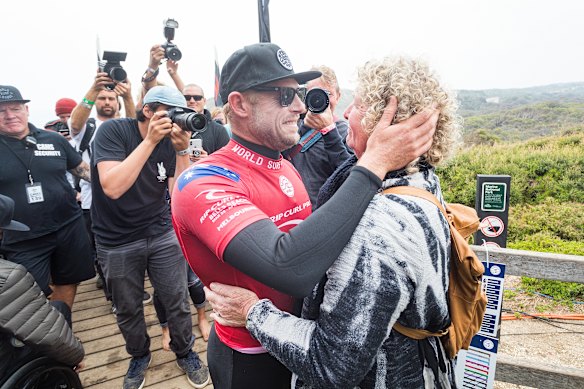
where he’d won his first major trophy 17 years earlier.World Surf League via Getty Images
His mum, a “Ten-pound Pom” who had worked long hours as a nurse before climbing into senior administrative hospital roles, took over his finances at his request. Joining him on tour, she also reminded him that brands weren’t just buying performance but association, encouraging him to consider what it means to be marketable. Yes, Mark Occhilupo was a world champion – but also a loveable comeback story. Sure, Rob Machado was one of the most stylish surfers ever – but his charisma extended beyond the water. She told him everything he needed to hear. “Don’t mess with her,” Fanning cautions. “She’s a powerful woman. We call her The Lioness.”
Finally, he had help from leading sports psychologist Dr Michael Gervais, the Californian author of Finding Mastery, who he began seeing in 2009. They practised breathing exercises and visualisation techniques – conjuring the sight of an approaching swell, the sound of a wave, the feel of water on skin. They also talked about Sean.
“I wasn’t there to have a cry, but I walked in and he just kept probing,” says Fanning, who realised he’d become adept at telling people the quick version – never loosening the knot enough to share his whole story. “I didn’t realise I was holding on to so much pain and grief,” he says. “I thought about the kind of things people tell boys, like ‘Be strong’, and I think now, to tell a 17-year-old kid who’s lost his brother to be strong, what the f— does that even mean?”
Surfing is a sport that lends itself to psychedelic hyperbole. It’s all monstrous closeouts and grinding slabs – thick lip pitches and bright blue drainers. Once in a while, man, you even fang it into a collapsing freefall – a cataclysmic detonation of wash. Yet none of that elicits the resonant fear of a single black fin.
When Fanning came face-to-face with a great white shark in Jeffreys Bay, South Africa, in 2015, it appeared to him as a dark shadow, then a splash. Next came a violent lurch and full-body panic.
In the viral video from that day, it’s hard to tell exactly what is happening but essentially, a three-metre predator bites into his leg rope and knocks him off his board, at which point Fanning begins flailing blindly. He’s hidden behind a wave in much of that competition footage, and this is the precise moment when reality really bites, when, underwater, he starts to yell and scream, punch and kick. The next thing you know he’s being ferried to shore on a jet ski. He looks composed, too, but that ride is one of maniacal laughter and nervous giggles, his pupils dilated into empty black holes.
He was, he says now, “shitfaced” on adrenaline and relief. On shore, people began hugging him and weeping, which is when the gravity of the moment – the cold horror of what almost happened – kicked in. He did interviews right away, because it was the quickest way to let family and friends know he was safe, and so the story went global. His phone began pulsing like a strobe light, practically melting down, and in the ensuing days he found himself hounded by crews from Europe and the US, the Middle East and Asia.
“He only did media to feed them something, so the story would die, but the attack of the media was almost worse than the attack of the shark,” says Blakey, who tried to manage the press. “They were insatiable. People camping in front of his house. The attention was so confronting.”
Then the dreams began – vivid nightmares back on the water, his legs dangling in damp darkness. Fanning woke regularly to the sound of his own screams, and the feeling of his heartbeat and cold sweats. He had PTSD.
“But I feel like I’ve done enough work to give myself the tools to deal with that emotion,” he says. “When someone else is attacked, it just reaffirms how lucky I actually was, and how lucky I am to have 10 fingers and 10 toes. But I don’t go out of my way to talk about it and make it my identity. I don’t want to be that guy.”
He made a few changes, the most public being to the colour underneath his boards, which used to be a specific fluorescent hue – “yum yum yellow” – which marine experts speculated might attract curious sharks. The biggest change, though, he says, was becoming statistically driven. “It happened, but what was the chance of that, what’s the chance of it happening again, and how does it compare to the chance of crossing the road and being hit by a car? I had to look at it that way. And after the initial shock, that was enough.”
Mick Fanning first surfed big waves – truly big ones – in Oahu, Hawaii. The water there is raw, with ocean storms generating giant swells that break with immense power over deathly shallow volcanic reefs. He has no shame in admitting that when he first saw such conditions, he freaked out. Completely.]
Hale’iwa is raging, he writes. A giant, surging, triple-overhead rip bowl that’ll just as quickly suck you out to sea as it will hold you on the inside and unload set after set directly onto your head in a never-ending impact-zone washing machine.
His coping method? “Get out into it,” he says. “Get the mind, body and equipment right, and a feeling that you belong. Then you have to paddle out, and it’s terrifying. There are people who just freeze. I didn’t.”
He says that probably comes back to his first game of footy as a five-year-old, when young Mick came up against a kid that looms in childhood memory as every inch of a six-foot-four giant. His brother Peter was adamant – “You’ve gotta go tackle him” – which young Mick promptly did, because the fear of his brothers ragging on him later was worse than a couple of stitches.
‘That’s life. It’s like a rollercoaster, up and down, and sometimes you do a few loops.’Mick Fanning
In time, he developed another method for psyching himself up ahead of such pulverising conditions. He’d get angry. Hot-headed. “I’d just start swearing at myself,” he says. “My Gemini kicks in and there’s one guy whispering, ‘Hold on,’ and one guy whispering, ‘Go you weak c—, go!’, and you’re to-ing and fro-ing between the scared one and the crazy one. You go into fight-or-flight, and I’d always choose fight.”
That wasn’t so simple, however, at the Pipe Masters event in Oahu in December 2015, chasing his fourth world title. It had already been a tough year, starting with separation from his wife, Karissa. The book goes into their split in some detail, not with prurience or bitterness but an open and elegant explanation for how busy people often drift apart.
“It was hard for me to switch off,” explains Fanning. “Even if we went on holidays, it was hard for me to enjoy drinking good wine or eating good food and, definitely, being away from the ocean. But there was no malice,” he notes. “If there’s a lesson, it’s that when you’re in the room, you’ve gotta be in the room. It would be the same thing for busy lawyers or FIFO workers.”
After the marriage breakdown came the shark attack; then, on the eve of the event in Hawaii, those psychotic North Shore waves maimed a trio of his mates in quick succession. Bede Durbige was thrown onto coral and suffered a broken pelvis and internal bleeding. Owen Wright was wiped out, too, the full force of the waves that hit him causing a traumatic brain injury. Young Floridian surfer Evan Geiselman was demolished, then rescued from the water by Fanning and others, before being taken to hospital limp, his face blue and blank. Then the news broke. Fanning’s brother Peter had died at home after his enlarged heart – caused by a hyperthyroid problem – gave out in his sleep.
Just to summarise, then. In 12 months, Fanning’s marriage ended, he was attacked by a shark, his brother died, and three friends were sent to hospital by the very surf he was meant to ride, while defending his world title. He got in the water anyway. “I just had this feeling I knew Pete would keep me safe, and that nothing was going to happen,” he says. “Then I went into this other mode: I am going to f—ing send it.”
As soon as he dived into the waves, it was the most confident he’s ever been when faced with that familiar terror. He didn’t get the title, but everything was easy and free-flowing and fine. “You grit your teeth and grind through it,” he explains. “That’s life. It’s like a rollercoaster, up and down, and sometimes you do a few loops.”
If that sounds a little mystic, superstitious or hippie-dippy, I’m sorry, but if it wasn’t already abundantly clear, I’m here to tell you that Fanning is a sentimental and spiritual soul.
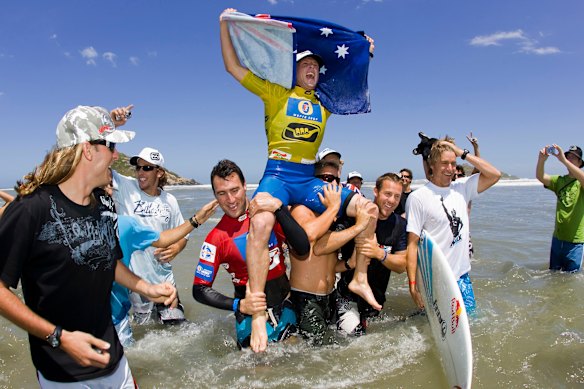
When he first started touring, for instance, he would head to Kirra Hill and pocket a leaf from Sean’s frangipani tree, put it in his wallet, then drop it in the water wherever he went in the world. He sees his brothers in flickering ceiling lights and slow sunrises. His mum’s voice trembles while telling me how, just before he won a world title in Brazil, a dolphin kept knocking up against his board: “When Mick came in from the win he said, ‘My brother was out there! I know it was my brother!’ ”
He’s seen a medium and sat with his eyes closed, imagining a ball of white energy shooting through the top of his head, where it turns into a fountain of raindrops. Every now and then he’ll be driving down the road and get sucker-punched by a brotherly memory, and other days he’ll summon those spirits himself, asking them for courage or a decent wave. He feels their energy every time. A crazy, cheeky life force from Sean. Calm confidence from Peter. Ed shows up to mess with his baby daughter, he thinks, keeping her awake. “Look, I’m not burning incense – not totally woo-woo – but I’ve always had this belief that energy stays. Always,” he says. “There’s no right or wrong way to heal.”
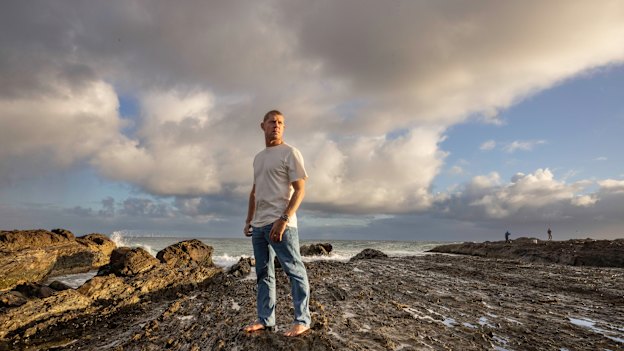
He thinks travel has a way of healing the soul, too. Makes sense. We wander the world for a sense of harmony and perspective, less to lose ourselves than to find ourselves – not to fall in love with places but with the version of ourselves those places make possible. Near the end of his career, an episodic search for the perfect wave (filmed by Rip Curl) became a critical form of self-soothing.
Once a control freak, Fanning was now a passenger on the most magical ride. He surfed choppy waves off the Cliffs of Moher in Ireland, icy slush ripples in Alaska (created by gargantuan blocks of glacier plunging into the sea), and at the dark mouth of a fjord in Norway, lit only by the twisting purple and neon green ripples of the aurora borealis.
Naturally, it grew harder to imagine resuming a life of press conferences and corporate keynotes. He had won three world titles, but the next competitor for him to chase and catch was the inimitable Kelly Slater, sitting on 11 titles, too far away. Still, giving up was tricky.
He would swear he was done and then every season would start right back at Snapper Rocks (his home break) before moving to Bells Beach (the site of his first major victory), creating an annual temptation to go again. And again. No one in his circle wanted him to quit, either. “Even I would semi-discourage him from retiring,” says Blakey. ” ‘Why don’t you take a few friends on the road with you? Why don’t you pick and choose your events?’ But he wasn’t built that way.”
He also began to realise the weight of all the barbecues and celebrations he had piked on or ducked out of early to train and compete. The cumulative personal cost was too great, because here’s another thing about Fanning: he’s a creature of community.
I spend two days with him and witness more than a dozen authentic interactions with people he knows and people he doesn’t. He’s polite and dutiful to a fault. A publicist fights with an umbrella and Fanning pipes up: “Need a hand?” A photographer struggles shifting a trolley full of gear and Fanning is there: “Need a hand?” A wet bench needs to be dried with paper towel, and you better believe Fanning is on the spot: “Need a hand?” (He never waits for an answer, either – just gets to work.)
He took that to the nth degree in 2022, when flooding swallowed the nearby Northern Rivers town of Murwillumbah – an entire landscape reduced to a brown, churning lagoon. Fanning and his mates spent a week on their jet skis, ferrying people to safety, helping a chemist deliver medications and bringing generator fuel to a local hospital, while their partners were on boat ramps preparing lunches and gathering donations. “It was this whole community of people putting themselves second,” he says. “Even though it was really tragic for a lot of people who lost everything, there was a lot of beauty in how strong community can be.”
He turned that effort into an annual golf day to raise funds for affected families, because if there’s something else Fanning knows well, outside of surfing, it’s money. He’s a multimillionaire, in fact, with investments in everything from a seaweed supplement for cattle (Sea Forest) to a sustainable dog food (Scratch). “The phone never stops ringing,” he says. “But I can be in as much as I want or out as much as I want.”
His earliest success was a pair of personally branded Reef sandals with a bottle opener built into the sole. He gets a small cut of every pair sold, thanks to his mum’s insistence. “I think they’ve sold about 7 million pairs,” he says. “That was a giant fluke.”
Then there was the craft beer Balter, an idea conceived in 2014 with a few mates, because … free beer for life sounded good? He did everything from mopping spillage between kegs to coming up with the name, along with a governing philosophy: no one is bigger than the brand. “Whether you’re a founder or first day on the job,” he says, “everyone gets treated the same.”
Balter was sold in 2019 to Carlton & United Breweries for about $200 million, leaving a question in the air for Fanning about whether to drift from business into sleepy, well-heeled retirement. “Do I want to be in an office every day, do I want to travel every day, do I want to do a podcast?” he asks. “I dibbled and dabbled.”
Dibbled and dabbled? Fanning has further interests in a protein powder and his own eco surfboards, not to mention diverse real estate holdings – plus sponsorships and ambassadorships into retirement. He quit surfing in 2018 and, one year later, Rip Curl signed him to a new 10-year deal, his appeal – and acumen – seemingly unmatched. “He knows when a good idea is under his nose,” says Blakey. “I don’t say no to anything on his behalf, even if I don’t like it at all.”
When we speak, he’s just finished a week filming a new American Express campaign, and the Land Rover Defender we’re driving through town – with his son’s shin guards in the front – is a loaner from a promotional day spent four-wheel driving around Stradbroke Island. If his wealth has a purpose, it’s creating experiences for his kids. “I don’t want them to be spoilt brats, but I want to give them core memories,” he says. “That’s the biggest driving force at the moment.”
He does that with his American wife Breeana, of course, who he met in 2016 on a trip to Las Vegas. They went back and forth a little online, and stole time between travels, and then she settled here. “It was one of those secret knowings,” Bree says now. “We both knew, but it was a slow burn.”
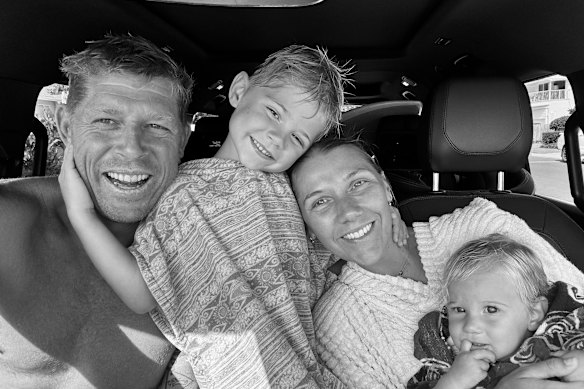
Theirs is an easy pairing. Her empathy and patience. His honesty and authenticity. Conversations flow effortlessly, whether surface-level or deep. Even their division of labour is harmonious. “I make sure the kitchen is clean every night, so we don’t wake up with a menacing pile of mess,” laughs Fanning. “But I ruin too many of her clothes, so I stay away from the washing and drying.”
Bree wrote the foreword to his book, too, noting that grief, grit and grace are the hallmarks of his life so far. “The loss of his brothers was his grief, but that gave him the grit to persevere, and now he channels it all through fatherhood and family to lead a graceful life,” she says. “He’s still learning what his mission will be, and I think he’s OK with that. Magic happens when the next chapter isn’t written yet.”
Magic for Fanning right now is taking the kids surfing. We sit high on the hill above Cooly now, watching the waves roll in at Duranbah Beach – D-Bah to locals – and he shows me a video on his phone of him and Xander cruising into shore. His little lad looks like a cape hanging off Dad’s neck and shoulders. Then he shows me a video of Lyla in the same spot, held up in his arms, in front of a wave, flapping her wings, pretending to be a superfairy.
Surfing is his constant but also his joy. He hopes it will be theirs, too – that they’ll love the same things he does, from the idea that no two waves are ever the same to the unique sensation of “surf exhaustion” when you step back onto the sand. “It doesn’t matter how you go into the ocean, you always come out feeling better,” he says, nodding. “It’s like washing the world away.”
All Heart by Mick Fanning (Simon & Schuster Australia) is out September 29.
Get the best of Good Weekend delivered to your inbox every Saturday morning. Sign up for our newsletter.
Read more from Konrad Marshall in Good Weekend: