SOURCE :- THE AGE NEWS
Washington: Journalists from three major news organisations, including cable news channel CNN, were locked out of the White House grounds and had their passes seized after President Donald Trump banned them because he dislikes their journalism.
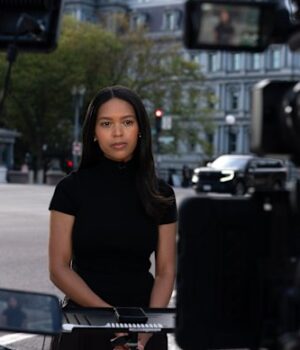
CNN’s Betsy Klein, MS-NOW’s Akayla Gardner and Politico’s Cheyenne Haslett were reporting from the streets outside the White House on Saturday (US time) after failing to gain entry to their usual on-site offices.
It came the day after Trump declared he was permanently banning the three outlets because they produced “purposely negative stories”, in a dramatic and potentially unconstitutional escalation of his war against the media, which he labels “fake news”.
The affected outlets are expected to launch a legal challenge imminently. Trump’s move also triggered broad condemnation from across the media sector, including the White House Correspondents’ Association (WHCA) and publishers such as The New York Times.
All three outlets reported that their staffers’ press passes were confiscated by Secret Service agents when they attempted to enter the White House grounds on Saturday morning. MS NOW said one of its producers was still able to enter the premises, however.
CNN’s Klein was broadcasting from the corner of 17th Street and Pennsylvania Avenue on Saturday. “We are going to continue to do our job whether it’s inside the White House grounds or right here at this intersection,” she said. “We can do our job anywhere.”
In a statement, CNN said its mission to report on the US government would continue regardless of attempts to restrict physical access to the White House or other government buildings.
“We have a right under the US Constitution to do our reporting without hindrance or interference from the government, and this ban is an illegal assault on this fundamental right,” the network said.
Jacqui Heinrich, the WHCA president and a White House correspondent for News Corp’s Fox News, said the revocation of access was a violation of the First Amendment and called for its immediate reversal.
“The implications extend beyond these organisations: a standard used to exclude one news outlet because of its coverage could be applied to any outlet in the future,” Heinrich said.
“The American people, through a free and independent press, must be able to scrutinise those elected to power, regardless of whether government officials view it favourably.
“That’s why courts have repeatedly held that once the White House provides access to journalists, it cannot deny that access arbitrarily or based on the content of their reporting.”
Trump signalled on Friday that he expected the ban to be challenged in court, and that he believed the result might depend on the particular judge.
“I don’t think that a court should allow fake news to be written day after day after day,” he said. “I think that somebody has a right to keep them away.”
There was no particular trigger for the sudden ban, Trump said. “It’s really just cumulative stories over the last few years. You get sick of it.”
The unprecedented ban is an escalation of Trump’s long-standing animosity towards the media, which he has deployed in multiple elections to paint himself as a victim of so-called “fake news”.
It comes just weeks before the midterm election, and in the absence of a White House press secretary. Karoline Leavitt departed the role last month and has not been replaced.
Politico reported the decision was made while White House chief-of-staff Susie Wiles was out of town, and blindsided the rest of the press office on Friday afternoon.
But there have been several precursors to a move of this magnitude. Last year, Trump attempted to ban the Associated Press from the Oval Office after it declined to rename the Gulf of Mexico to the Gulf of America, in line with his executive order.
And most mainstream news outlets no longer maintain a presence at the Pentagon after the Department of Defence required them to sign onerous new conditions. Defence Secretary Pete Hegseth said the outlets had “chosen to self-deport”.
Jose Zamora, American regional director at the Committee to Protect Journalists, said Trump’s arbitrary ban on the three outlets illustrated that he was not interested in a free press or protecting constitutional rights.
“His administration’s weaponisation of government agencies and access to target critical coverage must end, and journalists must be allowed to do their jobs free from retaliation,” Zamora said.
Trump said other news outlets could be banned, too, and named The New York Times and The Washington Post among those he particularly disliked.
A spokesman for the Times, Charlie Stadtlander, said the paper stood in solidarity with the other organisations being unfairly targeted by the president.
Get a note directly from our foreign correspondents on what’s making headlines around the world. Sign up for our weekly What in the World newsletter.
 Michael Koziol is the North America correspondent for The Age and Sydney Morning Herald. He is a former Sydney editor, Sun-Herald deputy editor and a federal political reporter in Canberra.Connect via X or email.