Source : THE AGE NEWS
Platina Resources has spent the past three years giving itself quite the makeover, swapping its former scandium ambitions for a sharper WA gold focus and progressively sorting through its exploration hand to decide which cards are worth keeping.
The transformation received a sizeable financial kick-start in 2023 when Platina sold its namesake Platina scandium project in New South Wales to mining heavyweight Rio Tinto for up to US$14 (A$19.7) million at current exchange rates, of which A$18.3 million has been received, giving the junior something every explorer covets: a decent war chest.
The proceeds have helped fund Platina’s gold push without repeatedly rattling the tin for fresh equity. Notably, the company is also entitled to a further US$2 (A$2.8) million from Rio, which is still due this year depending on a timing clause around the granting of Platina’s mining licence – now named Burra – to Rio.
The result has delivered a sharper proposition, increasingly concentrated in Western Australia’s prolific Laverton gold district, where the company’s Sunrise Bore, Mt McKenna and Mt Morgans South projects now form the centrepiece of its strategy.
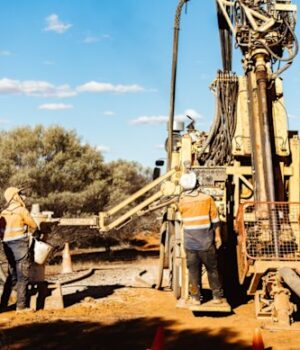
After completing a $1.15 million, largely scrip-based acquisition of the 11.59-square-kilometre Sunrise Bore gold project from private outfit Bravo Minerals in June, Platina wasted little time getting the rods turning. With the deal barely through the door, the company wheeled in a reverse circulation (RC) rig to give the ground its first taste of modern drilling since 1998, quickly putting runs on the board at its newest WA gold play.
And if the early results are anything to go by, the company should certainly have plenty to smile about. The maiden 23-hole, 2863-metre campaign delivered a hefty 29-metre hit at 3.38g/t gold from just 11m, including an 11m slice grading an eye-catching 8.62g/t, backed up by hits including 18m going 1.12g/t and a broader 37m intersection assaying 0.43g/t.
Hitting such promising numbers first up shouldn’t be a huge surprise given the company is hardly hunting in geological no-man’s-land. Sunrise Bore sits in serious gold company 45km south of Laverton. The broader district hosts AngloGold Ashanti’s multi-million-ounce Sunrise Dam operation 13 km away and Gold Fields’ 3.9-million- ounce Granny Smith mine. Closer historical deposits include Keringal at 450,000 ounces, Golden Delicious with 240,000 ounces and Jubilee, which produced 145,000 ounces of gold.
Although proximity to a mine should never be taken for granted, those ounces show the surrounding greenstones and structures clearly know how to carry gold.
Platina interprets Sunrise Bore’s mineralised zone as roughly 80m in true thickness and open down-dip, with a simple weighted average of current and historical intersections through the core area clocking in at 0.5g/t gold. There is an intriguing twist, though: the strong recent grades occur predominantly in oxide and could reflect supergene enrichment hiding a bigger orebody lurking below, making fresh-rock drilling an important priority.
Notably, plenty remains to test. The maiden drilling campaign covered only 200m of a broader 1.2km historically identified mineralised trend, which itself lies within a bigger 3.6km structural corridor. Impressive historical drilling included 78m going at 1.17g/t, featuring a 38-metre core of 2.13g/t, while another hole produced a 10-metre slice running at 5.31g/t within a broader interval of 20m grading 2.77g/t, reinforcing the prospect’s geological pedigree.
After electing to pivot away from scandium and sharpen its focus on the Eastern Goldfields in 2023, Platina also set about clearing the decks of its other non-core assets, including Xanadu in the Ashburton, Challa near Sandstone and Brimstone near Kalgoorlie. Xanadu was sold to Kalamazoo Resources after disappointing follow-up results, with Platina retaining a one per cent royalty and a potential $500,000 milestone payment, while Challa was relinquished after further work failed to justify continued spending. The still-retained Brimstone was farmed out to NE Minerals, which can earn an 80 per cent interest by funding the project through to a decision to mine.
For an explorer with money in the bank, the discipline to stop spending can be just as important as deciding when to start. Platina’s recent rationalisation looks a savvy piece of capital allocation: cut ground that failed to earn another dollar, preserve value where possible and redirect its own exploration firepower towards opportunities it believes can deliver greater scale.
With the portfolio reshaped, the treasury well stocked and Sunrise Bore already putting runs on the board, Platina’s next chapter is now about turning its carefully assembled gold hand into genuine scale.
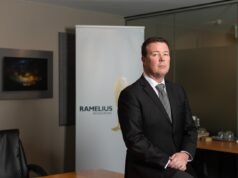
Charged with doing exactly that is geologist Dr Paul Polito, who took over as managing director from Corey Nolan in July. Nolan oversaw much of Platina’s portfolio transformation and the assembly of its current Laverton position, leaving Polito with the task of finding out just how much gold potential lies within it.
Polito brings more than three decades of exploration, geoscience, mine geology and development experience, including senior roles with IGO and Anglo-American Exploration. His arrival marks another stage in Platina’s evolution, from assembling and pruning its exploration hand to determining whether the projects surviving the cut possess genuine discovery scale.
And Sunrise Bore is not the only card in the hand. Platina’s 174-square-kilometre Mt McKenna project, 13km east of Laverton and 20km northeast of Granny Smith, provides another major prong of the company’s gold push.
Platina bought the gold project in September last year by acquiring 100 per cent of the shares in private vendor, Jasper Exploration. The deal comprised $320,000 cash, 20 million Platina shares and a 1.5 per cent net smelter royalty to Jasper. Platina can buy back half of that royalty at market value.
Since the acquisition, the company has carried out significant drilling. A maiden 26-hole air core program in late 2025 for 6000m was followed up with an even bigger drilling blitz in 2026. More than 10,800m of air core drilling across 220 holes outlined a mineralised corridor stretching one kilometre at the Granite Well East prospect, with hits including 1m at 7.1g/t from 40m and 4m at 1.11g/t from 12m. The company says follow-up air core drilling is now planned.
At two of Mt McKenna’s other prospects, Black Rock and Granite Hill, drilling added a 4-metre hit going 4.69g/t from 16m. Additional gold and arsenic anomalism point to a north-northeast structure that could support gold mineralisation extending more than 800m.
Several mineralised holes finished at or near the top of fresh rock, suggesting the shallow campaign has done its targeting job. Deeper RC drilling is now planned to determine whether the gold, structures and associated arsenic anomalism point towards something meatier lurking below.
As a vote of confidence, Platina was awarded $109,200 under the Western Australian Government’s Co-funded Exploration Drilling Program to support a planned 13-hole RC program at Black Rock and Granite Hill later this year.
The company has also recently added the 126.4-square-kilometre Mt Morgans South gold project to its Laverton hand, acquiring the ground from Genesis Minerals. Sitting 35km southwest of Laverton, the project lies in well-endowed gold country, close to Genesis’ Mt Morgans operations and its Westralia deposit, which hosts more than 1.4 million ounces of gold, while the nearby Jupiter deposit adds a further 740,000 ounces.
Platina acquired the 18 tenements for $100,000 cash and five million shares, with another $550,000 payable if a JORC gold resource of at least 200,000 ounces is defined. The ground includes a stretch of the regional Celia fault, although the project remains earlier-stage, with a review of historical exploration data and soil sampling still required to generate compelling drilling targets, along with executing a heritage agreement.
Beyond Laverton, Platina’s Beete gold project, near Norseman, contains prospective structures along an extension of the Norseman greenstone belt and sits 10km south of the one-million-ounce Scotia gold deposit owned by Pantoro Limited and Tulla Resources. Although an air-core program provided modest initial results, the company plans to undertake an RC program across selected zones and around the historical 24.8g/t Beete mine, subject to finalising native title requirements.
Rounding out the company’s assets is the Brimstone project, 40km northeast of Kalgoorlie, where Platina can keep a foot in the door while NE Minerals picks up the exploration tab. Under their joint venture agreement, NE Minerals can earn an 80 per cent interest by funding all exploration, evaluation and development expenditure through to a decision to mine, preserving Platina’s exposure without draining its own exploration kitty. Finally, its Jubilee project 15km east of Meekatharra in the prolific Yilgarn craton is subject to ongoing native title negotiations to establish a heritage agreement before the tenement application can progress.
Platina entered 2026 with $11.4 million in cash and still held a healthy $8.6 million at the end of the June quarter despite ramping up exploration and completing a string of acquisitions, allowing it to make the leap into full-time gold exploration from a position of financial strength. The additional A$2.8 million still expected to drop into the till from Rio will provide another handy fillip.
Three years after cashing in its scandium chips, Platina has tested projects, walked away when results did not warrant another dollar, preserved upside where it could and concentrated its own exploration spending around some of WA’s most heavily endowed gold country.
Sunrise Bore has supplied the eye-catching numbers, Mt McKenna has generated targets demanding a deeper look and Mt Morgans South adds another sizeable piece of prospective Laverton real estate.
Now it falls to Polito and his team to play those cards. With a healthy treasury, promising early gold hits and plenty of targets still to drill, the challenge is to turn three years of careful portfolio reshuffling into the kind of discovery scale Platina has been positioning itself to chase.
Is your ASX-listed company doing something interesting? Contact: mattbirney@bullsnbears.com.au