SOURCE :- SIASAT NEWS
Hyderabad: To walk on a footpath in Hyderabad is like running an obstacle course. You step on a pavement with broken tiles, avoid garbage and public urination on one side, find a way around a parked motorcycle, step onto the road where the footpath ends while dodging a speeding vehicle and scrambling back on what remains of a kerb, only to find a shop encroaching and blocking the way.
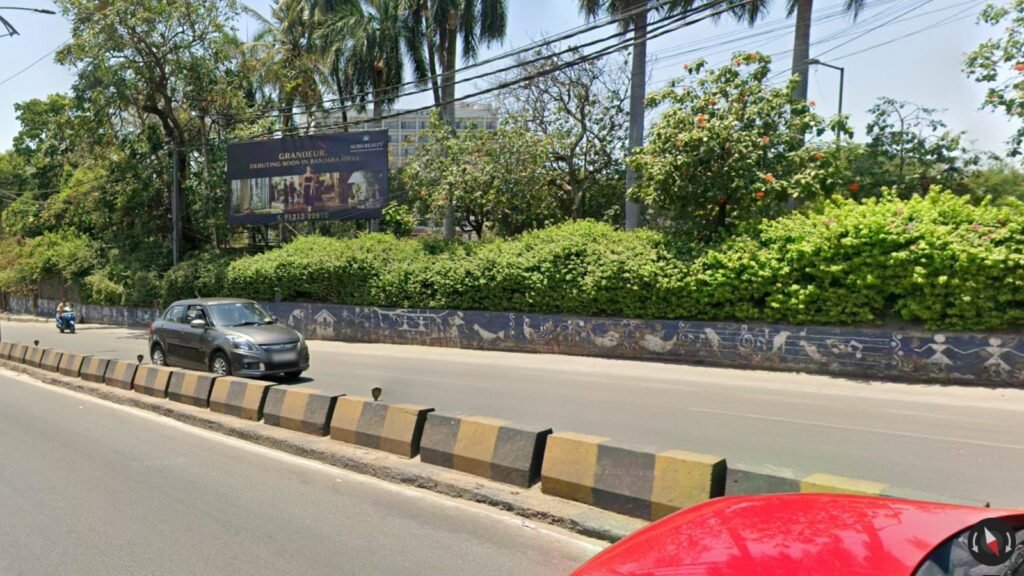
Take for instance the footpath opposite Bikanerwala on Road No 1, Banjara Hills, where it is more an idea than actual infrastructure. Anyone walking here only has access to a footpath for a very short distance from the last Meenakshi Lucknow store, after which a pedestrian has to step onto the road with oncoming traffic – a spot that leaves people thoroughly vulnerable to fatal accidents.
Over the last few decades, Telangana’s capital has seen a massive infusion of capital into urban infrastructure. Multi-level flyovers, underpasses and cable bridges have been rapidly constructed to ease vehicular congestion. Yet, the most fundamental unit of urban mobility – the pedestrian – has been systematically engineered out of the city’s design.


This inequity in urban planning comes sharply into focus following the Supreme Court’s recognition on June 19 of the right to walk on safe, demarcated footpaths as a fundamental right under Article 19(1)(d) (freedom of movement) and Article 21 (right to life).
On the ground in Hyderabad, however, that duty is mostly unmet.
An elitist blueprint
The absence of footpaths is not merely an administrative oversight. Urban planners and activists argue that it is a symptom of elitist policymaking.

“Walking was historically the most fundamental mode of transportation,” Dr Siddharth of the Sarvejana Foundation told Siasat.com. “However, with industrialisation, urbanisation and economic growth, motorised transport gained increasing importance because it enabled faster movement of people and goods, reduced travel time and supported greater economic productivity.”
This drive for economic productivity, however, has birthed an elitist infrastructure hierarchy in Hyderabad where pedestrians are treated last. Civic authorities prioritise easing vehicular congestion, a direct result of this lack of prioritisation for those on foot.
“Fundamentally, we are making more flyovers and new roads,” Kanthi Kannan of the Right To Walk Foundation told Siasat.com, who has been petitioning local bodies and the Lokayukta on this issue since 2009. “Footpaths don’t exist primarily because the powerful don’t walk. The people who use them are the poorest of the poor. They have no choice.”
What the numbers show
Data obtained by Siasat.com from the Greater Hyderabad Municipal Corporation (GHMC) shows it maintains 690.58 km of footpaths – 417.73 km on the left side of its roads and 272.85 km on the right – across six zones. Khairatabad has the most, at 229.8 km. Secunderabad has 172.36 km, Charminar 112.92 km, Golconda 108.15 km and Rajendranagar 63.81 km. Shamshabad has just 3.54 km on both sides of the road.

These figures cover only the GHMC as it stands after February 11, when the state government split the civic body into three. Figures for the new Cyberabad and Malkajgiri municipal corporations, which include the IT hub, were not available.
Official apathy
The city, however, misses a standard for footpaths. The Indian Roads Congress (IRC) guidelines for pedestrian facilities set a minimum clear walking width of 1.8 metres in residential areas and 2.5 metres in commercial ones.
GHMC Chief Engineer TS Jyotirmayi said such standards could not always be followed. “It is not possible to follow IRC standards while allocating footpaths. We have to keep in mind the viability,” she told Siasat.com. “There is so much traffic, we can’t always make wider footpaths,” she said, while acknowledging that pedestrians have the right of way and that footpaths would be built wherever a need was brought to the corporation’s notice.
GHMC Commissioner RV Karnan did not respond to requests for comment.
Bottom of the priority list
The hierarchy of road design in Hyderabad places the pedestrian at the absolute bottom. While authorities frequently blame street hawkers for encroaching on walking spaces, the reality on the ground tells a different story, said Kanthi.
“Hawkers have no role in this,” Kanthi said, pointing to the pub-lined affluent area of Road No 45 in Jubilee Hills and Road No 1 in Banjara Hills. Neither has hawkers and yet, footpaths are entirely absent or heavily compromised. Ironically, even the footpath leading to the GHMC headquarters in Lower Tank Bund is so narrow that it is almost impossible to walk on it.

Where footpaths did exist and serve high pedestrian volumes, they have inexplicably vanished. Outside the Mehdipatnam Rythu Bazaar, a heavily frequented area, footpaths were recently removed to widen the road, stripping away a safe walking zone for hundreds of daily commuters and shoppers. In its place came a skywalk at a cost of about Rs 38 crore, funded by the Hyderabad Metropolitan Development Authority (HMDA).

The larger encroachers, activists said, are showrooms and commercial establishments that spill onto pedestrian space. Eviction drives against them have been sporadic.
Clearing existing footpaths has stalled too. “The staff is busy with Special Intensive Revision (SIR) duties, that is why we have not been able to remove encroachments of late,” Bhavani, Chief City Planner, GHMC, told Siasat.com. She could not say how many encroachments had been removed this year.
The deadly cost of ‘fast’ traffic
The drive to keep motor vehicles moving faster has come at a severe human cost. “We now need to rebalance this approach,” Dr Siddharth said, citing the Supreme Court’s recent intervention.
“The need is evident from the data. Pedestrians accounted for 20.6 per cent of all road accident fatalities in India in 2024, which is approximately one in every five road deaths,” he said. Activists note that roughly 61 per cent of pedestrian deaths in the city occur at crossroads.
The victims are overwhelmingly male wage earners between the ages of 22 and 45. “Without insurance or a social safety net, a single traffic fatality plunges a working-class family into a vicious cycle of poverty,” Kanthi said. For women, the lack of pedestrian safety directly impacts mobility and economic empowerment. Without safe crossings, many are simply too scared to navigate arterial roads, limiting their access to employment and public transit.
Citizens habituated to walking on road
Footpaths alone will not fix it, Dr Siddharth said. A secondary challenge emerges here: behavioural conditioning. Years of poor infrastructure have habituated residents to walking on the road even when good footpaths exist. “Changing this requires strict enforcement against vehicle parking on footpaths and ruthless demolition of encroachments by commercial showrooms, which frequently hijack pavements for parking,” he said.
“The objective should not be to reduce the importance of motor vehicles, but to create streets where different modes can coexist safely, with pedestrians receiving the priority and protection they deserve,” Dr Siddharth noted, suggesting that roads only need a maximum of two lanes for cars, with a mandatory 3.5-metre width dedicated to pedestrians. He cited Chandigarh, where road space is shared more evenly among pedestrians, cyclists and motorists.
Kanthi aptly summarises the administrative apathy: “Those who decide do not walk, and those who walk do not decide.”
(This is the first in a six-part series focussing on Hyderabad footpaths and pedestrian infrastructure)
SOURCE : SIASAT