

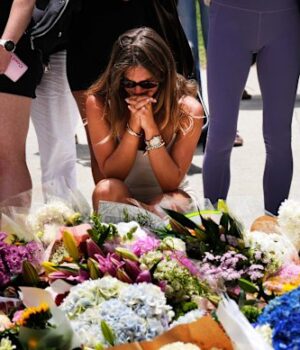
source : the age
There is a scene in Bondi Terror, my new book, which captures the invisible wounds. A father of two survived the Chanukah by the Sea massacre by shielding his infant son with his body, crouching behind a cement bench. As he peered out from the bench, he witnessed the moments when several of the victims, the oldest and least mobile, were murdered with headshots.
He then heard a man standing next to him say “he’s coming”, as one of the gunmen descended from the pedestrian footbridge and moved with weapon ready towards those prostrate on the grass, often on top of children, and those who had been unable to flee in time and instinctively dropped to the ground. Reuven Morrison hurled a metal bottle at one of the gunmen and shouted curses to distract him, allowing others to take cover or flee. Morrison then picked up the weapon dislodged by another hero, Ahmad Al-Ahmed, who had tackled the gunman.
This intervention cost Reuven his life but saved countless others. It delayed the gunman long enough to allow Cesar Barraza, on duty at the local police station, to run to the scene, and with his solitary Glock pistol, take out both gunmen with their cache of hunting rifles and shotguns. If not for Reuven Morrison and Cesar Barraza, the father and his infant son would probably have been picked off like the others.
When it all ended, the father had no physical injuries. What becomes of those with nothing to bandage, no shrapnel to remove and no surgeries to be performed? Who sees their wounds, and who heals them? Naturally, once the killing ended, the focus was to evacuate the severely wounded, triage and treat the rest. As a nation, we learnt the names of the 15 dead, we heard and retold their stories. We learnt too of the harrowing plight of the severely wounded who had shocking damage Australian doctors had never before seen.
We learnt of the greatness of ordinary people, the heroes like Boris and Sofia Gurman, the first to confront one of the gunmen, and Gefen Bitton, Ahmad and Reuven, who could have saved themselves but made decisions to move towards danger for the salvation of others. Gefen may not walk again. Ahmad has permanent injuries, and the Gurmans and Reuven surrendered their lives.
The father did not fall into these worthy classes of individuals, and so he was free and alone in the days after the massacre. He didn’t know where to go or what to do. Something drew him back to Archer Park, the killing site. He felt he had to go back. Late one night, in the pitch dark, he slowly manoeuvred around the park with its barbeques and playground and tall pine trees. He stood at the spot where he had crouched in what he thought would be his final moments. His mind ran strange hypotheticals. “What would have happened if my daughter was with me as well as my son? What would have happened if I wasn’t holding my son at the time of the first gunshot and I had to run to get him? What if I was in a different part of the park when it all began?”
As he was doing this, he noticed there were other people in the park. They were doing the same thing as him. Trying to make sense of what had happened. Trying to rationalise their actions, and most of all, understand why they were still alive when others were dead. “As soon as I sat down at the picnic benches where I had hidden, someone came up to me in the dark and asked, ‘Were you in the shooting?’ And in speaking to him, I learnt that he was the grandson of a man who was killed right next to me.”
Evan Zlatkis, my friend and colleague at the Executive Council of Australian Jewry, discharged himself from St Vincent’s Hospital the night of the shooting despite bullet fragments still lodged in his back. His trauma manifested in a refusal to relinquish his professional duties, insisting on updating colleagues and newsrooms even as he was stretchered from the scene. Psychologists would later tell Evan that burying himself in work was his way of restoring a semblance of control when his world had been upended.
Evan’s sister, Michelle, witnessed corpses around her and watched bullets fly past her husband as he shielded their two daughters with his body. After the shooting ended, she could still hear the cheerful holiday music that had been playing during the event, creating a perverse, mocking soundtrack to the horror.
“The sounds don’t leave you,” she says. “The sounds of Hanukkah music that never got turned off. It’s what we heard that day that ultimately sent us to the doctor for insomnia and anxiety.”
Alex Ryvchin is co-chief executive officer of the Executive Council of Australian Jewry.
Get a weekly wrap of views that will challenge, champion and inform your own. Sign up for our Opinion newsletter.
 Alex Ryvchin is the co-chief executive officer of the Executive Council of Australian Jewry and the author of Zionism – The Concise History.

