Source :- PERTH NOW NEWS
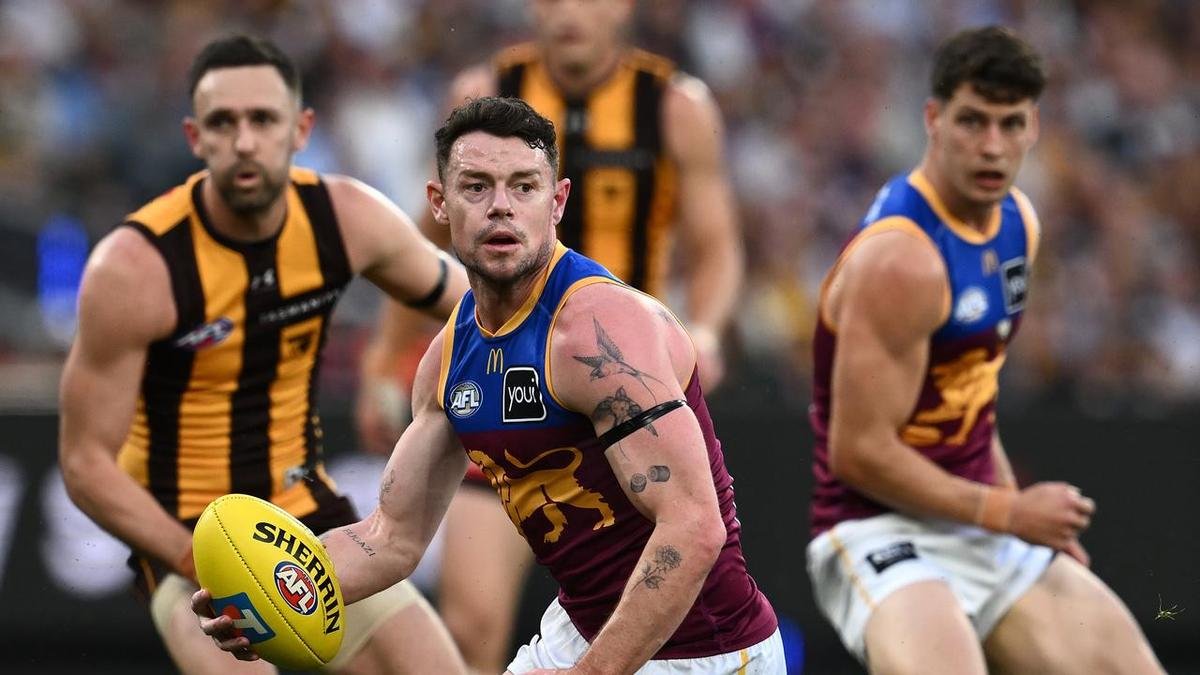
Finding Lachie Neale guilty was the easy bit for the AFL tribunal.
The hard part was whether to apply the ‘exceptional and compelling clause’.
As tribunal chair Jeff Gleeson KC noted at the end of a sensational four-and-a-half hour hearing on Tuesday night: “There are matters trending both ways on this issue.”
Gleeson and his fellow tribunal members, former players Darren Gaspar and Scott Stevens, decided not to enact the clause.
And Brisbane star Neale remains banned for the grand final against Fremantle.
Why? For many reasons, according to Gleeson.
There was Neale’s evidence, which Gleeson rejected as “inconsistent”.
Neale insisted he didn’t strike Hawthorn’s Jack Ginnivan during last Saturday night’s preliminary final.
“It was more a bump or body-check,” the dual Brownlow medallist said, adding Ginnivan “might have taken a bit of a dive to get a free kick”.
The tribunal didn’t buy it.
“We have listened carefully to Mr Neale’s evidence but we find it was inconsistent in key respects with what we saw on the video,” Gleeson said.
“And to that extent we do not accept it.”
Neale maintained his shoulder and chest made contact with Ginnivan; the tribunal found it was “a forceful blow delivered with a swinging arm and an open hand”.
The only video footage of the incident was long-range and, when enhanced, remained grainy – regardless of how many times it was played frame-by-painstaking-frame.
“It is the case that there is no single frame in the vision that shows Neale’s hand or lower arm making contact with Ginnivan’s abdomen,” Gleeson said.
“When played at normal speed, it appears clear to us that this was, to use the common vernacular, a strike to the guts.
“We are mindful of the significant consequences for Neale of this finding of intentional strike. But we find the evidence to be cogent.”
That’s the guilty part.
Now, for what Gleeson said was “the more difficult issue”.
Was using the exceptional and compelling circumstances clause justified to downgrade Neale’s penalty from a ban to a fine?
Introduced this year, the clause had been deployed once: to downgrade a one-game ban to Collingwood legend and the AFL’s games record-holder Scott Pendlebury, to a fine.
Neale wanted it applied to him.
But, as Gleeson noted, Pendlebury was charged with rough conduct. Specifically, graded as careless conduct, medium impact, and high contact.
Neale was charged with striking. Specifically, graded as intentional conduct, medium impact and body contact.
Gleeson narrowed on the difference between conduct gradings – Pendlebury’s careless; Neale’s intentional.
Then, there was Neale’s record which his barrister – the AFL’s former football operations boss, Adrian Anderson – compared to Pendlebury.
Until March, the Pie great had never fronted the tribunal or been suspended in his 21-year career.
Until Tuesday night, Neale had never been banned in a 15-year career including two Brownlow medals, six club champion awards, and captaining the Lions to two premierships.
But as the AFL’s counsel Andrew Woods KC pointed out, Neale had previously been found guilty of offences eight times – three of them, for striking the body of opponents. But he’d never been suspended.
“This is not the first occasion on which Neale has been found to have struck his opponent,” Gleeson said.
The tribunal chair also noted the purpose of the AFL’s so-called gut-punch law, also introduced this year. Nine other players had been banned for the offence this season.
“The purpose of the guideline is to stamp out this very sort of conduct. Neale ignored it and he knew the consequences,” Gleeson said.
“Being of Neale’s outstanding record does not render a one-match suspension for that act inappropriate or unreasonable.”