Source : the age
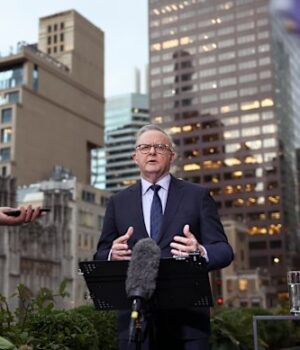
New York: Anthony Albanese will declare the post-1945 international order “no longer fit for purpose” and warn that Australia must help shape what replaces it as growing strategic competition between the United States and China transforms the Indo-Pacific.
In a major foreign policy address in New York, the prime minister will argue that the assumptions underpinning the global system since the end of the Cold War are being tested, forcing middle powers such as Australia to build new partnerships while defending the rules that remain essential.
“Since the end of the Cold War, the prevailing assumptions of international affairs were clear: openness was security; efficiency mattered more than resilience; and international rules would be observed as a matter of course,” Albanese will tell the Atlantic Council’s Global Citizen Awards dinner on Wednesday night, where he will be honoured alongside Finnish President Alexander Stubb, Formula One chief Stefano Domenicali and actor and singer Cynthia Erivo.
“Both those expectations are now being tested. The post-1945 world order is no longer fit for purpose. Universal institutions that remain necessary are now not always sufficient for the challenges we face.”
His speech carries echoes of the message Canadian Prime Minister Mark Carney delivered nine months ago at the World Economic Forum at Davos, Switzerland, where he said the “old order is not coming back” and urged fellow middle powers to unite to find a new way.
Albanese will meet with Ukrainian President Volodymyr Zelensky on Wednesday (New York time), where the two countries are expected to sign a bilateral security arrangement.
As US President Donald Trump and Chinese leader Xi Jinping prepare to meet at the White House on Thursday, Albanese sought several leaders of middle power nations, including Britain’s Andy Burnham, Canada’s Mark Carney and France’s Emmanuel Macron, to help build consensus on several issues, including the rise of artificial intelligence.
But efforts appear to have been fruitless, as Trump very publicly rejected the push from more than 20 leading economies several times in his UN address, saying he was interested only in the economic benefits of winning the technology race, and not regulating AI’s capacity.
Albanese was also at loggerheads with the Trump administration, which has condemned Australia’s plans to overhaul social media algorithms and regulate perceived harmful content. In a submission to the Albanese government, the US embassy described the reforms as “facilitating censorship”.
“It’s not about giving government control; it’s about giving people back control over what they receive on their devices, which is why it is framed in that way,” Albanese told journalists in New York.
The prime minister later met Trump at a UN leaders’ reception, posting a picture of the pair on his social media platforms saying it was “always good to catch up” with the president.
There is growing discontent within the group of middle powers at the lack of progress towards peace in the Middle East, Trump’s war against Iran, and Russia’s continued aerial bombardment of Ukraine after nearly five years. Several experts, including former prime minister Kevin Rudd, have also warned about the increased risk of conflict in the Indo-Pacific over Taiwan in the coming years.
Albanese will use his speech to set out a vision for Australia to help build a new international order rather than simply respond to the changes under way.
“Australia’s response to this is to actively seek to shape and build the order that replaces the old,” he will say, while preserving “the rules that matter most” and creating new partnerships and relationships.
The prime minister will identify the strategic competition between Washington and Beijing as the “most consequential factor” shaping the Indo-Pacific, while rejecting the idea that the region should be viewed solely through the prism of the two superpowers.
“Our alliance with the United States is the anchor of Australia’s foreign policy,” Albanese will say. But he will also reaffirm his government’s approach to China, Australia’s largest trading partner, saying the country would engage in the national interest.
“How Washington and Beijing manage their relationship matters profoundly,” he will say. “But it cannot be the only lens through which we see the region.”
“The Indo-Pacific is not a chessboard on which superpowers move the pieces. Its countries are not spectators. They are shaping its future and writing their own script.”
Albanese will argue that the upheaval of recent years, including war and the pandemic, has exposed the vulnerabilities of supply chains and forced governments to put resilience alongside economic efficiency.
“Governments must build the capacity to withstand shocks they did not cause and cannot control,” he will say.
That will include strengthening Australia’s sovereign capability while working with partners on economic security, critical supply chains and energy.
The Atlantic Council dinner is one of the high-profile events of UN General Assembly week, with more than 700 senior government, business, military, media and civil-society figures expected to attend.
Albanese is being recognised by the Washington-based think tank for his role in strengthening Australia’s alliances and partnerships and promoting security and stability across the Indo-Pacific.
His speech places particular emphasis on Australia’s expanding network of partnerships across the Indo-Pacific, including its relationship with ASEAN and a growing web of security agreements with Pacific nations.
He will describe the Pacific as “both a home and a family to Australia” and say the region’s priorities, sovereignty and culture must be respected.
“For our Pacific neighbours, climate change is the most immediate security threat,” Albanese will say.
The speech will culminate in a concise formulation of the government’s foreign policy.
“Building resilience without abandoning openness,” Albanese will say. “Strengthening regional partnerships without abandoning rules.”
And Australia would deepen its alliance with the United States and engage its largest trading partner, China, “without allowing either relationship to define who we are”.
“In an uncertain world, leadership means showing up for one another, sharing burdens and giving our neighbours greater power to shape their futures,” he will say.
Cut through the noise of federal politics with news, views and expert analysis. Subscribers can sign up to our weekly Inside Politics newsletter.
 Rob Harris is the national correspondent for The Sydney Morning Herald and The Age based in Canberra. He is a former Europe correspondent.Connect via email.