Source :- THE AGE NEWS
For the best part of an hour, the only sound was Wayne Bennett’s voice.
Few can command a room quite like the master coach, and those who had come to hear him speak about his remarkable life in rugby league, at a charity lunch for the Cure the Future foundation at Doltone House last December, were hanging off every word.
Bennett always makes you lean in to listen. On this occasion even more so, partly due to the subject but also the fact that the PA system barely carried his voice across the room.
“There was a point for a week or two where I didn’t want to coach any more. I really didn’t,” Bennett said. “I felt I didn’t have it in me.”
Bennett was talking about his time in Newcastle, specifically the fallout from the catastrophic injury Knights forward Alex McKinnon suffered in a tackle against Melbourne in 2014 that left him a quadriplegic.
It’s a moment that almost broke Bennett. And the club.
There have been many dark days at the Knights since their last premiership in 2001. There have been five wooden spoons, a turnover of seven coaches and enough turmoil off the field to the point that, at one stage, there were genuine concerns the Knights could fold.
It took the intervention of the NRL, and then the Wests Group, to secure Newcastle’s future after mining magnate and owner Nathan Tinkler left the club on the brink of collapse.
Every NRL club has its dramas, but the Knights have had more than their share over the last quarter of a century. Their two premierships came with Andrew Johns at the helm, but replacing an Immortal – perhaps the greatest halfback of them all – would prove impossible.
When the class of 2001 moved on or retired, they were never adequately replaced. Not all of those to subsequently wear the jersey represented it appropriately, with Dane Tilse, Danny Wicks, Russell Packer, Zane Tetevano and Jarrod Mullen all sacked over off-field matters.
The high point was the 2013 preliminary final under Bennett, but no one could predict what was to come. The Knights lost to the Roosters, Danny Buderus retired and Packer was punted before the first day of pre-season, for a drunken assault that resulted in two years behind bars. Things didn’t get much better once the football restarted the following year, with Mullen pinging his hamstring and Darius Boyd checking himself into rehab.
Worse was to come when McKinnon suffered his life-changing injury, at a time when Tinkler stopped paying his employees.
You know a club is broken when seven-time premiership coach Bennett, unable to fix it, walked away prematurely.
All of which makes the club’s resurrection, just a season after finishing last, all the more noteworthy. It’s one nobody saw coming.
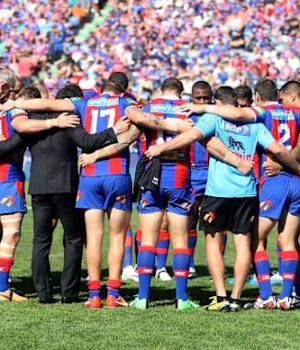
at a press conference for the Rise for
Alex Round in 2014.Kate Geraghty
It happened on the watch of recycled coach Justin Holbrook, whose own playing career as a halfback at the Knights was restricted to five appearances due to Johns’ presence.
“It’s a stable roster just waiting to be coached,” Holbrook said after replacing Adam O’Brien.
The only notable addition to it was Parramatta playmaker Dylan Brown, who required a $13 million contract to lure him to the worst team in the competition. After rupturing his ACL following 15 games for the Knights, his absence has been felt as much as his presence. Yet despite that and countless other injury setbacks, Holbrook’s heroes have somehow progressed all the way to Sunday’s preliminary final against Penrith.
They have done so playing a brand of football that has resulted in them scoring more tries from their own side of halfway than any other team. Kalyn Ponga has been at the forefront of it all, producing form every bit as stunning as during his storied run to the 2023 Dally M medal.
Which is why, after years of questions about his loyalty, the captain recommitted to the club long term.
“Obviously it’s about the community and the people within it,” Ponga said of the decision to stay put. “I didn’t want to leave that. I just thought there was an opportunity to win here.”
Suddenly, a club that didn’t know how to win doesn’t know how to lose. Newcastle took out the Harold Matthews premiership, made the SG Ball decider, finished runners-up in the Andrew Johns Cup, and made the preliminary finals in the NSW Cup and Laurie Daley Cup tournaments. When the Australian Schoolboys side was named there were six Knights, more than any other club.
And the NRL side isn’t content with what it has achieved so far.
“The belief’s there, it’s exciting times,” said star centre Bradman Best. “We’re here to do special things.”
The “one team, one town” philosophy was on full display during an open training session on Wednesday. About a thousand Novacastrians skipped school or work to witness preparations for the Panthers clash.
Theirs is a team that embodies their working-class values, yet still has the flair required to progress deep into September. Like Johns, Fletcher Sharpe is the son of a local coalminer.
“During pre-season [the team] went down and spent a bit of time underground,” Sharpe said. “It was a unique experience, but one that puts into perspective how lucky we are. And it’s something we’ve spoken about all year – getting into the community and making them a part of the club and the team, and going out there on a weekend and representing those guys.
“I tell you what, it’s not something I could do every day, going down there and working under there, so it makes you super grateful for the position that you’re in, getting to go out there on the weekend and hopefully playing a style of footy that represents them. I think we’ve been able to do that this year, which is good.”
Johns, who was pessimistic about the team’s chances when its campaign kicked off in Las Vegas, has become a believer.
“A few months back, I found myself thinking about it, and I honestly thought ‘when are we going to compete for a grand final again? Is it going to be in my lifetime?’ That’s what I was thinking, honestly,” Johns said.
“But then watching this team and the way they’ve improved, it’s given everyone hope. If not this year, then in the next couple of years, without a doubt. There’s a premiership window and it’s open.”
The seeds of the revival were planted early in the pre-season. Holbrook and his two assistant coaches, Brett White and Steve Hales, spent more than two months living together in a three-bedroom rental on Bar Beach. It was there that they devised an attacking brand of football that has taken them all the way to the penultimate game of the season.
“When you look at the strike we have in our team, we have threats all over the park,” said winger Dom Young.
“It doesn’t matter where we are on the field, we’re always ready to strike and that has made us exciting to watch.”
In 2001, the Knights were also underdogs coming into a finals series that featured a white-hot Parramatta side that was every bit as dominant as the current Penrith one. Few gave Newcastle a chance, but a Johns masterclass resulted in them winning their last premiership. Hope is growing that Ponga can lead them to their next one.
“I’m excited, but nervous as hell,” Johns said. “It’s funny when you’re playing, you don’t feel any of it. None of it. Because the game is in your control.
“But when you’re a fan, it’s out of your control. And because of that reason, and you mentioned all the hardships, it makes it even sweeter because there’s been so much pain over the years. When Newcastle win, lose or draw on Sunday, I’m just so proud of everyone at this club.”
with Dan Walsh