

SOURCE :- THE AGE NEWS
Beijing: There’s a saying in the Chinese capital: if you fall on hard times, try your luck in Majuqiao.
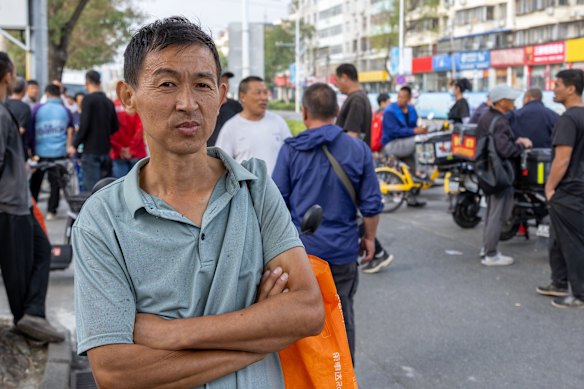
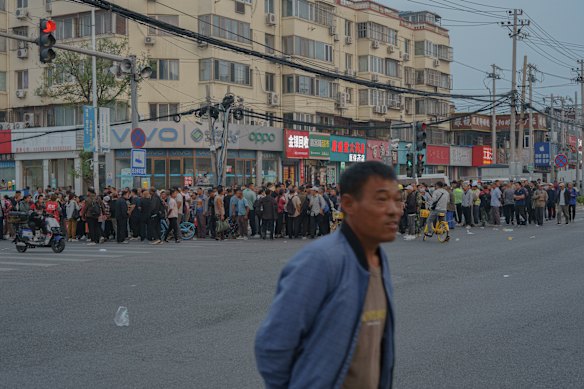
As daylight breaks over the city, dozens of day labourers are lingering around the main intersection in Majuqiao, a low-income neighbourhood in Beijing’s south-eastern fringe.
Some still hope to pick up work for the day, even though the morning peak for hiring has passed.
“I’m looking for a low-skill job such as carrying bricks and spreading mortar. I haven’t got one yet,” says Zhang (not his real name), 55, who originally comes from Shandong, a province south of Beijing.
“Work is getting harder and harder to find, and income is getting lower and lower. For example, I got paid 270 yuan ($56) a day on average last year, but only 200 to 210 yuan this year.”
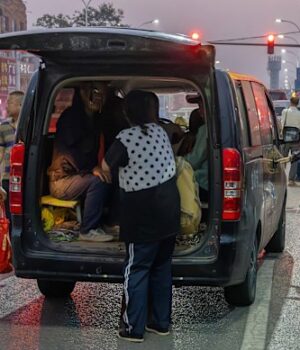
This junction, on Majuqiao’s main commercial street, is Beijing’s largest temporary labour market. It begins heaving about 4.30am daily, as recruiters offering shifts in factories, on construction sites or in parcel sorting zip by in minivans, shouting daily pay rates until they find their quota of workers.
Most people here are migrant workers from nearby provinces – a term in China that refers to the tens of millions of farmers who leave the countryside searching for better-paying jobs in cities.
Many are men aged over 45, already deemed too old by harsh and arbitrary age restrictions imposed via more formal recruitment channels.
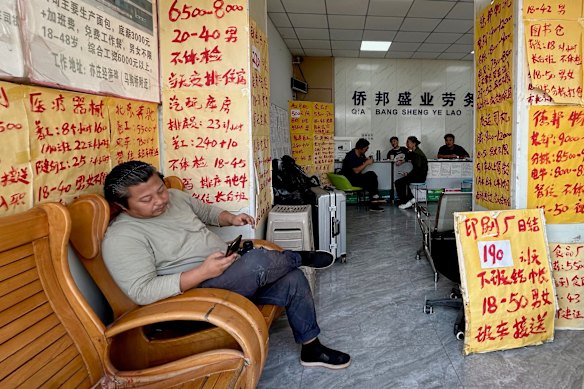
Job ads written on pieces of paper hang in agency shopfronts in the centre of Majuqiao, spruiking roles such as work in a honey factory for adults aged under 43, and shifts in a military industrial factory for people aged 20 to 36.
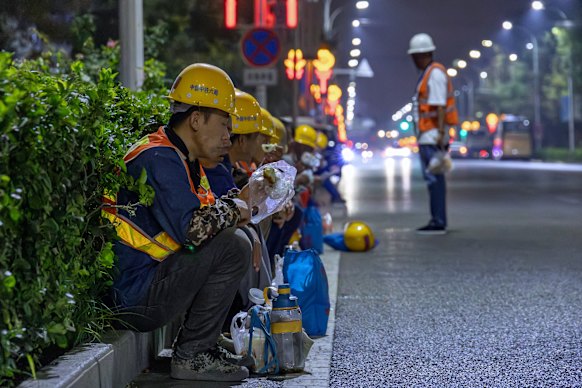
Coming to the Majuqiao market is a way to gauge the economic reality of ordinary people at the bottom of what analysts increasingly refer to as China’s K-shaped economy.
Some economists suspect the official government statistics are underselling the country’s gloomy domestic outlook even as exports boom and China’s AI-powered robotics and high-tech industries race at frenetic speed (the upper half of the K).
Data from August paints a bleak picture of an economy still dragged down by its property market bust in 2021, which tanked the main source of middle-class wealth, fuelling a collapse in consumer spending that has ricocheted across the economy. Property investment has plunged by 20 per cent this year, continuing a long decline, while retail sales have been stagnant at 0.4 per cent, and youth unemployment has hit a year-long high of 18.9 per cent.
Our visit to Majuqiao is illustrative in another way: a reminder of the challenges for Western media in reporting on sensitive issues in China (which the economy has become), and the self-censorship that occurs as people weigh up what they can and can’t say.
This stifles much of China’s public conversation about anything with a political undercurrent, against the constant refrain of authorities denouncing foreign actors who “smear” the nation, and expectations of positive media coverage.
As we walk along the main strip, one man who appears intrigued by our presence and open to speaking with us suddenly changes his mind, querying whether I am a spy.
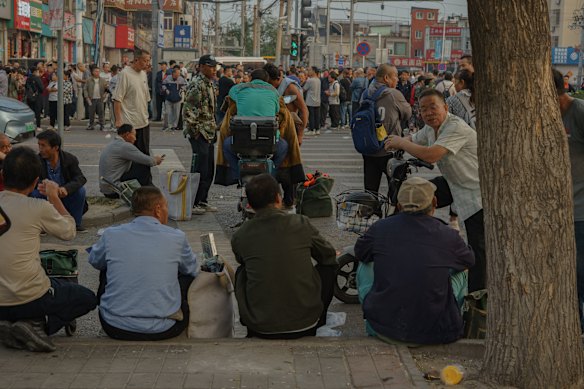
We meet Zhang on a side street where a medley of the day’s unsuccessful job hunters are milling beneath a venue ironically called the Rich Club, a dilapidated electronic music venue that seems to be under renovation.
“Don’t say too much!” one passerby yells, as my Chinese colleague and I are quickly surrounded by a dozen or so labourers while we talk to Zhang.
Few Westerners come to this part of Beijing, and the mood grows tetchy as their curiosity mixes with suspicion about our motives.
What happens when they cannot get work for the day, I ask.
“It means you just have no food to eat today. It’s a very realistic thing to say, right? China’s overall economic environment is not good right now,” one worker responds.
Midway through our conversation, Zhang receives a call from someone who warns him to watch what he says to the foreigner, lest it paint a negative picture that could have consequences – though exactly what those might be is unclear. He hangs up slightly chastened, and asks if we understand the Chinese system, where the imperative is to report positive stories.
“No one watches Xinwen Lianbo nowadays,” he says, referring to China’s flagship state television news program broadcast across the country at 7pm.
“You’re not allowed to tell the truth,” he adds, urging us to walk around the neighbourhood and see for ourselves before he hurries off, declining to give his name.
We take his advice and wander Majuqiao’s rabbit warren of narrow alleyways lined with cheap eateries, dormitories and bedsits that fit little more than a single mattress. The streets are remarkably clean, with barely a cigarette butt on the footpath, a sign that authorities know the benefit of ensuring living standards are maintained as much as possible, especially during tough times.
Still, a number of homeless people are asleep on public benches, which is a rare sight in Beijing. A few people loitering in the street are noticeably drunk at 7am.
“When people run into difficulties, they tend to come to Majuqiao as a temporary stop, a transition,” says Yang Zaiqiang, 43, of Hubei province in central China. Others like the flexibility and getting paid daily, he adds.
“You can find all kinds of people here, and it can be quite chaotic.”
There were many jobs going this morning, Yang says, but the pay was so low for exhausting work that it wasn’t worth it. He pulls out his phone to show his bank balance, revealing a small buffer of savings he can fall back on while holding out for better-paid gigs.
“For some jobs, you need to work 12 hours, and they only pay 180 yuan ($38),” Yang says. “You can’t really save much money living here.”
Before coming to Majuqiao a month ago, Yang was working as a day labourer in Wuhan, where he says recruiters would offer hourly rates as low as 16 yuan ($3.40). But there’s a reason for so many farmers to leave their villages.
“You have to farm a lot of land before you can really make money,” Yang says.
This is just a snapshot of the precarious existence faced by millions of China’s lowest-paid workers. But it aligns with the insights recorded by Cong Rui’an, a PhD student at Beijing’s elite Tsinghua University. Cong spent eight years regularly taking gig work at Majuqiao to study worker conditions before publishing a book on his research this year.
“There are still plenty of jobs in Majuqiao, but fewer and fewer of them are worth choosing,” he says in a recently translated podcast interview.
There is a high turnover, as workers arrive from distant hometowns only to be demoralised by the pay and conditions. They resort to saving enough to leave to find better work elsewhere, meaning the jobs constantly available at the labour market tend to be the worst ones, he says.
Cong describes factory work as particularly gruelling and often dehumanising.
“People are constantly scolding you, and both your body and mind gradually become numb,” he says.
“The employer wants you to sell your labour power and nothing else. Your other feelings, your dignity and your needs are irrelevant to them.”
By 8am, Li Qingliang, 60, has given up on the morning market and is walking back to his room, carrying a saw and a plaster scraping tool, and with a large bag slung over one shoulder.
He’s been working in construction for 30 years, though his wife has remained behind in their village in Henan province, where she farms their small plot of land and raises their grandchild.
“Nowadays, construction sites funded by the government turn away over-aged workers. So now, whenever there’s work, I take it. I’ll earn as much as I can for as many days as I can,” Li says.
Again, another passerby eavesdrops on our conversation and throws into the mix: “If you’re doing an interview, just tell the truth and lay out all the downsides. Don’t just talk about the positive things.”
With the property boom over, construction work is harder to come by, Li says, but his outlook is more sanguine than others’.
“I feel it’s all fine. Anyway, as long as I can earn a few thousand yuan a month, that’s enough, right? Buy some food to eat, work when I feel like it and rest when you don’t feel like it. It’s pretty free,” he says.
Li agrees to show us his living quarters, a room of 10 square metres he rents for 500 yuan ($105) a month. But as we follow him down an alleyway, another man on a bicycle comes up behind us. He’s been trailing us for a stretch, and he’s displeased by what he’s heard.
“Don’t go on TV. Don’t f—ing lose your mind. Does your family know what you’re doing?” he yells at Li, wrongly assuming we’re doing a televised interview.
Damage done. Li is rattled and says his landlord might be unhappy if he brings a foreigner to his room.
We thank him for his time and walk back to the intersection. The crowds are thinning as people disappear into their dormitories to wait for the afternoon to roll around and the night shift recruiters to arrive.
Get a note directly from our foreign correspondents on what’s making headlines around the world. Sign up for our weekly What in the World newsletter.


