Source : the age
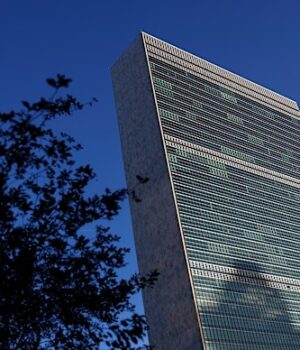
Noted human rights lawyer Geoffrey Robertson proposed in this masthead last week that, given widespread agreement that the United Nations should replace its New York headquarters with one in the global south, Melbourne would be a good candidate.
Robertson is convinced Melbourne hosting the UN would enrich this city’s life, and the economy. Many people admire the UN despite its long record of failures – as Winston Churchill observed, jaw-jaw is better than war-war – while another commentator wrote that there is no problem the UN cannot make worse.
I incline to the latter view, not least because of the embedded handicap of the veto for the US, Russia, China, the UK and France that generally guarantees no meaningful action can be taken in the organisation’s chief role, to preserve global security.
My pessimism – or realism – flows from the human nature. We cannot find security in any human institution precisely because all are run by humans.
This is an age of acute insecurity. People are insecure because of climate change, AI, conflicts, the abandoned rules-based global order, inflation, crime, the prospect of pandemics, the negative influences of social media and the rising epidemic of anxiety and loneliness.
The Bible, whose authors are fully aware of the flaws all of us are heir to, tells us our security is found in one place only: God himself.
Here security takes a different sense – it’s not that we are spared the ills listed above. Jesus is quite explicit to his disciples: “In this world you will have trouble. But take heart! I have overcome the world.”
The security people find in God is because, no matter what may befall, he has promised never to leave or forsake them – they do not face their trials alone.
The Bible is filled with metaphors about this: God is our refuge and strength, an ever-present help in trouble; he is our shield, our sword, our high tower; our rock; our shepherd; he shelters us as a mother hen under her wings.
It might be unclear from the outside how something so intangible can provide spiritual strength and comfort, not least because so many see Christianity as merely a set of intellectual claims rather than a personal, living experience. Yet for many believers it is very real and consoling.
Some humanists are even envious. As atheist Tom Drake-Brockman wrote a decade ago, “just as faith-based religion has run its dubious course, secular humanism has proved itself incapable of little else beyond an obsession with individual rights, manifesting as neo-liberal excess on the right and self-serving identity politics on the left”.
The Christian ethic of grace, Drake-Brockman suggested, could inspire a spiritual humanism “capable of reigniting the kind of self-belief, values, idealism and common purpose the Western world so desperately needs”.
Barney Zwartz is a senior fellow of the Centre for Public Christianity.
Get a weekly wrap of views that will challenge, champion and inform your own. Sign up for our Opinion newsletter.
 Barney Zwartz, a senior fellow of the Centre for Public Christianity, was religion editor of The Age from 2002 to 2013.