SOURCE :- THE AGE NEWS
China’s leader, Xi Jinping, is achieving what the celebrated ancient Chinese strategist Sun Tzu declared to be “supreme excellence” in warfare.
That is, he’s “breaking the enemy’s resistance without fighting”. Donald Trump is delivering advantages of historic consequence to China – free.
Apart from a pair of pandas and the fact of the visit itself, Xi declined to give Trump any concession during their three days of summitry in Washington at the end of last week.
Xi still hasn’t delivered fully the trade measures he promised to deliver Trump at their last meeting, in May. Or the one before that. Or even from Trump’s first term.
China’s president wouldn’t give his host even the smallest satisfaction. For instance, Trump wants to rename AI “superintelligence”. He thinks this will make it more acceptable to American voters.
He bragged that Xi agreed with him: “Like almost everyone else, he seemed to like calling the poorly and inaccurately named Artificial Intelligence to a far more accurate and important name, SUPER INTELLIGENCE. That would be ‘SUPER!’,” Trump posted.
But no. When Xi spoke of the subject, he ignored his host’s wishes and called it AI. In every reference.
Much of the commentary is that Xi’s three days of summitry with Trump was “all symbolism, no substance”. In reality, it was a triumph for the Chinese Communist Party and its leader in both symbolism and in substance.
To start with, Trump walked away from more than 100 nation leaders at the UN in New York to host Xi about 350 kilometres away in Washington.
“These last few summits” between Trump and Xi “underscore China’s and Xi’s dramatic arrival on the international stage in a way that highlights China’s growing influence and America’s growing alienation in the world,” Kurt Campbell, US deputy secretary of state under Joe Biden tells me. “It’s hard not to be deeply troubled.”
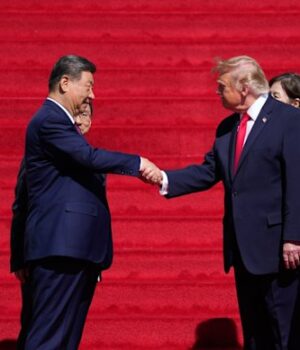
Trump, like an overexcited adolescent, went to Andrews Air Base to welcome Xi to Washington at the foot of the aircraft stairs. This is customarily assigned to a protocol officer.
The last time a US president did this was in 2015, when Barack Obama welcomed the Pope. Before that, it was John F. Kennedy welcoming Britain’s Harold McMillan in 1962. So it’s an extremely rare honour previously accorded a great religious leader and a key US ally. Now extended to a dictator leading an enemy state.
“We should have gotten something for that,” says Randy Schriver, a Republican appointed by Trump to be assistant defence secretary in Trump’s first term. “And I’m not sure we did.”
Schriver, now chair of the congressionally mandated US-China Economic and Security Review Commission, tells me that while Trump has political difficulties stemming from his war on Iran, “Xi is not without his own difficulties, primarily economic”. In other words, there was no need to fawn over him.
It got worse. Like an insecure teenager desperate to impress the cool kid, Trump repeatedly lavished Xi with praise – “strong, vibrant and fit” – and personally took him to inspect a presidential helicopter and the new White House landing pad, made of granite.
“He likes granite,” Trump enthused to reporters. “He’s an expert on stone, aside from many other things. And he loves good granite. Thank you very much.”
Xi maintained his customary smirk of amused indifference while saying nothing. Commentators noted Xi’s relaxed demeanour throughout his visit. No wonder. Trump continued to heap unearned gifts upon him.
Trump took Xi on a personally guided visit to the National Archives to show him the original US Declaration of Independence. As the leaders left, Trump told reporters: “We’re just comparing. Ours goes 250 years, which is great, and we’re proud of it. But theirs goes 6000 years.”
“It’s hard not to be deeply troubled.”
Former US secretary of state, Kurt Campbell
This is part of a Trump pattern of parroting Chinese Communist Party propaganda. The US republic is indeed 250 years old; the People’s Republic of China is a mere 76 years old. The CCP spruiks 6000 years of Chinese culture to create the impression of permanence and legitimacy for its modern dictatorship. The corresponding age for the US president would be to lay claim to the history of Western civilisation.
Kurt Campbell points out another example from Xi’s visit. Both presidents claimed that the US and China were united as allies against Japan in World War II.
But the US actually allied with the Republic of China, ruled by the nationalist Kuomintang, the system that the Communist insurgency drove out of mainland China in 1949. The Republic of China relocated on the island of Taiwan.
A Taiwan academic, Chen Fang-yu, of Taipei’s Soochow University, told a weekend conference: “We’re facing the Chinese communists’ enormous propaganda resources and their continuous attempts … to brainwash” the US public.
With help from Donald Trump. Campbell says: “Xi is seeking to imprint on Donald Trump his views, China’s perspective on Asia and the world. Xi wants to undermine confidence in Taiwan and drive a wedge between Japan and the US. Xi’s successful imprinting of his view on Trump is a priceless propaganda victory.”
Xi’s greatest ambition is to absorb Taiwan during his term. And so Trump’s concessions on Taiwan are, perhaps, his greatest gift to Xi.
“We reassure ourselves that he [Trump] doesn’t say ‘we are changing policy on Taiwan’,” Campbell explains. “But everything else around it is changing, and changing in troubling ways.”
He gives three examples. One is Trump’s approach of “no significant unofficial engagement with Taipei”. Another is “a sustained interruption in arms sales”. Astonishingly, Trump offered to sell US weapons to Xi during the visit, while withholding them from Taiwan.
Third, says Campbell, is “Trump’s public utterances which align closely with Chinese views”.
An American betrayal of Taiwan in the event of a Xi Jinping takeover attempt would be a profound historical blow to all US allies and to freedom of navigation for world commerce.
In the event of a crisis over Taiwan, “the South China Sea and East China Sea would be blocked,” says Nobukatsu Kanehara, a Japanese former diplomat and security adviser to the late prime minister Shinzō Abe.
“We have to understand the huge consequences,” he told the US Studies Centre conference in Sydney this week. These would include allowing Beijing to establish itself as the hegemon over the maritime arteries that carry about one-third of global trade. “Xi has to believe that there will be a big war that he cannot win.” Unless, of course, he can win without fighting.
Peter Hartcher is political and international editor. He writes on federal politics each Saturday.
Get a weekly wrap of views that will challenge, champion and inform your own. Sign up for our Opinion newsletter.
 Peter Hartcher is political editor and international editor of The Sydney Morning Herald and The Age.Connect via email.