Source : INDIA TODAY NEWS
From understanding India’s traditional symbols of governance to calculating income tax and learning how businesses grow, NCERT’s Class 9 Social Science textbook introduces students to concepts that shape the country’s public and economic life.
The textbook, Understanding Society: India and Beyond, covers governance, personal finance and entrepreneurship through historical figures, government policies and Indian business case studies. The chapters explain how citizens, institutions and businesses contribute to national development.
advertisement
FROM THE SENGOL TO THE PRINCIPLES OF GOOD GOVERNANCE
Chapter 4, Governance and Public Policy, connects India’s governing institutions with historical and cultural traditions.
It discusses the national motto, ‘Satyamev Jayate’, drawn from the Mundaka Upanishad, and the Supreme Court’s motto, ‘Yato Dharmastato Jayah’, from the Mahabharata. The chapter also traces the Sengol’s association with the Chola dynasty and its installation in the new Parliament building in 2023.
These symbols are presented as expressions of values associated with Indian governance.
The chapter uses a banyan tree to explain seven principles of good governance: participation, the rule of law, accountability, effectiveness, inclusiveness, responsiveness and transparency. An accompanying illustration shows citizens working together towards a just, peaceful and prosperous nation.
The National Education Policy (NEP) 2020 is presented as an example of consultative, evidence-based policymaking, highlighting consultation, expert advice and public participation.
Sport also features through Khelo Bharat Niti 2025. The textbook traces its implementation from the Central Government to state governments, local bodies, sports institutions, private organisations and individual citizens, presenting sport as an instrument of nation-building.
INCOME TAX AND FINANCIAL RESPONSIBILITY
Chapter 5, Managing Your Personal Finances, introduces personal income tax calculations under the new tax regime.
Students are taught how tax slabs work through a slab-wise explanation and worked calculations, bringing the concept of tax liability into the Class 9 financial literacy curriculum.
The chapter describes the honest and timely payment of taxes as an important civic responsibility. It explains how tax revenue helps fund public services and supports national development.
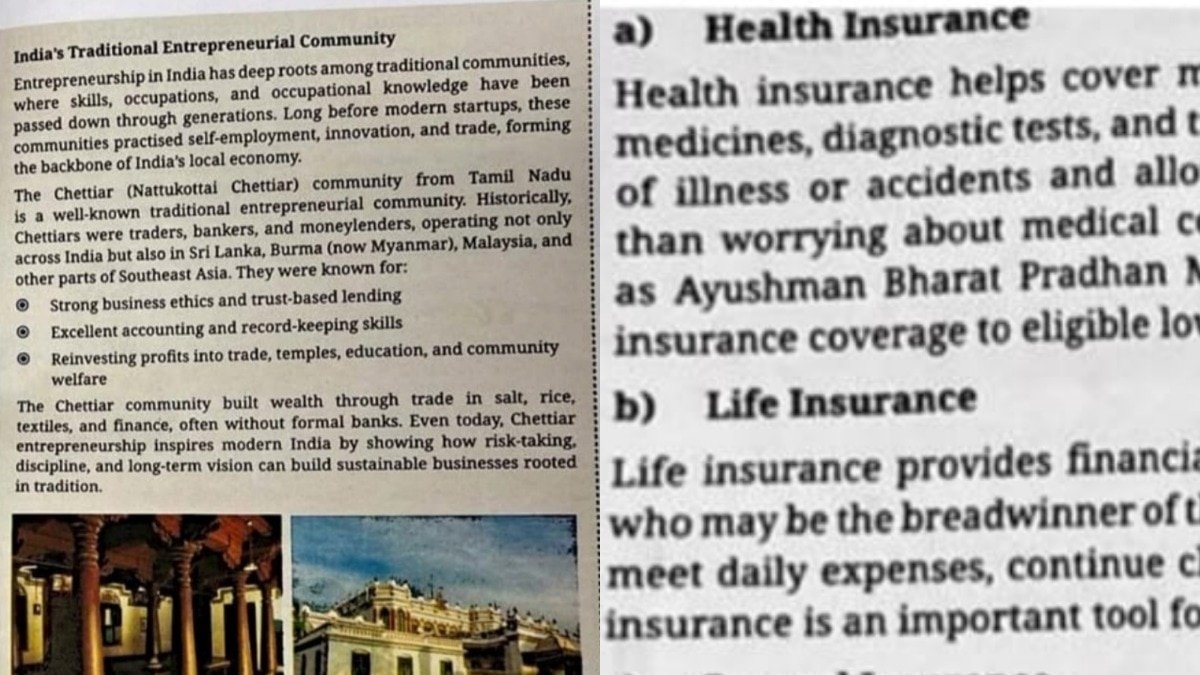
Ayushman Bharat Pradhan Mantri Jan Arogya Yojana (AB PM-JAY) features as an example of health insurance protecting eligible low-income households against medical expenses. The scheme is included in a broader discussion of how insurance can provide financial protection.
HOW LIJJAT PAPAD GREW FROM RS 80
Chapter 6, From Ideas to Startups, uses Indian businesses and entrepreneurs to explain how ideas can develop into enterprises.
One case study follows Shri Mahila Griha Udyog Lijjat Papad, which began in Mumbai in 1959 when seven homemakers pooled Rs 80. By 2023, the cooperative had more than 45,000 members and an annual turnover of Rs 1,600 crore.
The textbook highlights its cooperative model, in which women collectively own the enterprise and share its profits, as an example of entrepreneurship and women’s economic participation.
Another case study profiles Mohan Singh Oberoi. It traces his journey from working as a hotel desk clerk for Rs 50 a month to establishing one of India’s major hotel chains, presenting his experience as an example of entrepreneurial growth.
The chapter also examines the traditional business networks of the Tamil Nadu Chettiar community, including their historic involvement in trade, banking and moneylending. Their networks extended to Sri Lanka, Myanmar and parts of Southeast Asia.
The textbook highlights trust-based lending, business ethics, accounting and reinvestment as key aspects of these business practices, connecting traditional commercial networks with contemporary entrepreneurship.
STARTUPS AND THE VIKSIT BHARAT 2047 VISION
The chapter links India’s startup ecosystem with the government’s vision of Viksit Bharat 2047 and the goal of Atmanirbhar Bharat.
Introduced through a quotation from Swami Vivekananda, the section refers to India’s more than 120 unicorns and discusses entrepreneurship across e-commerce, fintech, healthcare and agritech.
It highlights how startups and businesses contribute to employment generation, innovation, production, tax revenues and improvements in quality of life.
An accompanying illustration identifies six areas in which businesses contribute to society and the economy: improving the quality of life, creating jobs and income, paying taxes, producing goods and services, driving innovation, and fulfilling corporate social responsibility.
Together, the three chapters use historical traditions, public policies and contemporary enterprises to explain governance, financial responsibility and entrepreneurship, placing these subjects within the broader context of India’s social and economic development.
– Ends
SOURCE :- TIMES OF INDIA