

source : the age
A 31-tonne whale carcass beached at South City Beach for two days will be removed by a specialist crew using heavy machinery, an excavator and a truck on Wednesday afternoon.
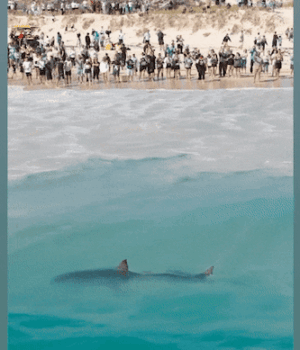
The 13-metre humpback whale was discovered early Monday morning, and soon began attracting large great white sharks close to shore, some more than five metres long.
The natural phenomenon drew crowds in their thousands on Tuesday, with curious onlookers eager to get a glimpse of the whale, or the apex predators lurking in the shallows.
Some copped $250 fines from the council for breaching the exclusion zone around the whale.
A teenager filmed jumping on the whale was also reprimanded for his actions, as Town of Cambridge Mayor Gary Mack urged people to respect the exclusion zone.
“[The carcass] is not a play thing, it’s very serious,” he said.
“We do know that there’s some really big sharks out there, and they can come right within the break, and so I would highly recommend people not to [get too close to the whale],” he said.
Mack said the excavation operation would likely cost between $60,000 and $100,000, with the contractor to bury the carcass at a Perth tip, either at Tamala Park, Red Hill or Baldivis.
“The whale will be retrieved from the beach, it will actually be put in a truck and sent out to landfill,” he said.
“The only other option was towing it out to sea and that’s not really endorsed by the government, and that’s because there’s difficulty in moving a 31-tonne object further out to sea, and also it can remain out there for quite some time, and it’s a shark attractant.”
Treasurer Rita Saffioti said the council was yet to reach out to the state government to ask for financial assistance to remove the whale.
“We’ll work with the council. It is, in a sense, their property, but it is a big cost, and these things don’t happen that often, so we’re happy to engage with the Town of Cambridge,” she said.
“I understand it’s quite a gruesome task too.”
On Tuesday, drum lines dropped in the ocean near the whale caught two great white sharks, which were tagged and released. One was a 3.7 metre shark at Floreat beach, and the other was a 3.1-metre shark at City Beach, bringing the state’s total tagged white sharks to 233.
Fisheries confirmed drum lines would not be deployed for a second day on Wednesday despite Macquarie University Fish Lab spokesman Culum Brown saying the whale carcass could attract sharks to the area for weeks.
“Usually, what happens is that the oil and the smell infiltrates into the sand, down into the water table, and as the tides come and go, it spreads out into a broader radius,” he said.
“So it could be weeks before that smell is sufficiently dissipated. So even if you remove the carcass, somebody is going to have to maintain some sort of watch over that beach for quite some time, yet I would imagine.”
The beach remains closed to swimmers.
Macquarie University marine biologist Vanessa Pirotta said tagging the sharks would provide valuable insight into shark movements off the WA coast.
“I have personally never seen such great public interset in a whale that’s deceased, and also the fact there are sharks in the area, which is people connecting to seeing something absolutely natural in terms of the sharks coming around a dead animal like that,” she told ABC Perth Radio.
“It’s not surprising that we have a humpback whale washed up, the bulk of the southern migration is now and so humpback whales are returning to Antarctica for the summer to feed.
“So from time to time we see whales die, and we don’t know exactly the cause of death for his whale, but scientists will probably work that out.
“It’s an awful thing to see a dead humpback whale, but if there’s got to be a silver lining from this, we will learn more from this whale, and also, shark scientists are having a field day out there tagging sharks so we as humans can learn more about our blue backyard.
“It’s so important for us to learn more about shark behaviour, especially around Australian waters because they’re poorly understood.
“An understanding of their movements, post this event, and where they’re going, this is a good opportunity for scientists and government to make use of this opportunity to inform more knowledge about sharks.”


