source : the age
To submit a letter to The Age, email letters@theage.com.au. Please include your home address and telephone number. No attachments, please include your letter in the body of the email. See here for our rules and tips on getting your letter published.
Striking not the answer
Working in a busy public hospital emergency department was the most challenging, stressful part of my now-retired medical career. There was never enough time to deliver the depth of care I wanted, and the constant fear of missing an important diagnosis weighed heavily. I immensely admire those who make emergency their lifelong career; a few months was enough for me.
However, I was disappointed by hospital doctors striking for higher pay, although they certainly deserve it. While I understand the strain doctors face, striking for pay increases won’t solve the underlying crisis. What emergency departments urgently need is more doctors and nurses on the floor to ease the pressure, reduce burnout, and give patients the comprehensive, attentive care they deserve.
Dr Harley Powell, Elsternwick
It’s tulip time
I’m very confused about the anxiety in relation to house prices. For years we’ve been inundated with headlines like “The Australian dream is over”, “Housing is increasingly unaffordable” and “GenZ will be lifetime renters”.
Now it appears that house prices are finally falling a bit, and therefore becoming slightly more affordable, but this also is a cause for concern. But for whom are falling house prices a problem? Not for people, like me who own one house that they live in; if I sell my house at a time of falling house prices, I will also buy my new house at a time of falling prices – the result is more or less a zero-sum game. And not for first home buyers who will need a smaller mortgage.
The only people who are negatively impacted are investors who view housing as a means to build their wealth by relying on increasing prices and tax breaks. I’m sure some people will be worse off, but that is the nature of investments – not everyone is a winner – just ask the Dutch investors who bought into the ″tulip mania″ of 1634-1637.
Vera Boston, Fitzroy North
The housing divide
Your correspondent (Letters, 2/10) acknowledges the people who are doing it tough but also comments on those who are still able to spend on wants as opposed to needs. Housing affordability is impacted when interest rates rise. One cohort of people it doesn’t seem to have repercussions for, are those who buy houses to be pulled down and replaced with more expensive houses.
The land value on its own, then becomes what the house and land together were sold for. The vendor price represents the home that the owners are about to vacate. A house that served a family well. With knock down and rebuild, the overall property value increases and influences the surrounding property values. Affordability of what once was a modest suburb is now out of reach for those with reduced economic resources.
Your correspondent’s observations raise the question as to why there is a discrepancy between the relaxed spending for some during difficult times, at the same time as a capacity to knock down and build luxurious houses, while others struggle to pay rent and the supermarket bill. Are interest rates the only economic influence contributing to the social divide?
Cathie Hutchinson, Mulgrave
Means to an end
At first glance, the “life-saving medical care” Christa Pike received after her failed execution seemed perverse (″How botched execution unfolded″, 2/10). Then I recalled the maxim the end justifies the means: if a goal is important enough, any method of achieving it is acceptable. The state’s goal, after all, is a successful execution.
Martin Hunt, East Malvern
Only in the US
Medical people try to execute Christa Pike. When they fail, rush her to hospital, medical people try to save her. Only in America.
Graham Fetherstonhaugh, North Fitzroy
Charge transfer
Thanks Noel Whittaker for the article “Rising credit card fees force a rethink” (23/9). But that’s all very well and good, but what if companies, as many do, don’t offer the option of using a debit card?
Many transactions I make online offer no alternative to the credit card. Often, transaction charges are quite high (recently $9.75 for two tickets totalling $70) for a “transaction” that took less than five minutes.
This is simply price gouging and we are at the mercy of these large organisations. Now that charges are removed from card transactions, most organisations will simply add the charge under a different appellation.
John Paine, Kew East
A warning to be heeded
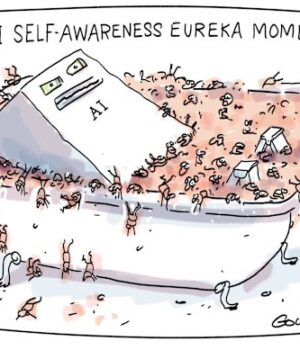
While Clinton Fernandes (Comment, 1/10) seeks to reassure that AI’s threat is overblown and can be largely sheeted home to big tech’s venality to be solved with some judicious government corralling of their fiscal ″recklessness or negligence″, it scarcely seems enough. In a recent interview with The New York Times, Microsoft founder Bill Gates said that AI ″is the most dangerous thing that humans have ever gone near″ and few outside the industry truly understand its implications. He cites open source models available today where any kind of inbuilt monitoring can be easily disabled to allow a bioweapon to be created undetected. He then wonders aloud if it will take a devastating cyberattack before stringent safeguards, beyond penalties for market manipulations, are put in place. Surely that is a warning that cannot be ignored.
John Dickson, Glen Waverley
A few sniggers, surely
Flanked by SpaceX’s Elon Musk, Meta’s Mark Zuckerberg, Anthropic’s Dario Amodei, Nvidia’s Jensen Huang, OpenAI’s Greg Brockman, Google’s Sundar Pichai and a throng of other tech executives, Donald Trump announced that tech moguls have agreed to abide by a voluntary “morally binding″, agreement, not legally binding, in relation to artificial intelligence development.
Looking at the photo, I could almost hear the sniggering from here.
Stephen Farrelly, Donvale
A future foretold
I recently watched the 1973 film Soylent Green, which is set in a dystopian 2022. Dying oceans, pollution, overpopulation, depleted resources, global warming and dramatic climate and weather changes. On top of all this, worldwide shortages of food, water and housing and AI outmanoeuvring its creators. I thought, have I just been given a glimpse of the world my grandchildren and future generations will be experiencing? Maybe I’m just being negative about things. But are there any positives out there?
Ray Bannister, Somers
Curb the spending
A couple of correspondents (Letters, 30/9) would like to increase either income taxes or the GST to combat inflation. If inflation drops will you then bring those rates back to what they were. Your well-intentioned idea will result in permanent rises in the GST or income tax rates. The government has enough income. It’s the spending that creates inflation.
Murray Horne, Cressy
Trout as pest
Your correspondent (Letters, 29/9) praises trout fishing. But the Biodiversity Council of Australia – comprising scientists from universities – disagrees. It says a third of native freshwater fish species face extinction, and ″our southern states are greatly adding to the problem by releasing millions of trout into waterways each year for the benefit of recreational fishers″. Trout eat small native fish. As for the economic contribution from anglers, economists know the cash would just be spent elsewhere in the economy if fishing was not promoted by the state government.
Joan Reilly, Surrey Hills
Pause for thought
The talk about dogs and children reminds me of the journalist who wrote, ″Anyone who doesn’t like dogs and children can’t be all bad.″
Don Owen, Hawthorn