

source : the age
To the untrained eye, the disruption to Paul Peluso’s property from a major interstate electricity transmission line seems minor, perhaps even lucrative.
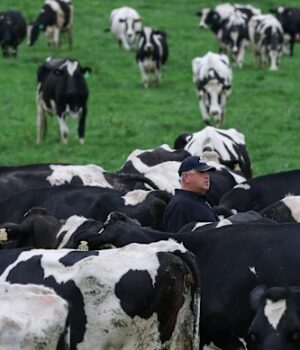
Peluso’s dairy farm lies in the proposed path of the Marinus Link project, which includes 345 kilometres of power and data cables running from north-west Tasmania to the Latrobe Valley in Victoria.
The cables will run beneath the Bass Strait and continue underground in Victoria. Whether they want to or not, many Victorian landholders including Peluso will host them.
It is crucial national infrastructure for electricity sharing between states, its backers say. But Peluso fears the four-hectare easement on his 180-hectare farm will ruin his dairy business in Mirboo North.
“What they’re proposing to do will shut me down as a dairy farmer,” he said.
Marinus Link will dig a trench for the cables and has a six-year window to access his land. Peluso said this would cut across tracks his cows used to move between paddocks and milking sheds.
“These main tracks are the arteries that pump the animals to where they need to be.”
Peluso said Marinus Link had made an initial compensation offer during the construction period, in addition to $8000 per kilometre annually on his property for 25 years.
Peluso declined to disclose the construction payment offer, but he said it paled into insignificance against the losses he expected to incur.
He is not alone. Many farmers have raised concerns about Marinus Link’s impact on their operations.
Peluso’s niece and former Victorian Farmers Federation president, Emma Germano, said real estate agents had advised there would be little interest from buyers in her uncle’s farm while there was uncertainty about the construction works and easement.
Germano, who is helping Peluso negotiate fair compensation, said the plans would hurt the farm’s value.
“Why would you buy this dairy farm when you can buy somewhere else with no easement and no construction?” she said.
The easement crosses where Peluso loads cattle, but Germano said Marinus Link had rejected a request to move it to a back fence to minimise disruption.
Although the cables will be buried, Germano said water movement on the property would be permanently altered and soil disturbances could hamper grass growth. She said there was a power imbalance, making it difficult for farmers to engage in fair compensation negotiations with a big company.
A Marinus Link spokesman said it had engaged with landholders since 2019, including discussions about the route through their land, and was committed to respectful negotiations. He said the company would resort to compulsory acquisition only when absolutely necessary.
The spokesman said the length of time the company needed on each parcel of land depended on many factors from weather to geotechnical conditions.
“The best thing we can do is have really open discussions with each landholder on what this will mean for them,” he said.
The spokesman said land access involved more than construction and was required for engineering and technical design surveys, and environmental and cultural heritage considerations.
In addition to power and fibre-optic cables, Marinus Link will include a communications station and converter stations on both sides of the Bass Strait.
It has attracted less controversy than above-ground projects VNI West and Western Renewables Link, where communities have railed against soaring towers.
The Victorian government approved the environmental effects statement for Western Renewables Link, but Premier Ben Carroll ordered a cost review, raising questions about its future.
The Marinus Link cables will run 255 kilometres undersea in Bass Strait and 90 kilometres underground in Gippsland, crossing the shore at Waratah Bay and then on to Latrobe Valley.
The federal, Victorian and Tasmanian governments are partners in the venture. The first stage of Marinus Link will have 750-megawatt capacity – enough to power about 750,000 homes.
Tasmania can generate power with its hydroelectric dams, allowing power to flow to Victoria when needed. Likewise, Victoria often produces excess electricity from solar and wind farms during the day, which could go to Tasmania.
The first stage is due for completion in 2030 and the second in 2033. In August last year, the Australian Energy Market Operator confirmed the project would cost about $7.57 billion for stages 1 and 2.
Preparatory works have already begun at Sandy Point. Construction will involve a method known as horizontal directional drilling to install cable conduits under the beach at Waratah Bay.
Nexa Advisory chief executive Stephanie Bashir said Marinus Link would form a crucial part of Australia’s energy infrastructure with enduring benefits and was worth the cost.
She said neither Victoria nor Tasmania could rely solely on the electricity they produced alone. While Victoria is currently a net exporter of electricity, Bashir said, the closure of coal-fired power stations from 2028 would result in Victoria needing to import electricity.
“Our modelling shows that every year of delay, our bills go up,” she said.
Nexa forecast average Victorian wholesale prices could increase up to 37 per cent between 2027 and 2031. Bashir said delaying projects like Marinus Link could cost Victorian households up to $472 over those four years.
Grattan Institute energy and climate change deputy program director, Hamish McKenzie, said Marinus Link should theoretically keep power prices down in each state.
More electric vehicles, data centres and households switching to electric appliances and heating are expected to drive up demand for power in coming years.
The closure of the Yallourn power station in 2028 is another factor set to reshape Victoria’s energy system.
“We don’t have enough renewable generation to replace that,” McKenzie said.
He said new transmission infrastructure would become increasingly important to meet Victoria’s electricity requirements.
“If VNI West doesn’t proceed then Marinus Link becomes even more important,” McKenzie said.
Green Energy Markets chief executive Tristan Edis said Marinus Link was initially based on the idea that Tasmania would become the battery of the nation, but battery technology was now rolling out across Australia.
“I do think we haven’t thoroughly evaluated other ways to solve those problems,” he said.
Marinus Link has discussed with community groups local causes it can support.
Among them is South Gippsland Landcare Network, which is seeking support to rehabilitate the Tarwin River catchment.
Network chair Jillian Staton said Marinus Link should back local community and sport groups as part of its social licence, but Marinus Link should also leave a lasting environmental benefit.
“Footy shirts are great, but this [Tarwin River] project is an opportunity for Marinus to have a positive long-term impact on the whole community,” she said.
Cut through the noise of federal politics with news, views and expert analysis. Subscribers can sign up to our weekly Inside Politics newsletter.
 Benjamin Preiss is The Age’s regional editor. He was previously state rounds reporter and has also covered education for The Age.Connect via X or email.

