source : the age
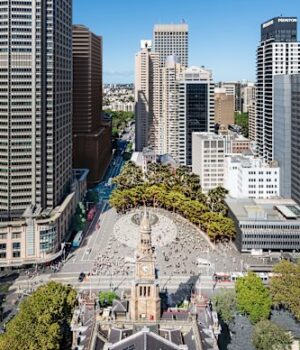
Recently, the City of Sydney’s proposal for Town Hall Square was called in by the state government for review after a public outcry. Critics either opposed the demolition of buildings to create a square as a waste of public money or opposed the design itself.
Meanwhile, the City has spent decades of bipartisan planning and property acquisition to achieve its vision. This has set the stage for a battle not only between two tiers of government, but also of ideology, with fiscal conservatism versus the common good.
The concept for a square was originally proposed by then-lord mayor Doug Sutherland in 1982, with Sydney City Council resolving to acquire the seven properties required to complete the square. The first property was purchased in 1985 and acquisition continued up until 2019, leaving one remaining property for compulsory acquisition. These buildings will be demolished to create a public space.
This is not the first time a government has demolished property to create open space for the public – indeed it is one of the hallmarks of making memorable spaces in great cities. Perhaps the best-known example is French official Baron Haussmann’s creation of streets and boulevards that cut through the dense medieval fabric of Paris, bringing modern amenities of light, air, sewage drains and vehicle movement to a clogged city.
Of course, cities need roads to function, but what about a public square like the one proposed? It’s not essential for the city to function but as our cities become denser and as we experience the effects of global warming, we need to provide spaces for people.
Piazzas in Italian cities often grew organically around urban life and focused on civic or religious monuments. In the 19th century as the industrial revolution made cities denser and more crowded, municipal reformers identified the need for more open space. John Nash’s Trafalgar Square or Plaza Reial in Barcelona were both created through demolition of existing buildings. Indeed, many Spanish cities used demolition to create geometrically perfect plazas architecturally framed by colonnades. These spaces are now some of the most visited urban spaces on the planet. They were created under monarchies or authoritarian governments but it is harder to do in a democratic society.
Today’s neoliberal governments celebrate the public generosity of private developers when they create public space. Spaces such as Rockefeller Plaza or Seagram Plaza in New York or our own Australia Square are seen as providing both public amenity and commercial benefits. It is ironic then that we now criticise a public authority for having the audacity to want to add a public space for the common good of people.
Have we so forgotten how great cities are made that our only salvation is for developers to create new public space on private land? Instead, we should be celebrating a city government prepared to create a public space for the common good. This new square sits in the heart of the city, and would be opposite the historic seat of the municipal government, itself an ornate sandstone civic monument.
Regarding the design – the geometry is an elegant resolution of a complex space and is appropriately aligned with the Town Hall spire. The trees, while adding much needed shade and greenery, could struggle to reach the density and maturity shown in the images, given the sunlight and environmental conditions of an urban setting.
Finally, a public space should have active edges, places where people can buy lunch, a coffee or a snack. How dynamic would Venice’s Piazza San Marco be without cafés? Notwithstanding these minor quibbles, the City of Sydney is undertaking one of the greatest civic acts in making a public space for people.
This is not a vanity project; it’s a legacy for future generations and shouldn’t be evaluated just on the financial cost. It’s important that we continue to improve our cities for people. As we plan for the future let us remember the Greek proverb: “A society grows great when old men plant trees in whose shade they will never sit.”
Now let our lord mayor plant trees for the people!
Philip Vivian is an architect, urban designer and managing director of Bates Smart, a contributor to Town Hall Vision in Sydney 2030-2050.
Get a weekly wrap of views that will challenge, champion and inform your own. Sign up for our Opinion newsletter.
 Philip Vivian is an architect with a Master of Urban Design from Columbia University in New York, and has studied Global Cities at the London School of Economics. He is the Managing Director of Australian architecture firm Bates Smart