Source : the age
Only two leaders from nations beyond the Pacific are attending the pre-COP meeting in Fiji this week hosted by Australia, Fiji and Tuvalu, as Climate Minister Chris Bowen insists the talks are a crucial to focussing world attention on the threat to the region ahead of next month’s UN climate conference.
The Albanese government faces intense pressure at the talks to justify the cost, estimated at over $20 million, and to live up to promises to champion the Pacific’s climate concerns on a world stage while responding to a global energy crisis and staving off accusations they are a distraction from domestic cost of living pressures.
Australian Climate Change and Energy Minister Chris Bowen said Australian taxpayers money was being well spent.
“This is our most important diplomatic engagement in the Pacific, certainly this term, probably for longer than this term,” he said in a press conference in Nadi before the talks formally began on Monday evening.
Pre-COP meetings between senior officials are normally held in the weeks before annual UN ‘Conference of the Parties’ Paris Agreement talks to help narrow the agenda before leaders and ministers engage, but this year Australia invited world leaders as part of its efforts to deepen its security ties across the region.
The most senior world leader who had agreed to attend was Thai Prime Minister Anutin Charnvirakul, who cancelled after heavy monsoons flooded Bangkok and other regions, triggering a national disaster response.
Fourteen nations have sent world leaders. From beyond the Pacific and Melanesia, only Timor-Leste and Mauritius have sent their leaders. Albanese attended for Australia, but New Zealand has not sent its prime minister, Christopher Luxon.
The Pacific and Melanesian leaders at the talks come from Fiji, Cook Islands, Nauru, New Caledonia, Niue, Palau, Papua New Guinea, Solomon Islands, Tonga, Tuvalu and Vanuatu.
Nations that initially accepted the invitation but did not send leaders include Antigua and Barbuda, Cabo Verde and the Maldives.
The talks come a month after the Pacific Islands Forum in Palau at the start of September, where China’s growing influence on the region dominated discussions.
On Tuesday, delegations will visit Tuvalu, one of the nations that faces the most immediate existential threat from climate change, a visit that Fiji’s climate minister, Lynda Tabuya, said would be crucial in bringing the threat of climate change into sharp focus.
Tabuya said Fiji and the Pacific have “four non-negotiable policy pillars” in the talks, including keeping the Paris 1.5 degrees target within reach and the creation of a mechanism for the Pacific to access climate finance. “Pacific nations have contributed the least to this crisis, yet we bear its highest costs,” she said.
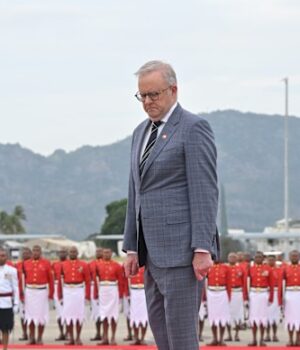
Ahead of the opening ceremony, Prime Minister Anthony Albanese said the talks unfold at “a critical time”.
“The impacts of climate change are no longer a distant threat or a future scenario. They are affecting people’s health, livelihoods and wellbeing today – through extreme heat, floods, infectious disease, food insecurity and the growing pressures on health systems. Health is the human face of climate change.
“And while these health impacts are felt everywhere, they are not felt equally. For communities across the Pacific, the climate crisis is an immediate and deeply personal reality. Climate action is not only about reducing emissions or meeting agreed international targets. But also about protecting lives, preventing illness and creating healthier, safer and more resilient communities.”
Bowen had hoped that this year’s COP talks would be co-hosted with the Pacific and held in Australia, but Turkey won the right to host the talks during a diplomatic showdown in Brazil last year. During those negotiations Bowen was appointed to the newly created role of President of Negotiations at the COP, which will be held in the resort city of Antalya in November.
Bowen said the relationship between Australia and Turkey was cooperative and close. “We no longer have two teams. We have one team, which happens to come from two different countries. We are working hand in glove. We are meeting daily, comparing our notes, working on challenges,” he said.
Also on Monday, Bowen announced Australia would spend $7.29 million on a package to accelerate the renewables’ rollout in the Pacific, and a new agreement to support Vanuatu’s renewable energy transition. He said the package would strengthen economic and energy security across the region, putting downward pressure on prices while cutting emissions.
Despite Australia’s active support for the Pacific, a gulf has emerged between the priorities of the region and those of Australia and Turkey.
Pacific nations are still demanding a focus on a just transition from fossil fuels in order to stabilise the climate at 1.5 degrees of warming, while Turkey and Australia have shifted their focus from the contentious issue of fossil fuels to a push to accelerate electrification.
Last month the UN’s environment program released a report confirming that the 1.5 degree target had been broken, and that world governments’ current policies put the planet on a trajectory of 2.8 degrees of warming by the end of the century.
Tuvalu Climate Minister Dr Maina Talia condemned leaders of major greenhouse polluting nations for failing to attend. “It’s immoral, I would say, and it’s unacceptable,” he told The Saturday Paper, adding criticism of Australia for its continued expansion of gas and coal projects.
“Being a good neighbour is doing what ought to be done, doing the right thing,” he said. “Are they good neighbours to the Pacific or not? That is a question Australia should be pondering.”
Opposition energy spokesman Dan Tehan has described the Pre-COP conference as a farce.
“We’ve got the prime minister leaving the country in a cost-of-living crisis to attend a leaders’ event, and we think there might be seven or eight leaders there, we don’t know,” he told the ABC.
Asked if Australia’s standing in the region would be damaged should it abandon the net zero target and measures designed to reach it, Tehan said Australia would be in a better position to help the Pacific with a strong economy.
“I don’t think we shouldn’t be helping the Pacific right now, but I do think that we’re much better off if we’re helping the Pacific with a strong economy where we are making sure that we’re looking after Australians.”
Cut through the noise of federal politics with news, views and expert analysis. Subscribers can sign up to our weekly Inside Politics newsletter.
 Nick O’Malley is National Environment and Climate Editor for The Sydney Morning Herald and The Age. He is also a senior writer and a former US correspondent.Connect via email.