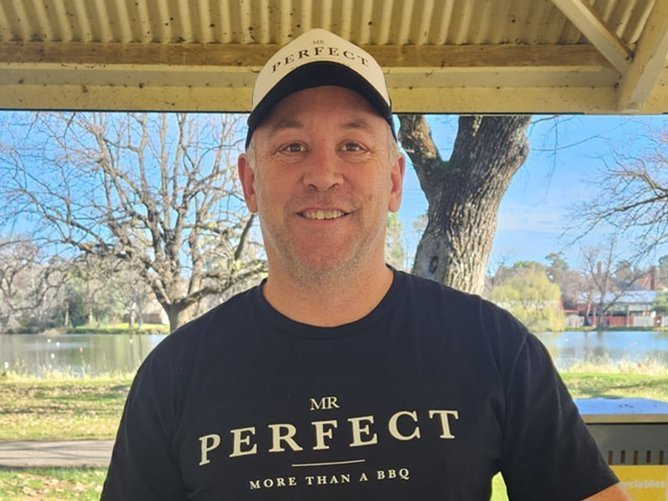
Source : Perth Now news
A former Victorian police officer who once felt he was one phone call away from ending his life is being honoured with a national mental health award after turning that moment of crisis into a mission to help others.
Luke Baker will receive the Community Hero Award at the 2026 Australian Mental Health Prize for work that has helped men in regional communities open up, connect and seek support.
Mr Baker, now a Lifeline Loddon Mallee ambassador based in Moama, knows how easily people can hide what they are carrying.
“I was okay, or for a long time I was very good at appearing okay,” Mr Baker told NewsWire.
After losing his stepfather to suicide as a child and then spending years in Victoria Police, he described the toll of cumulative trauma, depression, anxiety, and using alcohol to numb the pain.
“I reached a point where I really couldn’t see a future for myself,” he said.
The turning point came not through a grand intervention but through a simple check-in from a former colleague who noticed he had gone quiet.
“He just noticed that something was different in me and he reached in and that was a circuit breaker that I needed.”
At the end of the call, his mate told him to “say g’day to the kids for me”, prompting Mr Baker to ring Lifeline, open up to people close to him, and begin getting help.
The former officer said policing can make it hard for people to admit they are struggling, especially in a role built around looking after others.
“You’re in that role, you’re supposed to be the protector. So your health becomes secondary to all that other stuff,” he said.
He said there is also a fear that speaking up about mental health could cost people opportunities at work, and that this was part of what went through his mind at the time.
Suicide remains one of Australia’s most urgent public health issues, claiming about nine lives every day and remaining the leading cause of death for Australians aged 15 to 44.
The toll falls heavily on men, who account for about three-quarters of all suicide deaths, while Aboriginal and Torres Strait Islander communities and people living in regional and remote areas continue to face disproportionately high rates.

Mr Baker has since channelled his own lived experience into practical work in regional communities, where he believes stigma can still stop men from speaking honestly.
“A lot of men are very good at saying I’m fine and then just changing the subject and I know that because that’s exactly what I did,” he said.
His answer has been to create spaces where conversation feels natural rather than forced.
Through Mr Perfect barbecues in regional Victoria, Mr Baker helped build laid-back gatherings where men could grab a sausage, spend time with others, and talk if and when they were ready.
“We didn’t sit people in a circle and demanded that they tell us their feelings,” he said.
“Sometimes after two or three barbies, different conversations would just naturally happen.”
He has also helped shape suicide prevention strategies and resources, and raised awareness through his Pedalling for Hope ride, covering 3249 kilometres, one kilometre for every life lost to suicide in Australia in 2022.
His efforts also extend to communities reeling after traumatic events through the Lifeline Loddon Mallee Disaster Recovery and Critical Incident Response Team.

He described the importance of being there not only when tragedy first strikes but in the weeks and months that follow, when public attention fades and grief can hit hardest.
“The quiet times afterwards are when you’re probably most needed sometimes.”
That practical, low-pressure approach shapes Mr Baker’s advice for anyone worried about a friend or loved one. He believes many people stay silent because they are afraid of getting the words wrong.
“None of us have the script. Being genuine matters more than finding out what the perfect wording is,” he said.
The Australian Mental Health Prize, now in its 11th year, recognises Australians who have made outstanding contributions to promoting mental health and preventing or treating mental illness.
Presented by UNSW Psychiatry and Mental Health, the Black Dog Institute, and Neuroscience Research Australia, it honours winners across four categories: Aboriginal or Torres Strait Islander, Lived Experience, Professional, and Community Hero.
This year’s other winners are Dr Elizabeth McEntyre, recognised for her work advancing Aboriginal and Torres Strait Islander mental health; Michael Elwan in the Lived Experience category; and Professor Jayashri Kulkarni AM in the Professional category.
For Mr Baker, the recognition is still hard to take in.
“I never started doing any of this thinking that it would lead to something like this,” he said.
“What means the most is that it recognises the value of lived experience and community work.”
He credited his five children for their support and energy, and said his former partner gave him “an enormous amount of love, patience and support” while he pursued the work.
He hopes the award shines a bigger light on suicide prevention and the power of simple conversations, whether that happens around a barbecue, at a local sporting club, or through one mate picking up the phone.
“Sometimes it just starts with a simple conversation,” Mr Baker said.
Mental health support