Source : INDIA TODAY NEWS
The Galaxy Watch 9 is an interesting smartwatch to review because almost everything about it feels familiar once you start using it. Let me explain. With the Watch 9, Samsung has not radically changed the hardware design; the display is still a bright AMOLED panel we are accustomed to on Galaxy watches, and the health sensors are largely familiar too. Yet the Watch 9 feels noticeably quicker, more comfortable and more capable as an everyday wearable. Of course, the Snapdragon Wear Elite chip is the biggest change under the hood, while the larger battery gives this Samsung smartwatch some extra breathing room by stretching its endurance a little further, which becomes particularly useful when you are using the Watch 9 for sleep and health tracking. This and a lot more to address in my full review of the Samsung Galaxy Watch 9.
advertisement
Galaxy Watch 9: Design and build
The Watch 9 borrows its core design language from the Watch 8, with a round display housed inside Samsung’s slightly squarer cushion-shaped body. It looks premium, to be honest, but there is very little here that makes the Watch 9 immediately distinguishable from its predecessor.
Personally, though, I would have loved to see the rotating bezel here. That remains exclusive to the Classic model, and having seen it on the Galaxy Watch 8 Classic, I do miss it on the regular Watch 9. There is something particularly satisfying about physically rotating the bezel to move through menus, notifications and different screens. Touch navigation works perfectly well on the Watch 9, but the rotating bezel adds a tactile element that makes the Classic feel a little more like a traditional watch.
Beyond that, the Galaxy Watch 9 is a very comfortable smartwatch to wear. Samsung continues to use aluminium for the main casing, while the underside houses the sensor array. The combination keeps the watch light enough for all-day wear, and I particularly appreciate this when wearing it overnight for sleep tracking. The display is protected by sapphire crystal, which is reassuring for a watch that spends most of its life on your wrist. I have worn the Watch 9 for weeks and haven’t found myself worrying about every minor knock or scrape.
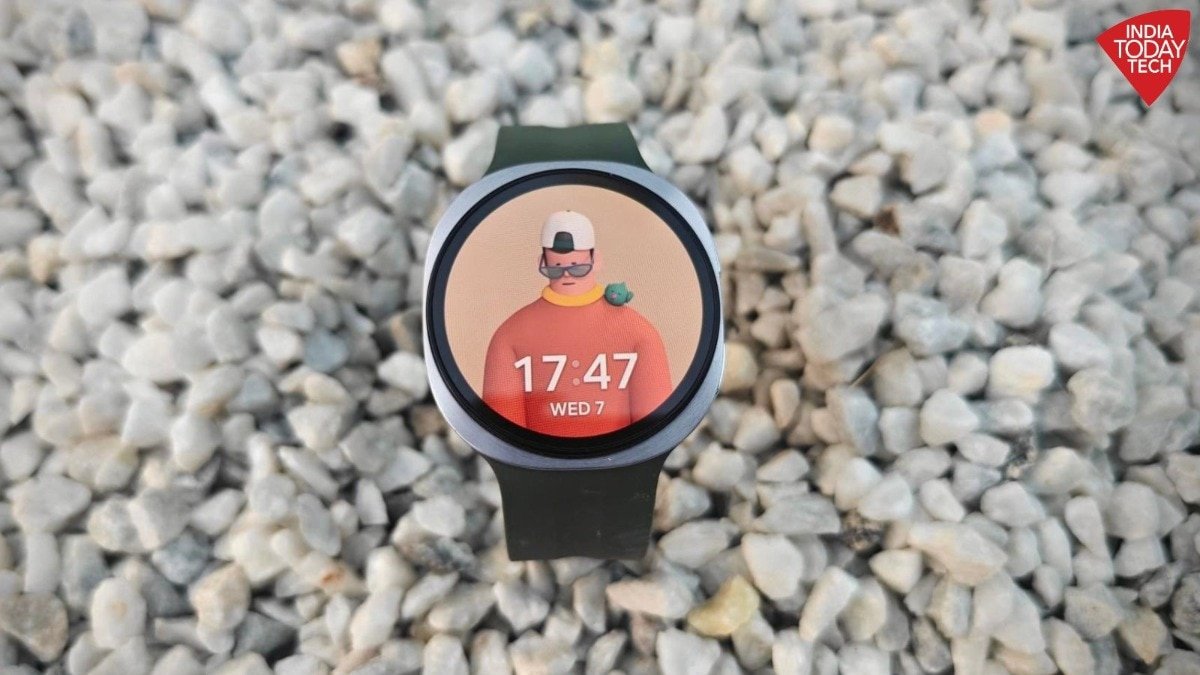
The Galaxy Watch 9 comes in two sizes, 40mm and 44mm, giving users some flexibility depending on their wrist size and how large they want the display to feel. The 40mm model is available in Cream and Graphite, while the 44mm version comes in Silver and Graphite. For this review, I am using the 40mm model with the green strap.
Samsung has also standardised its Dynamic Lug system across the current Galaxy Watch range. It first appeared on the Galaxy Watch Ultra and has now made its way to the regular Watch models as well. I like the implementation because changing straps takes only a couple of seconds. Press the button, slide the strap out, and you’re ready to put another one on.
The only thing to keep in mind is that Dynamic Lug is Samsung’s own attachment system, so you will need compatible straps when looking for alternatives. Thankfully, Samsung has a fairly wide selection, including silicone and fabric options in different colours, so there is plenty of scope to personalise the watch.
As for the supplied silicone Sport Band, it is simple but comfortable. It is soft, lightweight and doesn’t feel cumbersome to wear throughout the day or even while sleeping. Samsung has also introduced an air-pocket design in the band, which helps improve the fit around the wrist. That’s useful not just for comfort but also because consistent contact with the skin helps the watch’s health sensors collect more reliable readings.
For protection, the Galaxy Watch 9 carries an IP68 rating for dust and water resistance and is rated to 5ATM. That makes it well suited to everyday use, including swimming, workouts and getting caught in the rain. Samsung has positioned the Watch 9 as an everyday smartwatch, and its relatively compact design, comfortable strap, and water resistance fit that role well.
Galaxy Watch 9: Display
We all know that displays have always been one of Samsung’s strengths. The 40mm Galaxy Watch 9 has a 1.34-inch Super AMOLED display with a 438 x 438 resolution, while the 44mm model has a 1.47-inch display. The watch comes with a peak brightness of up to 3,000 nits, and Samsung says both sizes offer the same brightness capability. In practical terms, that means you don’t need to shield the Galaxy Watch 9 from the sun just to read a notification.
In all fairness, text remains readable, watch faces retain their punch and health information is easy to glance at even under strong sunlight. The larger 44mm may turn out to be even more useful if you read a lot of notifications or interact with apps on the watch. Granted, it doesn’t suddenly turn the Galaxy Watch into a miniature phone, but having a little more screen real estate makes interacting with the watch less fiddly.
The important thing, however, is that the display experience remains largely unchanged from the previous generation. Not a bad thing, though. The panel is bright, sharp and easy to read outdoors, and Samsung has focused on getting the fundamentals right rather than making changes just for the sake of it.
Galaxy Watch 9: Performance
Samsung has moved to Qualcomm’s Snapdragon Wear Elite platform, making the Watch 9 the first Galaxy Watch to use this Snapdragon platform. The chip is paired with 2GB of RAM and 32GB of storage. And, coming from any older Galaxy Watch model, you definitely feel the difference in speed and fluidity here.
Apps open quickly, animations are smoother and moving between different sections of the interface feels considerably less sluggish. Sure, there isn’t one particular moment that makes you go, “This is much faster than the older models.” It is more that the Watch 9 rarely makes you wait, whether you’re opening an app, checking a notification or jumping between different screens.
The Galaxy Watch 9 runs Wear OS 7 with Samsung’s One UI 9 Watch interface. The software is packed with features, perhaps to a fault. You can spend quite a bit of time discovering that another metric, setting or health feature exists somewhere inside Samsung Health or the Galaxy Wearable app.
Google Gemini is also integrated into the experience, bringing Google’s assistant capabilities directly to the wrist. I can see the appeal, particularly when you want to set something up or ask a quick question without reaching for your phone. But I don’t think Gemini is the reason to buy this watch. It is more of a useful extension of the Android ecosystem.
The connectivity options are equally comprehensive. The Galaxy Watch 9 supports Bluetooth and LTE depending on the variant, along with dual-frequency GPS, Wi-Fi and NFC. The LTE version can therefore handle calls and connectivity away from your phone, which makes the watch considerably more useful if you go for a run or head out without carrying your phone.
Galaxy Watch 9: Health and fitness
Health and fitness remain a big part of the Galaxy Watch 9 experience, but what I like this time is that Samsung hasn’t just dumped the specs at the end consumer. A lot of the focus is on making that information easier to understand and use.
The BioActive Sensor handles the usual heart-rate monitoring, ECG and body composition measurements. The watch also has sensors for skin temperature, movement and altitude, along with GPS for tracking outdoor activities. A lot of the useful stuff comes together inside Samsung Health.
Take Vitals, for example. Instead of looking at your heart rate, breathing rate, blood oxygen and skin temperature as separate readings, it uses your sleep data to establish what is normal for you and then highlights changes from that baseline. I find this approach quite easier to make sense of because you are not constantly trying to figure out whether an individual number is good or bad.
There is also a Heart Health Score, which brings together things such as activity, sleep, stress and body composition to give you a good picture of your overall health. Fitness Index works in a similar way, using different measurements to give you a better idea of your current fitness level.
If you exercise regularly, Daily Cardio Load is another feature worth paying attention to. It looks at how much cardiovascular activity you have accumulated and uses that information to give you an idea of how much strain your body has taken on. Samsung recommends wearing the watch continuously for 28 days to build a more useful picture, although the feature can start working with at least seven days of data.
I also like the addition of Hearing Health. The Watch 9 can monitor the noise around you and alert you when you are spending time in environments that are particularly loud. It is not something you will necessarily check every day, but it is a useful addition to a device that you already wear for most of the day.
Sleep tracking is probably the best feature that naturally fits into my routine. The Galaxy Watch 9 is light enough that I don’t mind wearing it overnight, and Samsung Health gives you a fairly detailed breakdown of your sleep, including sleep stages and blood oxygen levels. The Watch 9’s hardware also supports sleep apnoea detection, which would be a useful addition to its health-tracking capabilities. However, the feature is not currently available in India, so users here won’t be able to make use of it at the moment.
It is worth keeping in mind that some of the Watch 9’s health features are designed to work with a compatible Samsung Galaxy smartphone. This gives Galaxy users access to the watch’s full health-tracking experience, while those using other Android phones still get the core fitness and wellness features, with a few of the more advanced tools unavailable.
Galaxy Watch 9: Battery life
The 40mm Galaxy Watch 9 has a 390mAh battery, while the 44mm model gets a larger 445mAh cell. Samsung rates both models for up to 40 hours of use with the always-on display turned off and up to 30 hours with it enabled. The 40mm model also gets a sizeable bump over its predecessor, with about 20 per cent more battery capacity than the 40mm Galaxy Watch 8.
On my 40mm variant, the larger battery does make a difference to how I use the Galaxy Watch 9 through the day. With my usual mix of notifications, basic health tracking, and sleep tracking, I can get through a full day without having to think about charging it midway through. The always-on display does have an impact, as you would expect, and GPS-based workouts will also use more power. But for regular day-to-day use, the Watch 9 won’t leave you constantly checking the battery percentage.
Sleep tracking is where I have had to think a little more about when I charge it. Since I prefer wearing the watch overnight, I usually put it on the charger at some point during the day instead. It takes roughly 90 minutes to get from empty to full in my testing, so finding a suitable charging window isn’t particularly difficult.
For a compact 40mm smartwatch, I think the battery life is quite practical on the Galaxy Watch 9. You still have to charge it regularly, but the larger 390mAh battery gives you enough room to get through a full day of normal use while keeping the watch on your wrist for overnight tracking.
Galaxy Watch 9 review: Should you buy it?
In a nutshell, I enjoyed using the Galaxy Watch 9. The 40mm version is comfortable enough to wear all day and night; the display is excellent outdoors, and the new Snapdragon chip makes the whole user experience fluid and snappy. Samsung Health also does a good job of turning all the data it collects into something you can actually use. The bigger battery is another welcome change, especially if you use the watch for sleep tracking. I still wish the regular model had the rotating bezel, but that is really down to personal preference.
If you are buying a Galaxy Watch for the first time, the Watch 9 is a very good place to start. And if you already have an older Galaxy Watch, the faster performance and better battery give you enough reason to consider the upgrade.
– Ends
SOURCE :- TIMES OF INDIA