Source :- THE AGE NEWS
Santiago Vergara’s eyes flash when I mention the name of his Belgian rival. “Hm, Jonathan Engels,” he muses, a wry smile spreading across his face. “A very incredible Belgian man.”
Vergara will on Sunday attempt to become the fastest person to run a full marathon – on stilts.
The Melbourne Marathon will be Vergara’s second crack at a Guinness World Record. Earlier this year in Ballarat, he attempted to become the first (and thus fastest) person to run a half-marathon on stilts, finishing in two hours and 34 minutes.
“I submitted all my evidence to the Guinness Record organisation and was waiting for the approval,” he says. “Last week, I went to the website and I looked for half-marathon on stilts record, and the name of Jonathan Engels was there. I said, ‘What? What happened?’ … and what happened was that Jonathan Engels, this Belgian man, did the half-marathon the same day as me in Belgium, and he did it four minutes quicker.”
It makes this weekend all the more important for Vergara, who will be looking to complete the run in six hours and 30 minutes. The fastest man to run a marathon on stilts (not Engels, for what it’s worth) did it in just over six hours and 50 minutes, while the fastest woman made six hours and just under 38 minutes.
At first, it strikes me as an incredibly bizarre exploit, until I read some of the feats sitting alongside the “fastest marathon on stilts” listing on the Guinness World Records website: fastest marathon dressed as a three-dimensional bird (heavy), longest scarf knitted while running a marathon (hot), fastest marathon carrying a table (awkward), and most pairs of underpants worn during a marathon (potentially strategic).
I’m surprised to learn that the table carrier was the fastest, while the stilts, in fact, were the slowest. Until I give it a go.
While you might think there’s an advantage in the long legs, which add about one metre of height, each of Vergara’s stilts weighs about three kilograms. Unlike normal running, there is no ankle mobility. My feet and calves are stuck in place, with shoes stuck permanently to the platforms, and lower legs wrapped tight to the stilts.
Just standing up is difficult. A double-decker boat full of people drinking from champagne flutes cruises past just in time to see me almost stack it.
All in all, between frantically reaching for Vergara’s hand to stabilise me, and him fruitlessly encouraging me to relax my arms, I manage probably 20 unnatural-looking steps total on my own, and zero running. At least good practice for Vergara, who hopes to one day open his own stilts school.
It turns out getting down is even harder than getting up. When I take the stilts off, my legs are shaking.
“All the movement is borne in the hips and thighs … Also when running on stilts, you are prone to lean forward and that makes a lot of work in your lower back,” Vergara explains, recalling the soreness and muscle cramps he experienced after the Ballarat half-marathon.
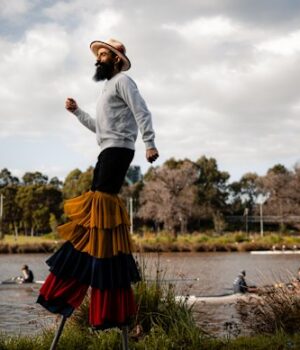
Compared to me, the Colombian is Usain Bolt, striding along a narrow stretch of pavement as teenage girls alternately heckle and cheer him from their rowing boats. He stoops over to high-five a couple sitting on a bench as he passes them.
“I always receive a lot of support, a lot of smiles, a lot of ‘go crazy man on stilts, you can do it!’,” he says.
Vergara says he wants to inspire others to pursue their own dreams, however weird or challenging, and is using his marathon attempt to raise funds for Special Olympics Australia.
While he is an odd sight on the streets of Melbourne, stilt walking is a more common hobby in his native Colombia. There is even an international stilt walking festival. “There are many incredible, talented stilt walkers in Colombia,” he says. “I don’t know why. We just like it.”
According to South American cultural associations, stilts were used in parts of the Americas – and other continents – to negotiate flooded or marshy landscapes, and over time became integrated into religious and theatrical traditions.
Vergara, who grew up reading the Guinness Book of World Records and says he’s always enjoyed testing the limits of his body, was introduced to the tradition aged 14 by a teacher at school in Bogota.
“It was love at first sight,” he says.
Vergara – who wears the colours of the Colombian flag whenever possible – moved to Melbourne three years ago, and now fits his marathon training around parenting, studying biology and performing as part of a Colombian theatre group in schools, with shows featuring storytelling, dancing and, of course, stilt walking.
But the 33-year-old’s dream job is finding some way of combining his love of biology and stilts to educate people about the natural world in a fun way.
For now though, he has one goal firmly in sight. And in a heartwarming twist, he’s got the support and advice of a knowledgeable pen pal – Jonathan Engels.
“I followed him on Instagram and now we are talking. Some days ago, we had a video call, and actually, we are friends now. And I told him, ‘I’m gonna beat you’,” he jokes.
“He told me I could go someday to his house and we could walk around on stilts.”
Has he promised not to do a full marathon on the same day this time?
Vergara smiles and shakes his head. “He didn’t promise that.”
Start the day with a summary of the day’s most important and interesting stories, analysis and insights. Sign up for our Morning Edition newsletter.
 Bridget McArthur is a sports affairs reporter at The Age, covering the intersection of sports and politics/business/economy/society.Connect via X or email.