Source : the age
US immigration agents shot and wounded a man in his car with a child present in the Marble Hill neighbourhood of New York City, according to the mayor, city police and eyewitnesses.
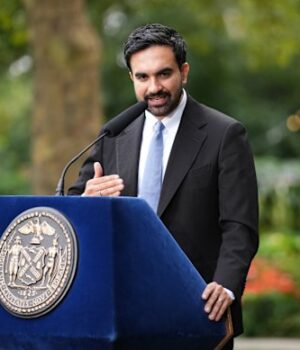
“Early reports indicate agents surrounded [the man] and a five-year-old child in his car before firing multiple rounds,” New York Mayor Zohran Mamdani said in a statement.
The mayor said the child was believed to have been physically unharmed.
“This is an unconscionable and incredibly serious situation,” Mamdani said, adding he planned to speak to US President Donald Trump and “demand that he ends all ICE enforcement actions in our city. I will not stand by while ICE agents terrorise our communities.”
Treasurer Jim Chalmers has brushed off a question over whether it is a double standard for small businesses to pay interchange fees but not the tax office. Chalmers said the ATO, an independent agency, can’t set the prices of its goods.
“I think it’s pretty obvious that the ATO doesn’t have the ability to set their own prices. They’re implementing the tax system, and so it is a different proposition when it comes to the ATO implementing tax rates versus small businesses and others setting prices for their goods and services,” Chalmers said.
“I acknowledge that that is one of the points that has been made with us in the feedback that we’ve received from the small-business community and others, and the feedback that the ATO has received as well. But [the extension of the transitional period] is a really important way for us to show that we take that feedback seriously,” the treasurer said.
The Reserve Bank of Australia modelled that there would be a 0.1 per cent increase to the cost of goods after surcharges were removed, with an offset in interchange fees being minimised.
However, some business owners have increased their fees more substantially, leading to harsh criticism that has largely fallen on the Labor government.
Jim Chalmers spoke with Commissioner of Taxation Rob Heferen “very early this morning” to discuss the government’s intervention on their credit card payment ban, before putting the proposal to government colleagues.
“I briefed him on the proposal that we were putting to our colleagues to fund an extension, so that the ATO would have time to do more consultation. You know, for example, when it comes to genuine hardship, or, for example, when it comes to trying to work with the card providers to get the cost down further, the difference between expensive providers and cheaper providers,” Chalmers said.
“All of these are the sorts of considerations that the tax commissioner will plug into his consultation. He now has longer to do that because we’ve stepped in.”
Treasurer Jim Chalmers has been unable to recall when the government was informed by the Australian Taxation Office of its intention to ban credit card surcharges but said the government “insisted” on a months-long transition period which is now being extended.
“We were informed by the ATO. I don’t know the specific timing of that. Of course, we were aware that they were considering what to do in response to the Reserve Bank’s announcement some months before that,” Chalmers told a Brisbane press conference.
“We insisted once we were aware that these changes were being proposed, we insisted on a transition period, which initially was from the beginning of October until the end of November, and today we are substantially extending that period so that the ATO has the opportunity and the time to consult more, particularly with small business, on their implementation of this ban,” the treasurer said.
Chalmers said the extension of the transition period to June 30 next year was done “on behalf of small business”, while reiterating that interchange fees were also lowered, bringing down costs for business owners.
He backed the plan to ban surcharges in general, saying they had “annoyed” consumers and were now a thing of the past.
Treasurer Jim Chalmers is announcing the government negotiated delay to the Australian Taxation Office’s ban on credit card payments for tax bills, confirming that the date the change comes into effect will move from November 30 of this year, to June 30 of next year.
“We’ve stepped in to ensure that the tax office can take credit card payments until the end of June next year. This will give them the time to consult more with small business and to get it right,” Chalmers told a Brisbane press conference.
“This recognises the important contribution that small businesses make to our local communities and to our economy more broadly. So we’ve stepped in here to provide the necessary funding to ensure that the ATO can continue to take credit card payments until the end of the financial year,” the Treasurer said.
“We take very seriously the feedback that the ATO and the government have received when it comes to implementing this surcharge ban. Now we try not to interfere with the RBA or the ATO when they go about designing and implementing this surcharge ban.
“But it’s really important that we have stepped in today to make it possible for the ATO to continue to take credit card payments until the end of the financial year.”
The opposition will continue with its attempt to reverse the ATO’s decision to ban credit card payments for tax bills despite the government preparing to announce a year-long delay, shadow treasurer Tim Wilson has said.
“The ATO decision has been a disaster but the Albanese government is the one that triggered this whole process because they introduced the surcharge ban. They didn’t think through the consequences of it and there’s a massive double standard. The double standard is they’re turning around to small businesses and saying you have to pick up this extra cost, while when you go and pay, we’re going to shut down the payments,” Wilson told News24 this morning.
“What the government has now done is said they’ve given themselves a 12-month reprieve. We still have legislation ready to go if necessary to overturn the decision that’s been made by the ATO because it’s leaving small business hung out [to] dry, and we need clarity,” Wilson said.
The Australian Taxation Office’s controversial banning of credit card payments will no longer come into effect at the end of next month, after the government negotiated with the independent agency to delay the push.
Treasurer Jim Chalmers will allocate additional funds to the agency to support a year-long transition period, after the ban that was set to come into effect on November 30 came under heavy criticism.
The announcement comes after fierce pushback from the business community, opposition parties and some members of the Labor backbench that saw the ATO’s decision as damaging to the cash-flow management of small businesses.
Money and meals given to doctors by pharmaceutical companies increased inappropriate prescribing, leaving patients with drugs that were more expensive, had fewer benefits or were not clinically necessary, a major global review has found.
The first-of-its-kind Cochrane review – considered the gold standard in healthcare research – analysed millions of doctors’ prescribing practices across 93 studies to understand how visits from sales representatives, sponsored educational opportunities and covered travel influenced prescribing.
The review, published on Friday, found that pharmaceutical company gifts and payments to doctors increased inappropriate prescribing and the number of prescriptions they wrote, and likely affected how much patients spent on prescriptions.
“Doctors often think that … they can’t be bought for the price of a sandwich but the data shows this is an effective marketing strategy,” said the review’s lead author, University of Sydney professor in pharmacy Barbara Mintzes.
“The more free meals a doctor receives, the more likely they are to prescribe less appropriate or more expensive drugs,” Mintzes said.
Opposition Leader Angus Taylor has promised to take legislation to parliament to reverse the tax office’s decision to ban credit card payments if the government does not take action on the issue.
“They should override the tax office decision today, and if they are not prepared to do it, we will take legislation to the parliament next week on Monday to do this,” Taylor said in a press conference. “Small businesses deserve better.”
Earlier this morning Foreign Affairs Minister Penny Wong said the ATO was an independent body, and the government did not have the power to directly intervene in its decisions: “They are independent. Governments can’t direct the tax office to implement tax in a certain way.”
Taylor said the decision should be reversed: “We don’t need consultation on this, we need change.
“[The legislation] would overturn the decision that’s been made. It’s pretty simple. It’s not going to be a complicated piece of legislation. The government, if they want to do it, can do it today, and they should.”
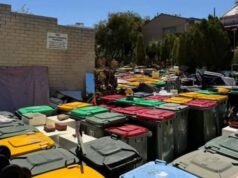
Students barricaded a high school in north-eastern Paris with garbage bins on Thursday before police moved in with tear gas, as France’s nationwide protests showed few signs of ending.
The Helene Boucher high school has been a flashpoint for clashes in the French capital and was one of hundreds of schools disrupted by protests on Thursday. Riot police gathered in side streets as students converged on the school. Many protesters wore surgical masks or hoodies, apparently to avoid being recognised.
At least a dozen demonstrations supporting the high school students’ movement were planned across France later in the day, including a rally at Place de la Bastille in Paris, where tear gas and a water cannon were fired at protesters.
Police have made more than 6600 arrests since late September, when students, most of them under 18, began protesting to demand more education funding, according to the Interior Ministry. The Education Ministry said on Thursday that 375 schools were fully or partially closed.