source : the age
Hello and thanks for joining our live coverage of national news this Friday, October 9.
Here’s what’s happened so far:
- The Australian Taxation Office’s controversial banning of credit card payments will no longer come into effect at the end of next month, after the government negotiated with the independent agency to delay the change. Jim Chalmers spoke about the government’s role earlier this afternoon.
- US immigration agents shot and wounded a man in his car with a child present, in the Marble Hill neighbourhood of New York City, according to the mayor, city police and eyewitnesses. More on this soon.
- A Mexican judge is expected to hear closing statements before he hands down his verdict in the trial of three men accused of killing two Australians and their American friend in 2024.
- The AFP plans to expand its overseas operations into more countries to target offshore organised-crime figures orchestrating violence in Australia, its commissioner has revealed.
-
And in entertainment news, iconic Australian rockers Powderfinger have announced they’ll return to the stage for a long-awaited reunion in 2027. The announcement follows days of cryptic billboards across Australia’s major cities.
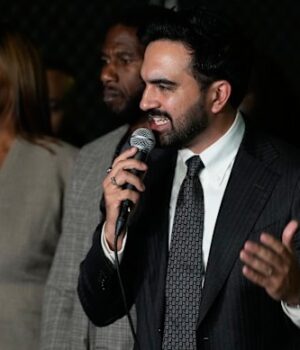
New York City mayor Zohran Mamdani has almost been drowned out by protesters while providing an update into the latest shooting involving ICE agents.
A federal immigration and customs enforcement (ICE) officer shot and wounded a Dominican man while arresting him in New York City on Thursday (7am Friday AEDT), during what the Department of Homeland Security called a “targeted enforcement operation.” A boy believed to be the man’s son was with him at the time.
Speaking at a late night press conference on the streets of New York, Mamdani said he had just spent two hours on the phone with US President Donald Trump, seeking to secure the man’s release.
“Those negotiations were unsuccessful. Just moments ago, ICE put them in an unmarked vehicle and whisked them away,” Mamdani said.
A KPMG-sponsored culture review of the failings that led to the whistleblower scandal has found that there was a significant “say-do gap” between its stated ethical values and what its most senior executives did in practice.
“Ethical expectations were weakened by a perceived gap between professed values and visible actions,” the report said.
The external review by Principia Advisory found that these issues were compounded by structural weaknesses in the firm’s governance and oversight.
This resulted in a circular system where board members were charged with supervising senior executives who effectively controlled the pay and career progression of these same board members.
The rural NSW couple who successfully prevented a Hunter Valley coal mine from being expanded – with potential consequences for Australia’s entire coal sector – says she hopes her action inspires others to do the same.
Wendy Wales and partner Tony Lonergan, of Muswellbrook, spent four years legally challenging MACH Energy’s plans to enlarge its Mount Pleasant coal mine.
Their campaign culminated in the High Court this week narrowly upholding a judgement that the expansion plan could not go ahead due to the climate impact of the emissions the coal would cause once it was burnt, including overseas.
On News24 on Friday, Wales was asked if her success might incentivise other Australians to also take action.
Hurricane Isaias strengthened on Thursday as it barrelled toward the US Gulf Coast, prompting mandatory evacuations in parts of Florida and emergency declarations in Alabama as forecasters warned of life-threatening storm surges, tornadoes and flooding.
Isaias has already severely disrupted oil and gas production in the Gulf of Mexico, forcing energy companies to evacuate offshore platforms and shut down operations.
The first Atlantic hurricane of the 2026 season was packing maximum sustained winds of 85 mph (140 kph) early on Thursday, the US National Hurricane Center said. Isaias was forecast to strengthen to near Category 3 intensity, with sustained winds reaching 110 mph (175 kph) on Friday before reaching the northern Gulf Coast late Friday or early Saturday.
Opposition Leader Angus Taylor says there is no good news in the announcement that a ban on using credit cards for tax payments will be delayed until June next year.
The tax office had planned to initiate the ban from the end of November, in response to the Reserve Bank of Australia banning surcharges being added to credit card payments – a ban that came into effect this month.
A government-brokered deal now means the tax office will hold off on that change, but on News24 Taylor said this only amounted to small businesses being hit “tomorrow rather than today”.
“The reality of this government is they want businesses to cough up, to shut up and to close up,” Taylor said, insisting the government had the authority to compel the ATO to ditch its plan entirely.
“They should scrap it, and the prime minister should scrap this treasurer while he’s at it because, frankly, this is just another humiliating backdown after the widow’s tax, the death tax, and so on.”
Taylor claimed the extra money the government will give the ATO to allow for this postponement amounted to “a taxpayer-funded bailout”, and that the opposition was drafting legislation to stop the ATO’s ban entirely in time for parliament resuming next week.
One Nation leader Pauline Hanson has sought to reverse damage caused by her suggestion that there were no “good” Muslims, pointing to a hero of the Bondi massacre as an example.
Hanson delivered a speech to the Australia-Israel Chamber of Commerce at Crown in Melbourne, calling for more spending on research and development to emulate Israel’s booming tech sector.
The populist-right leader used the speech to address her statement in February, when she said: “You know, you say, ‘Oh, well, there’s good Muslims out there’. Well, I’m sorry – how can you, you know, tell me there are good Muslims?”
The comment was described as racist by Hanson’s political opponents. Nationals leader Matt Canavan labelled the remarks “divisive, inflammatory and un-Australian”.
US immigration agents shot and wounded a man in his car with a child present, in the Marble Hill neighbourhood of New York City, according to the mayor, city police and eyewitnesses.
“Early reports indicate agents surrounded [the man] and a five-year-old child in his car before firing multiple rounds,” New York Mayor Zohran Mamdani said in a statement.
The mayor said the child was believed to have been physically unharmed.
“This is an unconscionable and incredibly serious situation,” Mamdani said, adding he planned to speak to US President Donald Trump and “demand that he ends all ICE enforcement actions in our city. I will not stand by while ICE agents terrorise our communities.”
The Department of Homeland Security, ICE’s parent agency, said in a statement that Immigration and Customs Enforcement officers were conducting a “targeted enforcement operation” in the Bronx, New York, to arrest a man from the Dominican Republic with a prior criminal conviction.
“During the incident an ICE officer discharged his weapon and the criminal illegal alien was injured,” DHS said, adding that ICE officers rendered immediate aid. “The individual is alive and at a local hospital.”
Treasurer Jim Chalmers has brushed off a question over whether it is a double standard for small businesses to pay interchange fees but not the tax office. Chalmers said the ATO, an independent agency, can’t set the prices of its goods.
“I think it’s pretty obvious that the ATO doesn’t have the ability to set their own prices. They’re implementing the tax system, and so it is a different proposition when it comes to the ATO implementing tax rates versus small businesses and others setting prices for their goods and services,” Chalmers said.
“I acknowledge that that is one of the points that has been made with us in the feedback that we’ve received from the small-business community and others, and the feedback that the ATO has received as well. But [the extension of the transitional period] is a really important way for us to show that we take that feedback seriously,” the treasurer said.
The Reserve Bank of Australia modelled that there would be a 0.1 per cent increase to the cost of goods after surcharges were removed, with an offset in interchange fees being minimised.
However, some business owners have increased their fees more substantially, leading to harsh criticism that has largely fallen on the Labor government.
Jim Chalmers spoke with Commissioner of Taxation Rob Heferen “very early this morning” to discuss the government’s intervention on their credit card payment ban, before putting the proposal to government colleagues.
“I briefed him on the proposal that we were putting to our colleagues to fund an extension, so that the ATO would have time to do more consultation. You know, for example, when it comes to genuine hardship, or, for example, when it comes to trying to work with the card providers to get the cost down further, the difference between expensive providers and cheaper providers,” Chalmers said.
“All of these are the sorts of considerations that the tax commissioner will plug into his consultation. He now has longer to do that because we’ve stepped in.”
Treasurer Jim Chalmers has been unable to recall when the government was informed by the Australian Taxation Office of its intention to ban credit card surcharges but said the government “insisted” on a months-long transition period which is now being extended.
“We were informed by the ATO. I don’t know the specific timing of that. Of course, we were aware that they were considering what to do in response to the Reserve Bank’s announcement some months before that,” Chalmers told a Brisbane press conference.
“We insisted once we were aware that these changes were being proposed, we insisted on a transition period, which initially was from the beginning of October until the end of November, and today we are substantially extending that period so that the ATO has the opportunity and the time to consult more, particularly with small business, on their implementation of this ban,” the treasurer said.
Chalmers said the extension of the transition period to June 30 next year was done “on behalf of small business”, while reiterating that interchange fees were also lowered, bringing down costs for business owners.
He backed the plan to ban surcharges in general, saying they had “annoyed” consumers and were now a thing of the past.