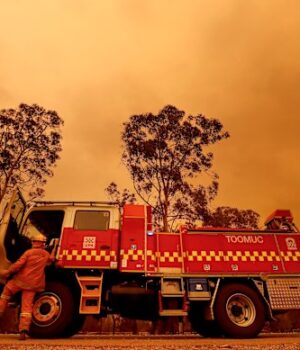
Source : the age
Imagine having the strength of character to charge towards raging infernos. That’s the job of around 35,000 firefighters – the vast majority of them volunteers – to protect lives, property and the environment from fire and other emergencies.
Now imagine doing so while unsure your equipment is up to the task or that a broken-down piece of machinery could put you or your colleagues at even greater risk.
This week, Victoria’s auditor-general detailed widespread cracking, caused by dangerous overloading, had forced half of the environment department’s fleet of fire trucks to be removed from service during our last fire season.
It was striking that the audit noted that of the department’s 600-odd trucks, the ones off the road due to cracking, were considerably younger – with only 6.7 per cent more than 15 years old – than those used by Fire Rescue Victoria (FRV) and Country Fire Authority (CFA).
The audit found 57 per cent of the 2400 trucks used by FRV and the CFA are 15 years or older, and more than one-third are over 20 years old. FRV policy gives fire trucks a useful lifespan of 15 years, beyond which the authority says they should be replaced.
This is clearly not being met. The audit further found that maintenance on those ageing trucks was falling behind.
Victoria’s three fire authorities use this equipment to respond to more than 100,000 fire emergencies and other incidents every year and with which they are eyeing predictions of a hot El Niño summer.
All up, fire authorities need $1.5 billion between 2024-25 and 2033-34 to address critical fire truck replacement and upgrade needs. Yet the auditor-general concluded fire authorities only have about one-quarter of the funding they desperately need. It’s a staggering shortfall for such a critical part of the state’s emergency response apparatus.
In response, Premier Ben Carroll acknowledged the report “clearly shows we have more work to do” and pointed to Labor’s recent election promise to commit another $167 million towards 150 new trucks by 2030, including 50 for FRV and 100 for the CFA. That still leaves a gap, once other commitments are included, of close to $1 billion over 10 years.
Disappointingly, the opposition is, after years of critical commentary, saying only that it will put in “more” funding than Labor and that its policy will be released before the election. It has already said it will not find the $1 billion called for in the audit.
This is the sharp reality of the state’s finances. Given the choice, the government has opted for record debt to fund infrastructure and left essential services literally cracking apart.
This year’s state budget showed a government under fiscal pressure on all fronts, with Victoria’s net debt set to rise to $175.6 billion in 2026-27 and grow to $199.3 billion over the forward estimates.
When the Andrews government was elected in 2014, it inherited net debt of $22 billion, or about 6 per cent of the state’s economy. That percentage rose steeply with COVID-19 spending – including a $285 million bungle and cover-up revealed this week. How dearly the state’s fire agencies would like that money back right now.
Even though the pandemic emergency has subsided, the big spend has not as The Age has noted previously with some concern. Debt now sits at about 25 per cent of the state’s economy.
The upcoming fire season could see the very real consequences of that debt for emergency preparedness and the operational firefighters on the front lines.
Forecasters are predicting increased bushfire risk – particularly in Victoria’s south-west, Central Highlands, far-east Gippsland and western plains – throughout spring and into summer.
This year, as every year, they should be updating their farm map, doing an inventory of their emergency kit, clearing vegetation and low branches and checking their gates. They will need to make sure their roadside property number is visible to help fire crews locate it or orient themselves in the worst-case firestorm scenarios. But that’s just the domestic perspective of fire season preparedness.
“We only need one bad day to have a bad summer,” said Country Fire Authority chief officer Garry Cook at his first event in the job this week.
Without safe and reliable equipment that is fit for purpose and well maintained, that day could have consequences lasting much longer.
Nobody will be able to say they were not warned.
The Opinion newsletter is a weekly wrap of views that will challenge, champion and inform your own. Sign up here.
 The Age’s View – Since The Age was first published in 1854, the editorial team has believed it important to express a considered view on the issues of the day for readers, always putting the public interest first.