Source : the age
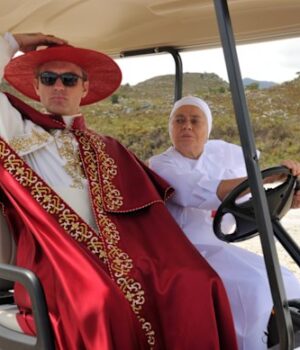
There are many unlikely papal moments in Paolo Sorrentino’s 2016 series The Young Pope: the Pope emerges from under a pile of babies, the Pope tames a kangaroo, the Pope spies on a couple having sex in their living room. Still, none is more unbelievable in these times than the Pope insisting that his face be hidden from the public.
“I do not have an image because I am no one,” says newly elected Pope Pius XIII (Jude Law). If he must appear it will be as “a dark shadow, [a] silhouette”.
Pius name-checks Banksy, JD Salinger and Daft Punk – “the most important figures in their respective fields” – none of whom let themselves be seen. “The Vatican survives on hyperbole,” he says, “So we will give them hyperbole. But this time in reverse.”
He has a point. The Pope is famous despite, not because of, his face. Take an ordinary man, dress him in a white pellegrina and zucchetto, add a chunky pectoral cross and you have the kind of instant recognition very few living people command. We’re talking Elvis Presley or Dolly Parton-level recognition from silhouette alone.
It’s this instant identification that makes the Pope such an effective vehicle for dramatic or comedic intervention. In Italian satirist Pierfrancesco Diliberto’s new film Holy Cannoli (Che Dio perdona a tutti) the protagonist, Arturo, eats so much sugar in one hit that he hallucinates the Pope (Carlos Hipólito) is in his living room. The absurdity, the wonder and the inclination to actually listen when the apparition speaks come almost entirely from the instantly identifiable costume, at least to begin with.
As the film goes on, it becomes clear that this is a fictionalised version of the late Pope Francis, but he could just as easily be an entirely invented character. His role in the film is to guide atheistic Arturo in his quest to be worthy of his devoutly Catholic girlfriend. For this, he does not need to be an actual Pope; he needs to be both a symbol of official Christianity and benign father-figure who will appeal to the audience regardless of religious belief.
The actual Pope also performs that role, of course, though his perceived benignity and appeal are far from universal. They also differ fairly dramatically depending on the specifics of the man in the costume. An Economist survey in June found the current Pope Leo XIV had the highest favorability rating among all the public figures polled, coming in a whopping 54 percentage points higher than the US president. The Public Religion Research Institute points out that his predecessor, Pope Francis, had even higher ratings at the same point in his papacy, and both have been consistently seen more favourably than Pope Benedict XVI.
So the Pope is a symbol, yes, but he’s also a person. The best papal fiction exploits this tension by testing what belongs to the former and what to the latter.
Returning to The Young Pope, for example, we have a pontiff whose (relatively) young age of 47 quickly becomes the least of it as we discover he is also a chain-smoking, American, hard-core reactionary who has no interest in making nice with the public, his own cardinals or Vatican bureaucrats. He also happens to look distractingly like Jude Law.
The conceit is that one or more of these things make him an extremely unlikely choice for pontiff but in fact, every one of these (except the Jude Law thing) has been true of at least one real pope. Pontiffs younger than Law’s Pius include medieval teen Popes Benedict IX and John XII; those said to have loved a ciggie include John XXII and Benedict XVI; and the ones who battled with their own curia are probably more common than those who didn’t. (An American pope didn’t exist until 2025, well after the show finished its run, but the joke is well and truly history now.)
So despite the show’s sumptuous surrealism, it, like others in the genre of pope fiction, provides a strangely realistic thought experiment in what the enormous multi-part engine of the Vatican can and cannot absorb when it comes to an individual pope’s quirks and personal qualities.
A clear answer can be found in the many retellings of the medieval legend of a female pope. The specific characteristics of the woman said to have disguised herself as a monk before rising all the way to the top job varies wildly across versions. But from Lawrence Durrell’s Pope Joan (1954) to Donna Woolfolk Cross’ 1996 version; from Caryl Churchill’s play Top Girls (1982) to my own 2024 novel Rapture, the Pope’s female body is an absolute dealbreaker for the institution. In legend, in history, and very much in real life right now, the Pope can be almost any kind of person, as long as that person is a man.
Really, almost any kind of person? Let’s consider the sub-genre of pope fiction that we might call Borgia-core (after the most obvious example, Showtime’s The Borgias), which revels in the juxtaposition of holiness and horniness, piety and perversion. The thing about these salacious stories of corrupt and hedonistic popes is that they’re taken right out of the history books. (Albeit from sometimes unreliable and agenda-driven sources.) The medieval era in particular was rife with men who took to the role with the spirit of Pope Leo X (another young Pope, at 37) who is said to have declared: “God has given us the papacy; now let us enjoy it”.
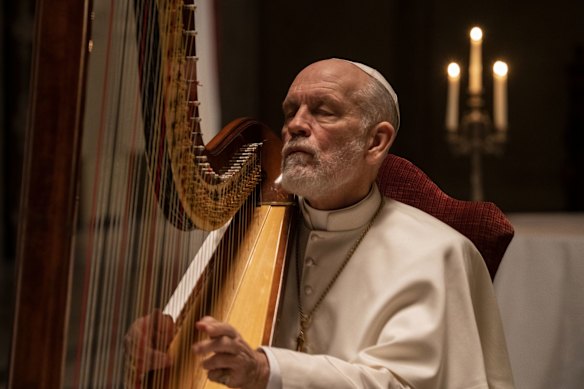
In contrast, the entirely fictional pontiff depicted by John Malkovich in The New Pope (the 2020 follow-up to The Young Pope) is decidedly unwilling to make the office his own. The conclave elected him because of his centrist views and he is unwilling to disappoint them. When the actor Sharon Stone (playing herself) asks him (having presented him with her stilettos as a gift) when “the pointless taboo” of gay marriage for Catholics will end, he answers: “When the church has a brave, revolutionary, resolute Pope. Qualities none of which I possess.”
A brave, resolute Pope is exactly what we find in 1968’s The Shoes of the Fisherman (adapted from Morris West’s 1963 novel) which features a Ukrainian pope who uses his knowledge of life behind the Iron Curtain to negotiate peace between the Soviet Union and the US, becoming a serious geopolitical actor who effectively stops World War III.
As with The Young Pope’s American pontiff, The Shoes of the Fisherman can appear to have manifested a real one not too far down the line. Ten years after the film, Polish-born John Paul II became, like the fictional Pope Kiril, the first non-Italian Pope in more than four centuries. Like Kiril, his experience of living in the Soviet bloc led him to intervene significantly — and successfully — in the diplomatic struggle to end the Cold War.
Walter F. Murphy’s The Vicar of Christ (1979) also features a politically interventionist (and American) Pope. The book’s Pope Francis (30 years before the real life one of that name) is a war hero and US Supreme Court justice before he becomes a man of the cloth. The fictional Francis is a resolutely progressive pope on questions of moral and social teaching. His opposition to war is equally uncompromising, and so effective that he is ultimately assassinated by those for whom war is an indispensable feature of the political order.
That a pope could be powerful enough to threaten a political regime is examined in Graham Greene’s story The Last Word (1988). Greene imagines a dystopian future in which “the last Pope” is an elderly man living alone in a bedsit with a contraband bible and broken crucifix. Organised religion has been eradicated in the name of one-world government and yet, still, as a general carries out the final act of executing the old man who was once its figurehead, he experiences the “strange and frightening” thought that “what this man believed may be true”.
The question of which kind of pope – centrist, progressive, reactionary or non-European – the church most needs is at the heart of 2024’s Conclave. The film is, in part, a study of how the people who know the role best disagree about who should fill it. The characters argue and grapple and pray, connive and conspire, and though for some it is a matter of personal ego and power-hunger, most are driven by a desire to find the right man for the job.
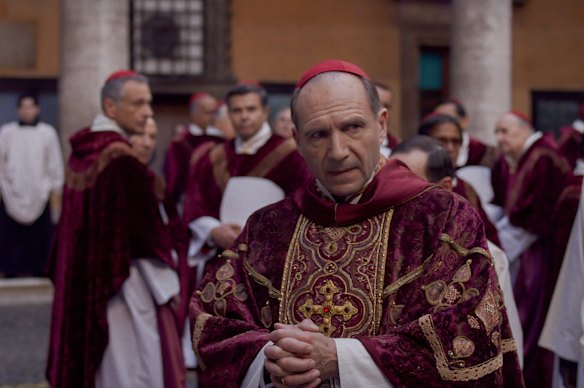
Conclave is indisputably fiction but in real life, as the Catholic Church’s cardinals gathered to choose a new Pope after the death of Pope Francis in May 2025, POLITICO reported that some of those eminent men were watching the film for pointers. It was, according to one cardinal, “a helpful research tool at a time when so many of the conclave participants have little experience of Vatican politics and protocol”.
Audiences outside the Vatican were apparently doing the same: streams of the film shot up 283 per cent in the lead-up to the real-world version and social media was flooded with memes about it.
As helpful as that film may have been for explaining the process of choosing a pope, it doesn’t necessarily help when it comes to understanding how becoming one might actually feel. What is it like to be a man one moment and a monumental, instantly recognisable symbol the next?
Nanni Moretti’s Habemus Papam (We Have a Pope, 2011) suggests it is a living nightmare. In the opening scenes, we are shown the prayers of the cardinals at the conclave: not me, not me, please not me, they each pray. The unlucky contender (Michel Piccoli) tries to rise to the call, but the moment before he is to address the crowd in St Peter’s Square, he screams and refuses. A psychiatrist is brought in to intervene, though given the session is conducted in the presence of the increasingly panicked cardinals, it is no surprise when the reluctant Pope bolts at the first opportunity.
One wonders if a similar impulse passed through Cardinal Ratzinger when he was elected Pope Benedict XVI in 2005. His reluctance was widely known within the Vatican: not only did he not want to be Pope, but he had asked twice in the preceding years to be released from his role as prefect of the Congregation for the Doctrine of the Faith only for Pope John Paul II to refuse. Benedict later said that his election “felt like a guillotine”.
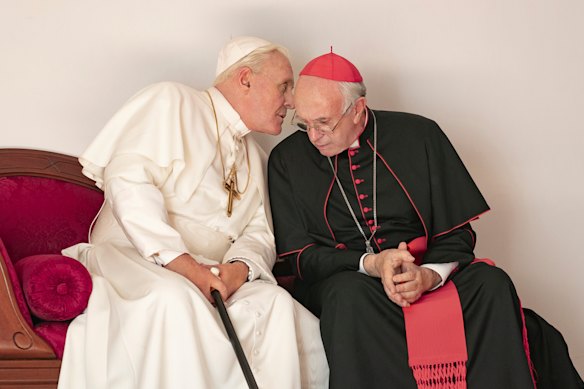
A fictionalised version of Benedict features in 2019’s The Two Popes, but his unwillingness to serve is not explored. Indeed, the film portrays Ratzinger openly campaigning for the position, in contrast to his eventual predecessor who is shown as reluctant to take on the role. It’s a reminder that a real-life Pope who has been fictionalised is still, well, fiction.
In Habemus Papam, when the runaway newly elected Pope is asked by a psychiatrist what he does for a living, he answers simply: “I’m an actor”.
The answer reveals a lot about this particular fictional Pope who doesn’t know how to play this next role he’s been given. This is what papal fiction does: it lets us watch the role collide with the person playing it and try to figure out what the papacy actually is. What endures despite the changing person? Is it only the stunning backdrop, millennium-old ritual and fancy Swiss guards?
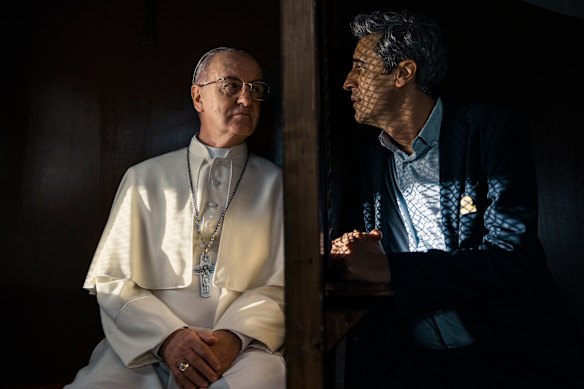
The Pope is supposed to be the ultimate symbol of continuity, the same white figure emerging onto the same balcony. Yet the person inside can change the meaning of the role entirely. A pope from behind the Iron Curtain once belonged to the realm of geopolitical fantasy; then a Polish cardinal walked onto the world stage. An American pope once seemed ridiculous; now a Chicagoan is on the papal balcony.
Perhaps that is why the Pope remains such a useful character. The costume supplies the instant recognition, ritual brings millennia of accumulated authority, but the bloke underneath it all introduces the possibility that something entirely new will happen. Fiction keeps putting someone new into the role to see what happens and, as in real life, believers and unbelievers alike keep watching.
Emily Maguire’s Rapture (Allen & Unwin) is the story of a female Pope in the 9th Century. Holy Cannoli opens in cinemas on October 22.