Source : ABC NEWS
It was the speed and adrenaline that first attracted Reema El Qassem to wheelchair basketball.
After two years in the game, she is regarded as one of the best up and coming players in the Women’s National Wheelchair Basketball League.
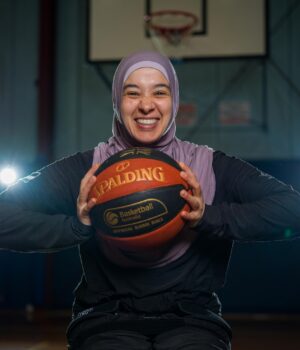
Not only extremely talented, El Qassem is the first non-verbal and hijab-wearing player on the court, challenging the notion of who belongs in the game.
“I feel the most alive and the most able when I’m playing sport,” El Qassem told ABC Sport.
“For those moments, I’m not thinking about my disability; I’m just an athlete.”

Reema El Qassem plays for the Sydney Uni Lions in the National Wheelchair Basketball League. (ABC News: Fletcher Yeung)
El Qassem’s journey has been a difficult one; she acquired her disability, Functional Neurological Disorder (FND), in 2023.
The condition affects how the brain and nervous system function, leading to a variety of neurological symptoms, including walking and speech difficulties, cognitive issues, and chronic fatigue.
After spending 320 days in hospital and taking eight months to adjust to life as a wheelchair user, sport was the pathway to normality for El Qassem.
“When the doctors told me I would be going home in a wheelchair, I remember thinking, that’s OK, I’ll just play wheelchair basketball,” the 35-year-old said.
“Finding sport again after acquiring my disability felt like finding a part of myself that I had lost.”
It’s been a meteoric rise in the sport for El Qassem, who plays for the Sydney Uni Lions, with the team making it to both the 2025 and 2026 national league play-offs.
Paralympian Hannah Dodd is coach of the Sydney Uni Lions and a mentor for Reema El Qassem. (Getty Images: Kelly Defina)
In recent years the women’s game has been actively rebuilding across the country, adding three new teams to the national league in 2025.
Sydney Uni Lions player and coach Hannah Dodd believes this growth is what has supported the development of players like El Qassem.
“She’s naturally got a really good push on her, and she’s got naturally some good speed on her, so we’ve just been teaching her how to control it and how to use it successfully,” Dodd said.
“It’s just teaching her the patience and the finesse of things.”
It’s not just the team that is teaching El Qassem; in bringing her disability and faith to the court, she is showing the league that anyone can play.
Muslim women face additional barriers
Muslim women can face many barriers in sport, such as uniforms that don’t meet modesty needs, discrimination and inflexibility around religious and cultural practices.
Reema El Qassem’s community, including her four daughters, often turn up to support her at national league games. (Supplied: Wheelchair Sports NSW/ACT)
This has made El Qassem’s journey into wheelchair basketball even more remarkable as the first ever player to wear a hijab on the court.
Marta Myhill, from Wheelchair Sports NSW, said El Qassem was helping those around her learn about her culture and faith.
“In her bringing her culture, wearing her hijab, there’s not a problem with that at all,” Myhill said.
“Everybody within the wheelchair basketball community has embraced her.”
From her teammates reminding her it was time to pray, as well as notifying officials and players that they can’t shake her hand, the support has almost bought El Qassem to tears.
“Growing up, I spent a lot of time trying to shrink myself and be subtle because I was always scared to draw attention,” she said.
“To be so outwardly me as a Muslim woman and feel safe and welcome to practise my faith is something I don’t take for granted.”
Another key part of El Qassem’s life is being a single mother to four daughters, some of whom also have additional needs.
Balancing her sport, faith and family can be a challenge.
The single mother of four daughters wants to show what is possible for other Muslim and non-verbal women in sport. (ABC News: Fletcher Yeung)
“There is always that guilt when I leave them, when I fly interstate, or when I come home from sport and I’m too tired for them,” El Qassem said.
“There were so many times when I considered leaving the sport completely because I felt like I was being a bad mum for choosing myself.”
As a mother, it has been important for El Qassem to show her children what people with disabilities are capable of.
Loading Instagram content
They have become her biggest supporters, with El Qassem taking them to cheer her on at national league games.
“It [wheelchair basketball] gives them an environment where they can admire other people, appreciate what they have, and understand that life isn’t over because someone has a disability or because something difficult has happened to them,” El Qassem said.
“Now they see the person, they see the athleticism, the speed, the talent, the strength, and the determination, and for me, that is such a beautiful thing for them to experience.”
Non-verbal El Qassem team’s ‘loudest player’
Naturally very expressive, El Qassem relies on body language and facial expressions, alongside her phone app, to communicate with her team on and off the court.
So much so, last season she won the Uni Lions team award for the loudest player.
But the technology on her phone can be fiddly to use and doesn’t quite cut through the ambient sounds during a game.
Generally, Reema El Qassem uses a phone app to communicate, but this doesn’t work when on the court during a game. (ABC News: Fletcher Yeung)
“I can’t call out that a pick is coming, call for help, or yell out to my teammates that I’m open,” she said.
“Those are all things I would normally be communicating on court.
“I’m starting to see and understand the game as a whole, rather than just my own role and that has made me much more aware of the impact of being non-verbal.”
Embracing the challenge with gusto, the Sydney Uni Lions have trialled different tools to help El Qassem communicate with her teammates, including talking buttons.
Unfortunately, these were not loud enough for game days when fans were cheering from the sidelines.
They are also contemplating trialling an air horn of some kind, which she could bump with the side of her leg, but the search for an effective solution is ongoing.
“Having a player like Reema has obviously been a new experience for all of us and a new way to figure out how to play a very verbal sport, non-verbally,” Dodd said.
“A lot of the time we’ll pair [Reema] up our most experienced pointers, to help her navigate, so she has someone that will talk to her constantly.”
The Sydney Uni Lions wheelchair basketball team has been working with Reema El Qassem to figure out a way for her to communicate on court. (ABC News: Scott Preston)
Despite occasionally feeling frustrated having to rely on her team this way, El Qassem appreciates the community and friendship she has found with the Lions.
Being in a safe and supported environment has enabled her to focus on developing her potential and set her sights on representing Australia one day.
Getting classified to play at an international level, however, has proven her biggest barrier in the sport yet.
The role of classification is to make Para sport as equal and fair as possible for all athletes, but in recent years there have been some changes that have affected newer athletes like El Qassem.
Unfortunately, her impairment, FND, doesn’t fit within eligibility requirements for the sport.
Reema El Qassem dreams one day of playing for Australia in wheelchair basketball, but faces an uphill battle to be classified. (ABC News: Fletcher Yeung)
“The problem isn’t that the disability isn’t real, it’s that the current classification system isn’t designed around [it],” El Qassem said.
Unable to be classified for international competition means that El Qassem is limited to playing within the national and local league seasons.
“There is not a lot of competition available for us in Australia; even our national league only runs for three months of the year,” Dodd said.
“[It’s] trying to get game time for the developing players, in a space where they’re comfortable and where they are going to succeed and not get frightened or stressed.”
Representation and belonging key: El Qassem
While El Qassem may be locked out of international competition, it’s her cheerleaders at home that make the game worth it, including retired Paralympic wheelchair basketballer Gerry Hewson.
Reema El Qassem is working with retired Paralympian Gerry Hewson to improve her skills. (ABC News: Fletcher Yeung)
El Qassem has brought Hewson on for one-on-one training with the focus on building her skills, with Hewson taking her through her drills each week.
Hewson says her determination is unbelievable.
“She’s on a big learning curve at the moment,” he said.
“For me as a coach it’s just kind of building her self-belief that she can play at a national league level and that’s what I’m trying to help her out to do.”
And while the dream of representing Australia one day is still there, for El Qassem it is the community she has created and the pathways she is carving out for athletes like her that keep her in the sport.
Reema El Qassem wants to see more Muslim and non-verbal women participating in sport. (ABC News: Fletcher Yeung)
“For Muslim women living with disabilities, I think representation and belonging are particularly important, and we deserve to see ourselves in sport too,” she said.
“I also love how sports bring people together. It doesn’t matter what your race, ethnicity, background or mobility is, everyone has a place, and everyone belongs.”