Source :- THE AGE NEWS
What happened to the Wallabies? Well, a lot has happened to the Wallabies over the past four years.
The Eddie Jones appointment and the World Cup disaster, the Joe Schmidt repair job and the somewhat awkward handover to Les Kiss – three coaches in four years in a turbulent period whose origins can be easily traced back to the decision to sack Dave Rennie.
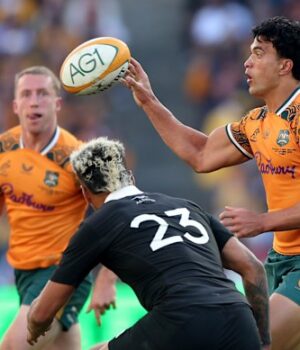
Based on evidence of the past two weeks, it would be difficult to argue the Wallabies are better now than they were in 2022, especially relative to the All Blacks (whom they beat in 2022).
The other side of this coin is that Rennie has clearly improved the All Blacks, as most of the Wallabies he coached knew he would.
In the old debate about whether the Wallabies were poor or the All Blacks were good, the former was true at Eden Park, and the latter argument held more sway in Sydney.
Suaalii and the reverse Nawaqanitawase effect
Mark Nawaqanitawase is proving as elusive off the field as he is on it, toying with the idea of switching to Fiji or Italy at the World Cup.
It’s all good content, but the reality is Nawaqanitawase isn’t going to return to Test rugby and dominate as he did in the NRL, no matter who he plays for.
In fact, the trajectories of Nawaqanitawase and Joseph Aukuso-Suaalii over the past few years definitively show it is now easier going from rugby to league than the other way around – there is far more space in the 13-man code and smaller athletes to contend with.
The NRL is a great product because of that, but it is poor preparation for the realities of Test rugby.
As SMH colleague Christy Doran noted in his Wallabies player ratings: “Suaalii was found out a fair bit in defence, missing five tackles.” The expectations on Nawaqanitawase, therefore, need to be put into context.
Good news for Wallabies as Declan Meredith steps up
A few poor restarts aside, Wallabies No.10 Declan Meredith took a big step forward against the All Blacks in Sydney: he was almost unrecognisable from the nervous player who made his debut against France in July.
This was the Meredith that Kiss had obviously been seeing in training, as the Wallabies coach was emphatic in his defence of Meredith in his pre-Test comments.
On that argument – backing newer players over veterans such as James O’Connor and Bernard Foley – Kiss made a reasonable argument and reading between the lines the older heads are far from out of the picture.
Interestingly, Kiss also name-checked Kurtley Beale, who was an influential figure for the Western Force in Super Rugby AUS.
It would not be a surprise to see one of Beale, Foley or O’Connor in the World Cup squad. Kiss didn’t appear to be closing the door on any of them.
RWC implications? Less than zero
The irony of the Wallabies’ loss on Saturday is that it could well turn out to be their best result if it is repeated at the World Cup next year.
As has been well documented, the World Cup has again attracted some controversy by putting the world’s best teams on a collision course before the actual final.
On current form, two out of South Africa, France and the All Blacks will be knocked out in a heavyweight quarter-final or semi-final – and they are the top three teams in the world.
It really does open up the other side of the draw, and if the Wallabies can repeat their loss to the All Blacks they could get a very winnable quarter-final against England in Sydney.
It doesn’t take a genius to work out which side of the draw the Wallabies would like to be on: they have waited 24 years for revenge against Jonny Wilkinson.
O’Neill weighs in on RA-RUPA dispute
The Herald’s article on the RA-RUPA pay dispute on Friday prompted a message from former ARU boss John O’Neill.
With O’Neill’s permission, his insights are repeated here, and they speak for themselves: “In the period leading into our hosting of RWC 03 there was a similar problem/disagreement with the Players Association and senior Wallabies.
“They mistakenly and conveniently attempted to connect the financial benefits that may have accrued to the ARU for hosting the tournament and the involvement of the Wallabies in the tournament. The fact is that those matters were entirely separate and it was totally opportunistic to attempt to connect them.
“The Wallabies were one of 20 participating teams, and their rewards would be based on match fees and a generous bonus arrangement which was based on making the semis firstly, then significant amounts if they won it. Exactly what we did in 1999 where we actually doubled their bonuses on the spot when they won it!
“Unfortunately, the hosting rewards of 2003 were not ring-fenced. That can’t be allowed to occur 24 years later.”
 Paul Cully is a rugby columnist for The Sydney Morning Herald.Connect via X or email.