

source : the age
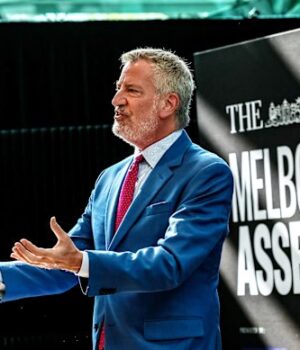
Former New York City mayor Bill de Blasio has implored Melburnians to embrace high-rise, high-density living as the city’s population races towards 9 million.
But as de Blasio decried urban sprawl – constructing homes further away from city centres on urban fringes – as a “massive failure” of the Western world, former Victorian premier Steve Bracks told The Age’s Melbourne Assembly on Tuesday that it could be too late.
“I think the genie is already out of the bottle. We are already a sprawling city,” Bracks said.
“What we need is a hard full stop on the city. We should be protecting the green wedges … [and] encouraging our planning scheme development at activity centres around our transport hubs.”
Held at Federation Square, the second day of the inaugural forum brought together industry leaders, decision-makers and the community. As well as the pillar of shaping the city, it focused on education and innovation, with experts discussing how to attract and keep the brightest minds and commercialise research breakthroughs.
Melbourne’s planning policies were at the centre of the debate, ahead of next month’s state election in which Labor’s “activity centres” are on the ballot, with the Coalition vowing to abolish the zones where developers are allowed to bypass local planning rules to build high-rises up to 20 storeys.
The government implemented the plan in response to surging house prices and population growth, with activity centres spread across the city near transport hubs in a bid to shift population growth away from the urban fringes into established suburbs.
Bracks pointed out that Melbourne was five times the size of New York, and suggested that instead of imitating de Blasio’s hometown, increased density should be targeted in the activity centres.
The former New York City mayor, however, urged authorities to “reverse” sprawl and build “as tall as you can go” closer to the CBD, backed by careful planning to include amenities and services.
“The reality of people’s quality of life, living far from the centre is going to get harder and harder,” he said. “People want culture and connection more than ever. You must embrace height and density. You must turn away from sprawl.”
It may be politically easier to sprawl, but it is more costly to society, Grattan Institute chief executive Aruna Sathanapally told the forum’s panel on shaping the city. Where developers invest in the construction of homes on urban fringes, the cost of supplying residents with access to jobs, and infrastructure for water, electricity and roads is straddled to state governments, she said.
“I don’t accept that it’s cheaper if you actually take those costs into account to sprawl. It can be much more efficient to use infrastructure densely in your existing cities,” said Sathanapally, who pointed out that the handbrake on density was the rising cost of construction and poor construction productivity.
Architect Sarah Lynn Rees also advocated for greater density – but in a way that connects people to their homes and neighbourhoods, and factors in the needs of families.
“We’re putting people in white boxes and expecting them to live a life of thriving within their community, but they’re so disconnected from it, and they don’t have the space that they need,” Rees said.
Prime Minister Anthony Albanese used his address to reveal Victoria would receive $350 million in federal funding to connect “last mile infrastructure”, particularly basic utilities, to new housing in the state’s growing suburbs and regions.
In the face of criticisms of urban sprawl, Albanese nodded to the outer suburbs including Frankston, Point Cook, Dandenong, Melton, Sunbury and Cranbourne as the “powerhouse” of Melbourne.
Melbourne Lord Mayor Nick Reece said density was a key plank of the City of Melbourne’s 25-year city plan, including its target of building 120,000 new homes in the next 25 years. He pointed to Fishermans Bend, Macaulay, Arden and West Melbourne as having “huge tracts of land”.
“Melbourne is blessed in that it has plenty of underutilised land that can be developed very close to the city,” he said.
“These areas can accommodate our population growth in sustainable, high-density suburbs with plenty of green space.”
But he said it was crucial major infrastructure was delivered by the state government based on long-term strategic planning and independent advice, not the “short-term political considerations and electoral maps” that influenced projects such as the Suburban Rail Loop and the West Gate Tunnel.
“I would urge the next government, whoever it is at the end of November, to reverse the decision to abolish Infrastructure Victoria and preserve its independence,” he said.
“Any proposed major project should be subject to independent analysis … the government of the day can then select from this menu. If it’s not on the menu, then you can’t go committing billions of dollars, leaving it to future generations to pay off.”
The education and innovation debate was kicked off by Professor Marek Tesar, the faculty of education dean at the University of Melbourne, the presenting partner for Melbourne Assembly.
The internationally recognised scholar in early childhood education asked the audience to consider who the future Melbourne was being designed for, pointing out that a four-year-old living here today would by 2080 have experienced more than half a century of the decisions being discussed.
“We need to ask the four-year-olds,” he said, urging leaders to consider the views of children who refused to “accept that the world must remain effectively as it is”.
“I’d love to see Melbourne develop a network of youth innovation hubs connected to schools, libraries, universities and neighbourhoods across the city,” Tesar added. “Places where all young people could work with mentors on real problems: biodiversity, disability access, loneliness, robotics, transport, housing, climate change … not just classroom exercises.”
Doherty Institute director Professor Sharon Lewin took up the theme with her insights into how Melbourne can become the destination of choice for the world’s best researchers and innovators.
Lewin, who runs the world-renowned biomedical research hub in the Parkville precinct, spoke about what could be learnt from Australia’s past and the way her parents were welcomed from war-torn Europe as survivors of the Holocaust.
“The great cities of the future will compete for many things: for investment, for technology, for companies. But above all, they will compete for people,” she said. “Talent will go somewhere. We need to welcome that talent … Just as Australia did all those years ago for my parents.”
Lewin also argued for a more comprehensive effort to achieve bigger economic gains from Melbourne’s research capability. “We are really good at discovery. We’re not always that good at what happens next,” she said.
Melbourne Assembly will be held from October 19 to October 21. More information is available on the Melbourne Assembly website.


