

Source :- THE AGE NEWS
Riddle me this: If you’re an athlete of such excellence that you’ve been picked to represent this glorious country, and then for whatever reason are observed to have refrained from singing Advance Australia Fair , were you ever really fit to display the Coat of Arms in the first place?
At the Rugby League World Cup, the Fiji Bati’s pre-match performance before their opening game – an a cappella hymn, then their anthem – combined soaring vocal harmonies with a raw display of faith and national pride. Spine-tingling stuff.
Fijian players are getting paid ashtray change to represent their country in the tournament. They are there for reasons of national pride.
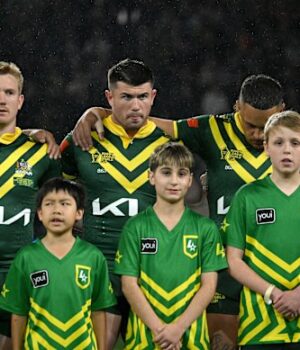
By contrast, the Australian squad is trousering $40,000 per man. But when the national anthem rang out before the Kangaroos’ opening match and the TV camera panned along the line of players, Latrell Mitchell, Bradman Best and Keaon Koloamatangi appeared not to be singing. How. Dare. They. The next night, footage circulated of several Jillaroos players apparently doing the same before their match against Samoa.
Which prompted tired rhetoric about disrespect, disgrace, and the players fingered as unfit to shoulder the green and gold.
The anthem matters a great deal to a great many Australians, and nobody should sneer at those who are moved to tears by it. Reece Walsh appears to be a case in point. But respecting the anthem has never required everyone to actually sing it. The demand that players sing, and be seen to be singing, gets the law wrong. It gets the players wrong, too.
There’s no Australian statute, regulation or rule requiring anyone to sing the anthem. The Governor-General’s 1984 proclamation declares what the national anthem is, and nothing much else. You don’t have to sing it. This isn’t North Korea, after all.
If singing is to be demanded as a condition of representing Australia, who audits the players’ efforts? What if the words are mouthed rather than sung? Jehovah’s Witnesses abstain, as an article of faith, from singing anthems and participating in nationalistic ceremonies; what to do about any player of that faith? Drop them? That’s religious discrimination.
The Fair Work Act prohibits adverse action against an employee because of race, religion or political opinion, among other attributes.
And the exemption for a role’s inherent requirements wouldn’t assist, because singing isn’t an inherent requirement of playing rugby league. Any selection rule mandating anthem singing would fall hardest on Indigenous players, and would also have to survive the Racial Discrimination Act challenges that would inevitably follow.
Which feeds the subtext of this confected outrage. Because Latrell Mitchell is in the frame, the inference drawn – loudly by some; more slyly by others – is that this is Indigenous protest dressed up as stage fright.
For some players, perhaps it is. In 2019 Mitchell, together with others, declined to sing the anthem before the first State of Origin match in Brisbane. In 2023, on the night the Voice referendum result came through, Selwyn Cobbo and several others copped the same treatment before a Kangaroos Test in Townsville.
Seems to me that’s a political opinion, sincerely held and quietly expressed. Holding it isn’t disloyalty per se. Last time I checked, we hadn’t legislated against it.
But last week’s camera caught a cross-section of the squad, not a bloc. Walsh, whose father is Indigenous and whose mother is of Māori descent, was the one in tears. Silence has many explanations, not that any is required – conviction, nerves, concentration or a second line changed in 2021 that plenty of Australians still mess up. The weaponising lies in reducing all of these to a single motive, and then branding it seditious.
Elsewhere, this argument was settled decades ago. In 1943, the United States Supreme Court – the one Donald Trump has done his level best to stack with conservative judges, who still routinely rule against him – struck down a rule compelling schoolchildren (Jehovah’s Witnesses, as it happened) to salute the flag. One justice wrote that no official, high or petty, can prescribe what shall be orthodox in politics or nationalism. In the middle of a world war, no less.
Even the NFL, at the height of the Colin Kaepernick protests and with President Trump urging owners to sack any player who knelt, went no further in May 2018 than requiring players on the field to stand. STAND, not sing. The policy was suspended within two months, after the players’ union filed a grievance; by 2020 commissioner Roger Goodell was conceding the league had been wrong not to listen to its players.
In France, in 2013 the National Front demanded Karim Benzema be dropped after he admitted he didn’t sing La Marseillaise. Benzema replied that playing for France was a dream, and pointed out that Zinedine Zidane hadn’t always sung it, either. Zidane scored twice in the 1998 World Cup final. Nobody in Paris seemed perturbed.
The critics, in other words, aren’t demanding singing; they’re demanding visible lip movement. A squad of Milli Vanillis miming to a backing track would satisfy them entirely. Which illustrates how much of this is about respect, and how much is about optics.
Now the obvious reply is that the Kiwis, Tongans and Samoans sing their anthems with hands on hearts and magnificent gusto, so why can’t ours?
Well, look at why they do. New Zealand sings the first verse of God Defend New Zealand in te reo Māori, then in English; it changed how its anthem is performed so that more of the country could claim it. The Tongans and Samoans sing anthems that are unambiguously their own. Enthusiasm follows a sense of belonging. It can’t be manufactured in advance.
Our own recent history makes the same point. In October 2020, the NRL dropped the anthem from State of Origin, on the entirely sensible basis that Origin is an interstate contest and not an international one. Within hours, after a phone call from Prime Minister Scott Morrison, it was reinstated.
Two months later, Morrison changed the anthem’s second line from “young and free” to “one and free”, recognising some 65,000 years of First Nations history. EVEN PAULINE HANSON WAS ON BOARD. The government, in other words, accepted the substance of the objection Indigenous players had been making for years. But their critics still haven’t.
What should be done? Nothing, really. The NRL has said before that each player decides whether to sing. That’s plainly correct, and no level of trolling from the rats in the TikTok sewer should cause deviation from that position.
The Kangaroos and Jillaroos coaches have World Cups to win; they shouldn’t be moonlighting as choirmasters. If the country wants every player singing, the honest course is an anthem every player can see themselves in. That’s a question for parliament and the public.
News, results and expert analysis from the weekend of sport sent every Friday. Sign up for our Sport newsletter.
 Darren Kane is a sports columnist for The Sydney Morning Herald.Connect via X or email.


