Source : the age
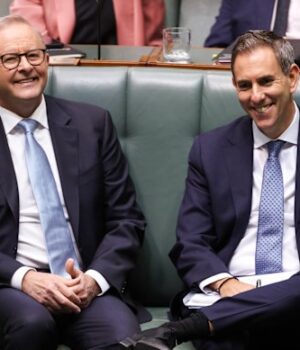
Treasurer Jim Chalmers’ push for tighter fiscal discipline was obstructed by the prime minister’s razor gang ahead of the last budget, intensifying scrutiny on Anthony Albanese’s economic credentials as Labor scrambles to find savings to offset new spending.
High-level government sources said that in the run-up to the May budget and years past, Chalmers had often advocated for the lowest-cost option when proposals came to the cabinet’s expenditure review subcommittee. Budget proposals usually come with a range of options on the cost, giving ministers the option to spend more or less.
Chalmers told this masthead’s Inside Politics podcast this week that he had become a “lightning rod” for criticism at a time when inflation is running hotter in Australia than the UK and the US and the G7 average.
But the role of Albanese and his close allies on the secretive budget spending committee has not attracted the same level of scrutiny.
The prime minister’s allies Finance Minister Katy Gallagher, Foreign Minister Penny Wong and Health Minister Mark Butler dominate the nine-person group. Chalmers is not factionally aligned with Albanese.
While it is not the first time a treasurer has been unable to convince colleagues to tighten belts, several party sources said that they’d heard Chalmers comment on the fact that he had pushed for lower spending than the razor gang approved.
“[Chalmers] has told people he wanted to do more both on the revenue side and spending side,” one source familiar with the matter said. “It shows that this really is Albo’s cabinet, at the end of the day. But it also begs the question of how much authority the treasurer commands in the cabinet.”
Even if the treasurer had found extra savings, it would have probably trimmed spending at the margins rather than overhauled Labor’s broader economic strategy.
Renewed scrutiny has been placed on the relationship between Albanese and the treasurer this week. Inflation was revealed to be well above target on Wednesday – fuelled by domestic pressures, soaring oil prices and the war in Iran – and the RBA is expected to raise rates for a fifth time this year on Melbourne Cup day.
Party colleagues took note when Chalmers told Inside Politics that he was attuned to criticism that he was isolated from colleagues and said he took responsibility for his part in Labor’s polling decline, which he pointed out had begun before the budget was unveiled in May. Albanese’s approval ratings started to drop following the Bondi massacre in December.
“It’s up to other ministers and the prime minister how they describe their part in that,” Chalmers said.
Chalmers was previously reported to be pushing for a tax on gas exports, a popular idea that would have created a fight with multinationals but was ultimately not taken up by the cabinet. Chalmers wanted the revenue to fund a broader incentive package to stimulate business investment.
Albanese was also critical in conversations with colleagues about Chalmers’ proposal for a road user charge, which Albanese thought would have been too controversial. Plans to introduce this charge, widely viewed as a necessary move as more people buy EVs, have not advanced in months.
A push for each department to find cuts worth 5 per cent – to spend on other priorities – did not materialise in a major budget saving, as the size of the public service continues to balloon. Federal spending increased by 4.3 per cent last financial year, more than double the projection of GDP growth from the last budget.
Albanese and Chalmers have said they are aiming to find savings in the December budget update to take heat out of the economy and put downward pressure on interest rates. However, they have not committed to finding enough savings to offset new spending.
Sources in the government said it would be difficult to create net savings given a series of backflips and blocked measures, such as a $3 billion private health insurance change blocked by the Coalition, had blown a hole in the budget. The Australian Financial Review reported Labor would need to make up $11 billion to offset the gap, which is increasing through higher interest payments and bond yields.
Labor ministers argue they receive little credit for finding $64 billion in savings and reprioritisations in the last budget, and $180 billion over the life of the government. But economists including Chris Richardson have noted that an unexpected $400 billion-plus revenue boost since coming to government in 2022 meant Labor had been wasteful.
“We know that economic reform in this country can be difficult,” Chalmers told parliament on Thursday after passing a bill on tax reform tweaks. “If it wasn’t, those opposite would have done some in their nine years of office, but they didn’t do any economic reform or any tax reform.”
Chalmers accused the Coalition of dealing in “post-truths” in their assessment of inflation, but shadow treasurer Tim Wilson demanded Chalmers “finally take responsibility”.
Wilson also sledged Albanese for his upcoming travel to international summits, saying the prime minister was “jetting off to the Caribbean” as the RBA was expected to hike rates.
Albanese also laughed off criticism from former treasurer Peter Costello, who used an Institute of Public Affairs to condemn Labor’s economic settings.
“Peter Costello is a partisan participant,” Albanese said. “I’ll make this prediction, when the election’s on in 2028, there’ll be a splash in a broadsheet which is, ‘Howard condemns Albanese government’. Wait for it.”
Cut through the noise of federal politics with news, views and expert analysis. Subscribers can sign up to our weekly Inside Politics newsletter.
 Paul Sakkal is Chief Political Correspondent. He previously covered Victorian politics and won a Walkley award and the 2025 Press Gallery Journalist of the Year. Contact him securely on Signal @paulsakkal.14.Connect via X or email.