Source : THE AGE NEWS
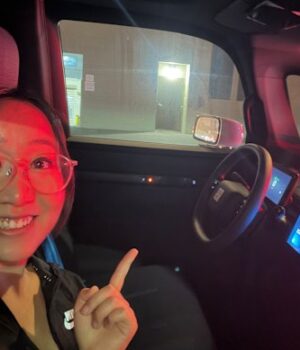
When I visited San Francisco a few weeks ago, it took me a while to notice the driverless cars. It was only when I was crossing the street one day, and looked up to see a car with an empty driver’s seat slowing down for me, that I began seeing them everywhere.
As someone who hasn’t learnt to drive, rideshare services such as Uber and Didi have been crucial in getting me to places where public transport is patchy or nonexistent. While taxis can be optimal in some circumstances, Ubers are often cheaper (at least during non-peak times) and more abundant – and the upfront pricing allows me to make a considered choice about whether to take the long way home when I’m trying to save money.
The latest development in on-demand transport shakes things up a bit.
Driverless rideshare platforms such as Waymo, owned by Google’s parent company, Alphabet, have been rolled out across more than a dozen cities in the US, including Miami, Dallas and Los Angeles. The company’s website shows Tokyo as a future destination.
Economically, these driverless vehicles pose some trade-offs. They also provide some insight into how AI could affect the economy – as it has already begun to do.
One major concern, for example, is how Waymo might affect jobs.
While Uber shook up the taxi industry when it was introduced more than a decade ago, sparking anger and worry from some taxi drivers and businesses, it wasn’t a technology that looked like it would wipe out drivers entirely.
With Waymo, there’s a physical absence you feel as soon as you step into a car and see the empty driver’s seat. An array of sensors outside the car feed data into a machine learning model that decides what will happen and what path the vehicle will take.
The Transport Workers’ Union has pushed to pause the rollout of these robotaxis in Australia until stronger rules have been put in place, and proposed a “human driver guarantee”.
Under the union’s proposal, operators such as Waymo would have to ensure human drivers received 95 per cent of jobs during the early rollout and closer to 85 per cent over time.
Exactly what this would look like is unclear. It could mean Waymo will have to partner up with Uber, for example, and ensure most rides are assigned to human drivers. Or, it could mean Waymo would need to hire on-the-ground staff: those responsible for problem-solving, remotely viewing the car’s sensors and guiding a new path when cars get stuck.
The rollout of robotaxis without such rules would undoubtedly lead to some job losses in Australia.
John Curtin Research Institute, for example, has estimated widespread deployment of robotaxis without protections could cost up to 85,600 jobs and $220 million in wages. And early data from areas such as Austin and Phoenix where these cars have been deployed show that wages have taken a hit, with per-trip earnings falling 5.3 per cent and 2.4 per cent respectively, compared with a 3.4 per cent increase nationwide in the US.
Some new jobs could be created (such as those called on when a car runs into trouble), but these would almost certainly be far fewer than the “driver” jobs lost.
The union is also keen on the human driver guarantee because it allows it to go to the Fair Work Commission to ask for things such as a legally enforced minimum rate for workers (as it did for food delivery workers earlier this year). This helps to ensure the profits of multinational platforms such as Waymo or Uber do not just end up offshore, and instead flow through to the Australian economy and workers.
This might, however, make the service uneconomical for Waymo. Without scale (being able to serve many customers), the cost of setting up a fleet of robotaxis in Australia, and maintaining them, may not make financial sense.
Technologies such as Waymo also shift the share of money going to workers. Rather than drivers receiving wages, for example, the profit from these tech-based services largely flow to owners of capital such as investors. This shift often worsens inequality because owners of capital are more likely to be wealthier or high-income people.
But it’s worth remembering that there are also upsides for customers.
New technologies offer greater choice and often some quality improvements.
Some people may value not having to interact with a human driver (while others love it), or may appreciate the ability to adjust the temperature and music in the vehicle without having to bother the driver. More importantly, it can feel safer for some passengers knowing there is no risk of being harassed by a human driver.
The ride itself feels smooth, perhaps partly owing to the premium Jaguar cars that make up some of Waymo’s fleet, and the fact all of their cars are electric. The cars are also programmed to accelerate and brake very gradually and can’t be distracted the way most human drivers might, at least occasionally.
While I was in the US, I used Uber and Lyft to see how they compared. Admittedly, the sample size was small, but one of my Uber trips to an airport left me wishing I was back in a Waymo: I could see the driver, with his phone propped up, was watching YouTube videos while driving me. He didn’t seem to notice the remarkably well-timed billboard ad we drove past that spruiked Waymo’s focus on safety.
Perhaps unsurprisingly, safety is one of the main concerns from a customer perspective.
It’s probably why a lot of Waymo’s marketing, from social media ads to billboards, focus on how safe its services are. Waymo is “always alert, follows speed limits, promotes seatbelt use and operates some of the safest vehicles on the road”, the company claims, labelling its technology “the world’s most experienced driver”.
The statistics it provides seem to back this up. Waymo’s vehicles have had 95 per cent fewer crashes resulting in “serious injury or worse” and 93 per cent fewer crashes with pedestrians resulting in injuries than human-operated vehicles travelling over the same distance.
While Waymos have been captured in (sometimes funny, sometimes somewhat distressing) videos getting stuck between other cars, taking a suboptimal path, or struggling to read unusual situations such as a police officer directing traffic, they seem, for the most part, to be safer than human-driven vehicles. That counts for something when it comes to weighing up the economic costs and benefits of these vehicles.
The other big factor for passengers is price. Currently, most Waymo rides tend to cost a bit more than those with more established platforms such as Uber.
I found my trips in the US cost about 10 to 15 per cent more when using Waymo compared with Uber or Lyft (although the gap narrowed when considering tips).
But as with most technologies, the gap will almost certainly narrow over time. And the competition between rideshare platforms could drive down prices further across the board (although, of course, that means driving down wages for human drivers, too).
One risk is that if a company such as Waymo ends up becoming the dominant rideshare provider, driving out human-driven ridesharing, the company could then jack up its prices again. And because setting up a robotaxi business is hugely expensive, there may not be many companies able to compete in the driverless rideshare sector.
For now, it seems Waymo is still in discussion with the federal government — although some state government officials, including NSW premier Chris Minns, have expressed support for their introduction onto Australian roads.
AI companies such as Waymo do pose a threat to jobs and need to merge carefully into our rideshare market with clear rules, safety standards, and worker consultation. But we also shouldn’t be afraid of the benefits they could bring or of giving them a test drive in Australia.
The Market Recap newsletter is a wrap of the day’s trading. Get it each weekday afternoon.
 Millie Muroi is the economics writer at The Sydney Morning Herald and The Age covering workplace and economics. She was formerly an economics correspondent based in Canberra’s Press Gallery and the banking writer based in Sydney.Connect via X or email.