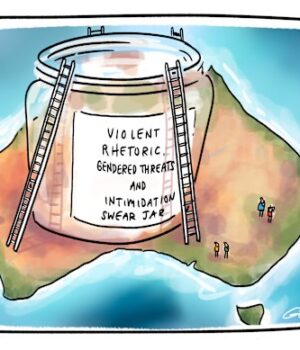
source : the age
To submit a letter to The Age, email letters@theage.com.au. Please include your home address and telephone number. No attachments, please include your letter in the body of the email. See here for our rules and tips on getting your letter published.
Think compromise
Columnist Peter Hartcher identifies significant issues likely to stop any one political party from forming government alone (Comment, 31/10). Many countries have this problem regularly, including Italy and Israel. They have horse-trading of policies and cabinet positions after elections, with compromises reached.
The closest example in recent Australian history involved Julia Gillard’s government. Three pre-teal independents supported Labor on supply and no confidence motions, in return for some policy concessions.
On current opinion polling, the Victorian state election might force Ben Carroll or Jess Wilson into similar or wider deals with the Greens or One Nation, whatever the protestations now.
In 2028, Anthony Albanese could be forced to promise with the Greens and/or independents more radical carbon emissions cuts, in return for parliamentary support. One Nation might extract concessions from Angus Taylor on migration numbers or a further reduction of climate efforts.
Our major parties could avoid the worst of the apocalypse by compromising with close rival parties.
John Hughes, Mentone
Independents option
Peter Hartcher paints a miserable picture of the four main political parties competing for attention and votes. Yet he makes no mention of the fifth contemporary force in Australian politics: the community independents in the House of Representatives and the significant independents in the Senate.
For the past few weeks, we have had people and politicians across the spectrum rightly lauding the character, leadership, and work ethic of community independent Helen Haines following the shocking incident in Wangaratta.
Members of parliament such as Helen Haines have shown just how valuable and valued independents are in our political landscape. At the next election, undoubtedly Labor and the Coalition will lose several seats, but they might not go to One Nation or the Greens; they may instead go to community independents. This would be a good outcome, as would a minority government requiring negotiations with a large crossbench of high integrity, high-quality independents.
Graeme Henchel, Yarra Glen
Plenty of advice
Why does any federal minister need 20 advisers? (″Albanese faces backlash over staffing″, 31/10)?
Christine Hammett, Richmond
The forgotten ones
As much as I like Ross Gittins’ explanations of monetary policy, I don’t agree with him about raising the GST (Comment, 28/10). The low wage and welfare benefit recipients are always forgotten when it comes to the GST. Yes, workers would have lower taxes but what if you don’t pay tax or you’re a low-income earner? The price of goods would rise and make life even more difficult for these people. It’d be OK if you earn a decent wage, it’ll all work out but not for people with less money. Even people earning well now have trouble paying their rent. A raised GST would just make it harder to survive every day. Imagine being on the dole and prices rising even more to cover a GST?
Chris Hooper, Castlemaine
The forgotten lesson
Jewish philosopher Hannah Arendt understood something fundamental about political freedom: its greatest enemy is not disagreement, but the abandonment of independent judgment.
Jillian Segal’s latest proposals seem to have forgotten this lesson. In the name of combating antisemitism, she wants greater oversight of public broadcasters, enforceable conditions on arts funding and tighter restrictions on protest. Meanwhile, she identifies progressive social justice advocates as a particularly pervasive source of antisemitism. The irony is extraordinary. People who insist that human rights must apply universally, including to Palestinians, are now being treated as a threat to social cohesion.
Antisemitism is a serious evil. But so is the political habit of turning moral disagreement into grounds for suspicion and institutional punishment. Universities exist to question accepted truths. Journalists exist to scrutinise power. Artists exist, among other things, to disturb our certainties. None should have to demonstrate political conformity to retain public support.
Arendt knew where the suppression of independent judgment could lead.
We should be especially wary when restrictions on freedom arrive dressed in the language of moral responsibility.
Fernanda Trecenti, Fitzroy
An actor’s legacy
The death of Sir Patrick Stewart at 86 is a loss that reaches far beyond the worlds of television and cinema.
While millions will remember him as Captain Jean-Luc Picard of Star Trek and Professor Charles Xavier of the X-Men, we should not overlook the distinguished Shakespearean actor whose extraordinary voice, presence and command of language brought such depth to both characters.
Yet perhaps his greatest legacy lies in the message of Star Trek: The Next Generation. Gene Roddenberry’s vision of humanity’s future was one worth aspiring to: a united Earth, free from racism and prejudice, with no nations waging wars against one another, and a humanity that had moved beyond greed and division to embrace knowledge, exploration, and co-operation.
Watching today’s world, with its wars, nationalism, racial hatred, and political division, one wonders how far we have travelled in the wrong direction.
Perhaps the greatest tribute we can pay Stewart, and the fictional captain he brought so magnificently to life, is to remember that this vision was never simply science fiction. It was a challenge to humanity.
Make it so.
Darren Grindrod, Glenroy
Lose-lose situation
With US Defence Secretary (aka Secretary of War) Pete Hegseth busily firing all the expert leaders in US defence and downgrading America’s military strength, why are our leaders continuing to align Australia with America and paying billions of our dollars for submarines we will never get and America can’t actually build? We are aligning ourselves with a “superpower” that can’t even win against Iran and is subservient to Russia. It’s a lose-lose disaster for Australia. Pull out now, PM.
Robyn Westwood, Heidelberg Heights
Childhood’s end
I supervised two VCE exams last week, 50 years after I sat my own finals. It seemed like a blink of an eye since that time, until I read through the General Maths paper and realised I couldn’t answer any of the questions.
Observing these kids, I wondered if their demeanour was a hint of their future: one gazing into nothing; a boy wielding his highlighter like a light-sabre, supremely organised; another, jiggling their leg incessantly as they flipped in a frenzy between exam booklet and calculator.
Many of these students will never again utilise the ″Hungarian algorithm″ (a mystery to me, too), or calculate a seasonal index; but hopefully they’ll retain for a few years some vestige of the sharp analysis required for such a testing time. I feel for these kids. I hope the resilience that got them into this room keeps them strong for what’s outside the door. The world is a scary place, even more so, 50 years on.
Jane Neville, Wattle Flat
Off message
Who in One Nation thinks that cartoons depicting politicians being run over and a colouring book for children, depicting Bluey, obviously scared, being held at knife point, is a legitimate way of getting their message across.
Michael Brinkman, Ventnor