

source : the age
Underworld kingpin Kazem “Kaz” Hamad was tortured so badly after his arrest in Iraq that local authorities released doctored images to Australian authorities and the media to cover up the abuse.
The exiled illicit tobacco kingpin was arrested in January 2026 on the orders of Iraqi authorities for alleged drug trafficking, based on intelligence that had been provided by the Australian Federal Police.
The revelation that the nation’s most wanted criminal was subjected to torture as a result of co-operation from Australia has the potential to derail future collaboration with Iraqi and other foreign governments over serious organised crime and national security threats against Australia that are orchestrated overseas.
This includes ongoing threats from Hamad’s Iraq-based syndicate, The Commission, which operates a cartel that controls the Australia’s multibillion-dollar illicit tobacco market and has been linked to hundreds of acts of violence including murders, shootings, kidnappings, torture and arson attacks.
Since Hamad’s arrest 10 months ago, control of the organisation has been taken over in Iraq by 23-year-old Ali Al-Huseini, who police intelligence suggests orchestrated the “bar wars” attacks earlier this year and is linked to widespread and violent criminality.
A source with knowledge of the investigation, who cannot be identified speaking about confidential operations, said the Iraqis had created doctored photos of Hamad in detention in order to conceal from the AFP and Australian public that he had been tortured.
Australian authorities had later been informally told about the abuse and that the photo had been manipulated to conceal it, the source said.
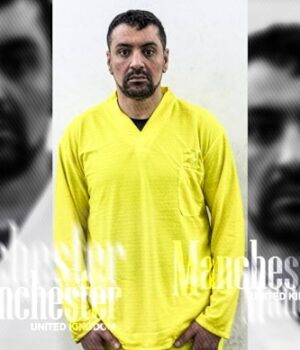
The photo, which was released by the AFP in February 2026, contained a number of bizarre anomalies including a height board that suggests Hamad was nine feet (274 centimetres) tall, and he appears to have six fingers on one hand.
The AFP has never publicly commented on issues raised with the photographs, only stating that the images were provided directly by Iraqi authorities and had not been altered in any way by the AFP.
The AFP declined to comment for this story.
The Iraqi National Centre for International Judicial Co-operation did not respond to a request for comment on the allegations.
Australian authorities took the highly unusual step of sharing information that could have led to Hamad’s execution in his native Iraq for drug trafficking following the emergence of intelligence linking the then 41-year-old to the 2024 Adass Israel synagogue terror attack.
Traditionally, prosecutors and politicians have been reluctant to allow the sharing of intelligence and information about the activities of offshore and expatriate criminals in jurisdictions where the death penalty is practised. The stance followed serious backlash after the execution of Australian citizens in Singapore and Indonesia for drug trafficking.
The Attorney-General’s Department said any questions about the circumstances leading up to Hamad’s detention was a matter for the AFP.
“The Attorney-General’s Department has no role in authorising the disclosure of information by the AFP in relation to operational matters, including in connection with the investigation of Kazem Hamad,” a spokesperson said.
The AFP has never disclosed what information was contained in the brief, but Iraqi authorities arrested and charged Hamad with drug crimes. He was convicted and sentenced to life in prison in late July 2026.
The United Nations and non-governmental organisations including Amnesty International report that torture is common in the Iraqi justice and prison systems.
The existence of a secret operation involving the AFP and Iraqi authorities that led to Hamad’s arrest was discovered only because of a surprise announcement about his arrest made by Iraq’s National Centre for International Judicial Co-operation on January 13.
The AFP, while welcoming the arrest as a significant step in the fight against The Commission, had stated it was made as an “independent decision” by the Iraqis.
In the wake of the success of the operation, the AFP made a formal statement about its involvement a month later.
The AFP media release was accompanied by a photograph purporting to show Hamad in the custody of Iraqi authorities at an unknown location.
But even before the photograph was officially published, various media outlets – including The Age – had begun to question the veracity of the image with the AFP.
In the image, Hamad is dressed in a T-shirt and yellow prison garb and is holding a printed sign with his personal and arrest details in Arabic.
He is positioned in from a height chart – a standard format for mugshots – but the numbers on both sides of his head are out of sequence and scale. Anomalies were also visible with Hamad’s hands and shirt neckline.
Photo experts from The Age and online image assessment tools suggested the photo had likely been digitally manipulated using artificial intelligence or PhotoShop.
“The photo was a disaster. What were they thinking when they released it?” said a law enforcement source, who cannot be publicly identified.
A number of sources who personally knew Hamad questioned whether the photo was legitimate.
“It doesn’t look like the bloke, not at all,” said one underworld source when the photo was first released.
The AFP said at the time it had not altered the image and was not aware of any alteration.
In the wake of Hamad’s arrest, there had been widespread rumours circulating in the underworld that Hamad had been tortured by Iraqi authorities in prison, including claims that three of his fingers had been cut off or both his legs broken.
The growing questions from the media led the AFP to release a second mugshot half an hour after the initial photo was published.
It remains unclear if this photo was allegedly taken at a time before or after the first photo.
The two images also presented strikingly different versions of the man.
However, Hamad is known to have amblyopia – or lazy eye – on his left side, a condition that appears present in varying degrees in both images.
Making direct comparisons with past photographs proved almost impossible because all published photos of Hamad date from 2015 or earlier. Back then, the rising gangland player still maintained a Facebook profile under his own name or frequently appeared in Instagram posts of his then mate, ex-bikie Toby Mitchell.
Hamad, who had been charged with drug trafficking in 2014, had his bail revoked in September 2015, was sentenced to eight years’ jail and never reappeared in public until his deportation to Iraq in July 2023. Since then, he has remained hidden from view.
The strangeness of the photos began fuelling speculation online and in the underworld that Hamad had not been arrested but had escaped, paid his way out or was dead and the photos were a kind of “false flag” operation.
“They got Kaz Hamad the cigarette salesman from down the way, not Kaz Hamad the tobacco kingpin. Imagine,” a source joked at the time.
The initial queries about the authenticity of the photos from the media became a flood the following day.
A freedom of information request called “KazGPT” filed by transparency advocates RightToKnow.org.au shows the AFP sought “urgent advice” internally about the questions about the photo.
Dozens of documents containing internal discussions were redacted or exempted for release, citing in part that “grant(ing) access to the documents would, or could reasonably be, expected to cause damage to the Australian government’s relationship with a foreign government”.
The materials that were released dealt primarily with orders to issue a standardised PR line by the AFP media unit: “The AFP released images to the media which were supplied by Iraqi authorities, who have Hamad in their custody in a secret location. The AFP has no further comment.”
The unit was also instructed to simply say, “the AFP has no comment”, to any subsequent follow-up questions or criticisms.
The use of torture by the Iraqis on a man captured with the assistance of Australian authorities could have a negative impact on future planned operations with international authorities, including ongoing work targeting The Commission.
The dossier handed to the Iraqis that led to his arrest was based primarily on more than two years of work by Victoria Police’s Lunar Taskforce, which was formed in October 2023 to bring down Hamad.
In July, Detective Inspector Graham Banks had called for greater co-operation with Iraqi authorities following Hamad’s arrest and new police intelligence showing The Commission was continuing to operate out of Iraq.
“When you’ve got serious actors doing [what the gang is orchestrating], I think there should be a free flow of information,” Banks said at a press conference announcing the arrest of a suspected Commission lieutenant in Australia.
Cut through the noise of federal politics with news, views and expert analysis. Subscribers can sign up to our weekly Inside Politics newsletter.

