


Source : the age
It is not often that the interests of Pauline Hanson and constitutional law buffs collide. But they are about to, as early as Thursday afternoon.
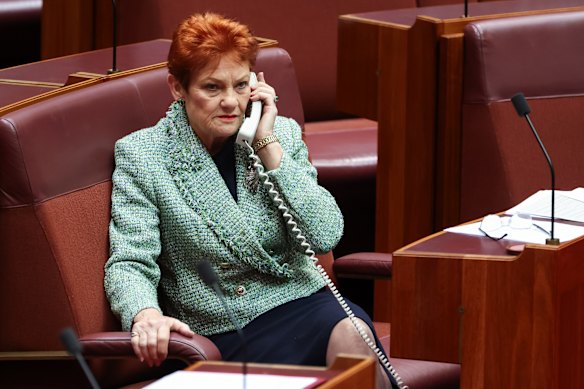
The High Court is expected to publish a decision imminently on whether it will hear Hanson’s last-ditch appeal of Federal Court findings that her “piss off back to Pakistan” tweet to Greens senator Mehreen Faruqi was unlawful hate speech.
The High Court’s decision will be short, with one pivotal word: “granted” or “refused”. Either result will feed into a swirling, complex and increasingly nasty debate about freedom of expression in this country.
A win would allow the One Nation leader to argue that section 18C of the Racial Discrimination Act – which bans speech that “offends, insults, humiliates or intimidates” on the basis of race – is invalid. Hanson says it interferes unacceptably with political communication.
But a knockback by the High Court would work for Hanson, too. It would add moral leverage to her larger political goal, one most Australians would be unaware of: to hold a referendum on adding an American-style free speech clause to the Constitution.
The seven black-robed justices of the High Court are already facing a stack of tricky political communication matters, described by one barrister as “unusually spicy”. Everyone from the far right to the far left is asking where the lines are drawn and who gets to draw them.
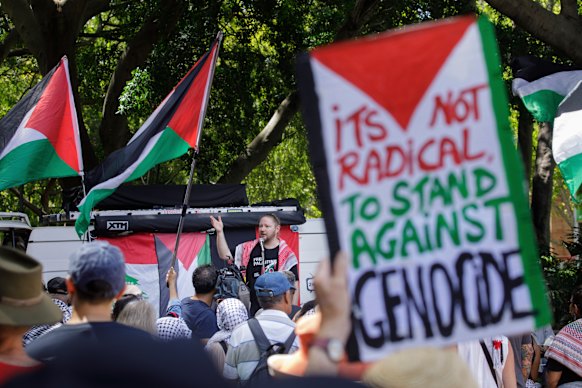
Can parliaments legally ban a neo-Nazi party as a hate group? Kick under-16s off social media? Make it a crime to chant “from the river, to the sea” at a protest against Israel?
“This will be a litmus test for where the High Court stands on freedom of speech,” says Mia Schlicht, executive director of the conservative Samuel Griffith Society.
Judges have spent decades in bitter disagreement about the “implied freedom of political communication”, first found by the High Court in the 1990s.
The court has long held the freedom is real, if unwritten. For citizens to enjoy the democracy promised by the Constitution, they must be able to discuss politics.
But legal conservatives despise what they see as a dangerous invention, one used by activist judges to grab power from parliaments.
The dispute has fuelled a war of words between some of the most powerful judges in the country. It’s a fight over authority, influence and integrity.
The black belt judge
The Betoota Advocate once ran a story headlined: ‘You Can’t Say Anything These Days’, Says Man Who Says Whatever He Wants All The Time.
But polling suggests there is a grain of truth in the comedy. Only 58 per cent of Australians feel they have the freedom to express political opinions, according to new research by McKinnon. The number fell 10 percentage points in a year. Among young men, it plummeted from 72 per cent to just under 50 per cent.
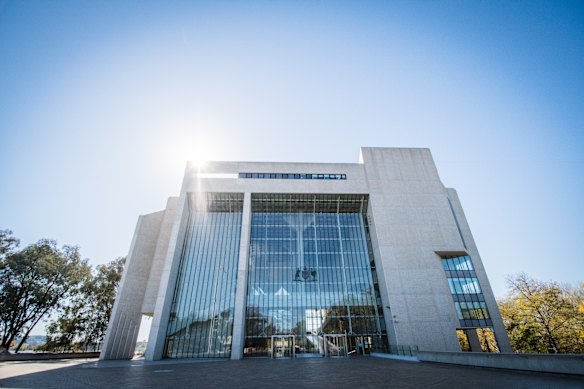
The High Court does not see itself as a free speech saviour. It likes to project a quiet, stable, apolitical image. Its courthouse – a brutalist building on the edge of Canberra’s Lake Burley Griffin – is open to the public, if not particularly welcoming of it.
But the low-profile High Court will struggle to navigate away from political controversy with its current crop of implied freedom of political communication cases.
“It’s an incredibly hot topic,” says one senior Australian legal figure, who expects Hanson will be granted leave to appeal. (This masthead spoke to a wide range of legal professionals, who were granted anonymity to discuss current cases and serving judges.)
“It’s an opportunity for the court which [Chief Justice Stephen] Gageler, who retires in 2028, will grab,” the source predicts.

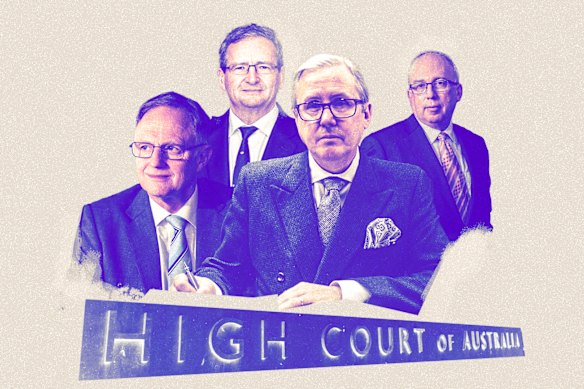
Gageler grew up in the NSW town of Sandy Hollow, the son of a sawmiller. He attended primary school in a one-teacher shack before later studying at Harvard. Other qualifications include a black belt in taekwondo. Once a minority voice on political communication cases, he has become influential over time.
“No High Court justice surpasses Chief Justice Stephen Gageler in supporting a robust implied freedom,” says former public law barrister Louise Clegg.
A rarity in the law, Clegg is a legal conservative who broadly supports the implied freedom. (She is also married to federal Opposition Leader Angus Taylor.)
“We have a mechanism for the court to protect political communication, while being more deferential to parliament than the US Supreme Court might be,” she says, predicting Hanson will win her hearing bid and then her appeal. “I sense this could be a legacy case for the Chief Justice.”
The two tweets
When Queen Elizabeth died in 2022, Mehreen Faruqi shed no tears. Within hours, the Greens senator posted on Twitter: “I cannot mourn the leader of a racist empire built on stolen lives, land and wealth of colonised peoples.”
Hanson replied: “Your attitude appals and disgusts me. When you immigrated to Australia, you took every advantage of this country. You took citizenship, bought multiple homes, and a job in a parliament. It’s clear you’re not happy, so pack your bags and piss off back to Pakistan.”
Faruqi won a civil suit against Hanson under section 18C of the Racial Discrimination Act, which guards against hate speech.
Hanson appealed. She invoked the implied freedom of political communication, a legal concept that allows courts to intervene if a law is clearly over the top. Unpersuaded, the Full Federal Court ruled against her.
But some experts think the decision contained flaws the High Court could pick apart.
“It’s just a really odd judgement,” says Anne Twomey, professor emerita of constitutional law at the University of Sydney. “Their reasoning is rather weird. It does not take into account the most recent judgements of the High Court of Australia on implied freedom.”
While judges are rightly focused on evidence and precedent, the political context of this case is impossible to ignore, Twomey suggests.
“[The court] will be conscious of the fact that whatever it does will be a political football,” she says. “That might discourage them from going on the field. They might say they don’t want to play.”
Judges are both independent arbiters and actors within the political system, says UNSW constitutional law professor Gabrielle Appleby. As such, “all judges are aware of the social and political context in which they are operating”.
‘Shade thrown’
That context now includes a white supremacist group jostling for a place in politics and a tech giant bucking against government restriction, both of whom have launched claims based on the implied freedom doctrine.

The High Court is deciding whether to strike down Commonwealth laws used to ban the neo-Nazi White Australia Party. This week, the court heard arguments by the US platform Reddit that the federal government’s under-16 social media ban robbed children of chances for political communication.
Returning to the bench on Monday after several months’ sick leave was the court’s strongest critic of the implied freedom of political communication.
Justice Simon Steward is in many ways a man out of his time. Sartorially, he looks like an escapee from an Evelyn Waugh novel. He dresses in double-breasted suits, with a pocket square. He has a bust of Winston Churchill in his chambers and likes to smoke the odd cigar.
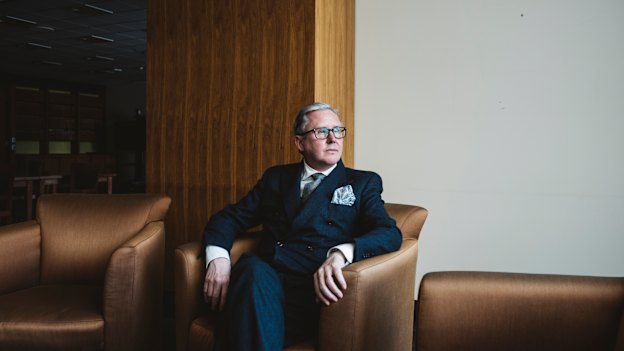
Such was Steward’s judicial bearing from a young age that colleagues have been calling him “Your Honour” since he was a junior lawyer.
Steward’s legal style is conservative. In the tradition of judges such as Ian Callinan and Dyson Heydon, he favours a black-letter law approach, which means he loathes the implied freedom of political communication as the worst of judicial activism.
Steward dutifully accepted it as established law in a case last year. But he took the opportunity to decry the freedom’s “ever-expanding reach”. He called it “uncontrollable”, “very wrong” and “just too broad”.
It was, he wrote, “anathema to a country that is supposed to be ruled by laws”.
Legal circles were scandalised, and not a little thrilled, to see a judge trash-talk a longstanding precedent, one that Steward’s fellow judges support.
On LinkedIn, a barrister posted part of Steward’s solo judgement alongside a passage from Gageler, who wrote that “respect for and fidelity to the past decisions of this Court must start with the individuals who are the current members of this Court”.
This was, according to the barrister, “shade thrown” by the Chief Justice. Another lawyer commented that Steward had been “plunged into darkness”.
Since the implied freedom was established in the 1990s, there has been little sign of any reversal by the High Court. Importantly, the freedom is not an individual right; it is merely a constraint on what governments can do.
But Melbourne University law professor Adrienne Stone says the “strong line of criticism” from Steward and his predecessors continues to unsettle the doctrine.
“There’s always this question just hanging in the air: Should we go back to the beginning and overrule it?” says Stone.

According to the Samuel Griffith Society, a conservative discussion club devoted to the constitution “as it was written”, the prospects of defeating the implied freedom depend on who’s on the court.
“Over the next 10 years, the make-up of the High Court will change drastically,” says Schlicht, the executive director. “Five members of the High Court will turn 70, which is the age at which they need to retire from the bench”.
Allegations of US-style court-stacking
Lately, judicial tensions have broken into open ground, as senior judges attack each other in public speeches. They argue about points of law and personal style. But more fundamentally, they are at odds over what it means to be a judge.
The acrimony began with a speech by High Court judge Robert Beech-Jones in May.
The Tasmanian-born Beech-Jones, who is married to the acclaimed playwright Suzie Miller, accused the Samuel Griffith Society of trying to ape the US Federalist Society, which he described as “a type of secret handshake club” bent on influencing judicial appointments via “ideological training schools”.
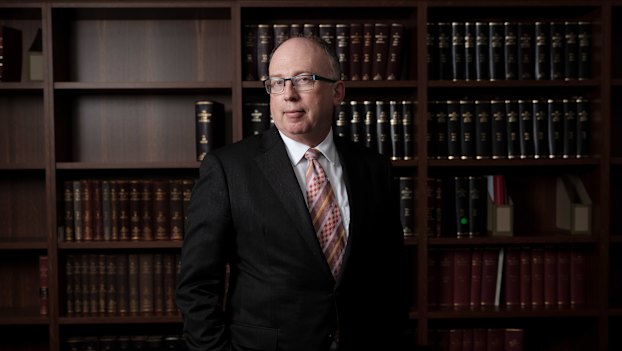
Without naming her, he pointed to a 2020 speech by former Liberal senator Amanda Stoker, who told the Society that “looking to judicial appointments in future, it is imperative that candidates are screened for their judicial methodology”.
Beech-Jones concluded: “If anyone thinks this particular US style of court stacking and judicial decision-making is a good idea, then go and live there.”
The speech went off like a cracker in legal chambers. Steward, Beech-Jones’ High Court colleague, has close ties with the Samuel Griffith Society. He received the endorsement of prominent members before he was appointed to the High Court and has delivered several papers at Society events.
At this year’s conference, the conservative judge introduced the Archbishop of Sydney Anthony Fisher, who made criticisms of the implied freedom and the conduct of pro-Palestine protests.
Schlicht said the claims in Beech-Jones’ speech about the society were baseless, although he did deliver it a recruitment boon. “We received an enormous outreach of support,” she said. “In fact, our membership grew by about 30 per cent in just two months.”
Addressing criticism that the society had become increasingly political, Shlicht said: “If the High Court is making political decisions, it should expect political scrutiny.”
Legal observers say it is easy to overstate the influence of the Samuel Griffith Society. But the speakers delivering conference papers (about 90 per cent of them male in recent years) are individually powerful and mostly conservative.
They include former prime ministers John Howard and Tony Abbott, former attorneys-general George Brandis and Christian Porter and prominent media figures such as Janet Albrechtsen and Gerard Henderson.
The star this year was Justice Ian Jackman.
Vicariously famous through his brother, the Hollywood actor Hugh, the older Jackman had already delivered a breakout performance in June at another lecture series, in which he attacked fellow judges on the Federal Court for being too slow to deliver decisions.
Jackman named names. One of the alleged culprits had died after a long illness. The incendiary speech on “go-slow judges” was exclusively reported on the front page of The Australian, complete with pictures of the six singled-out judges.
It didn’t help that Jackman had already upset some on the Federal Court by inviting his friend, alleged serial sexual harasser and former High Court judge Dyson Heydon, into his chambers to visit. After complaints from juniors, Jackman was asked not to invite Heydon again. Heydon denies all allegations against him.
A Rhodes scholar who grew up playing rugby and later turned to yoga, Jackman gave a punchy lecture to the Samuel Griffith Society conference in August, where he spoke of “deeply fractured times” and the “widespread evil of antisemitism”.
He called for a new debate on the “so-called implied freedom” and its consequences, including a NSW Court of Appeal decision this year to strike down anti-protest laws. Legal conservatives see the freedom as a fiction used by judges to disempower parliaments.
“I don’t think it’s really about free speech at all,” says one barrister, describing the conservative position. “It’s about judicial power and unelected judges.”
But Jackman’s speech was also personal. He said Gageler, the head of the High Court, had demanded “unquestioning submission to precedent” and had taken “great exception” when Steward aired his disquiet about the implied freedom.
“Given that the subject matter concerns freedom of speech,” Jackman quipped, “there are those who have been led to think (rightly or wrongly) that irony never takes a day off.”
‘A handful of bad judicial actors’
The latest salvo came from the final judge in this story, NSW Chief Justice Andrew Bell. The 60-year-old Bell is an affable former Rhodes scholar and musical theatre tragic who found love with a fellow associate when he worked under the Chief Justice of the High Court, Anthony Mason, in the ’90s (his High Court paramour, Joanna Bird, became his wife).
Bell is widely regarded as a future contender for the High Court, so people took notice when he gave a speech in September about threats to the judiciary “from within”.
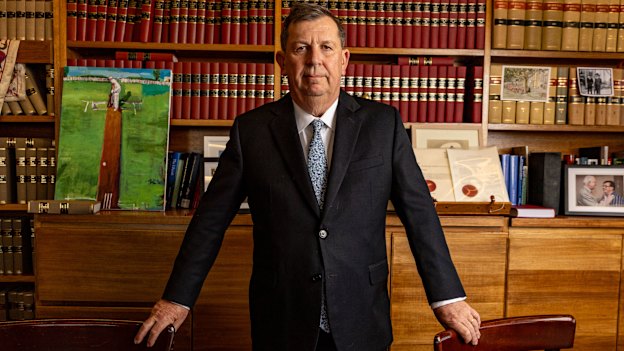
“If judges are not respected, their decisions will also not be respected”, he told a legal conference in Japan. “The institution can suffer considerable damage even from one or a handful of bad judicial actors.”
Without naming him, Bell singled out Jackman as an “unfortunate example” of a judge publicly denouncing colleagues, including one who had died. The speech had “attracted generalised newspaper headlines such as ‘Our judges are letting us down’, and did damage to the reputation of judges as a class”.
One silk, describing the attacks as “wild”, maintains judges “should be able to say whatever they want, so long as it doesn’t interfere with their jobs”.
Brandis, the former attorney-general, cautions against “over-interpreting” the conflict. “Judges have always been having cracks at each other in judgements,” he says. “What is unconventional is for judges to criticise each other in public speeches.”
Professor Appleby says the conflict reveals “a level of tension and you might even say frustration in relation to these issues”. Her UNSW colleague Professor Rosalind Dixon says in Australia, unlike the US, the “ideological contest about how judging is done” is not usually fought by the judges themselves. “It’s a departure from tradition,” Dixon says.
Decorum might prevent judges from sending any “piss off” tweets to their colleagues. But even they can disagree, passionately, over how far is too far.
The cases before the High Court will see it decide how far is too far for the rest of us.
Start the day with a summary of the day’s most important and interesting stories, analysis and insights. Sign up for our Morning Edition newsletter.


